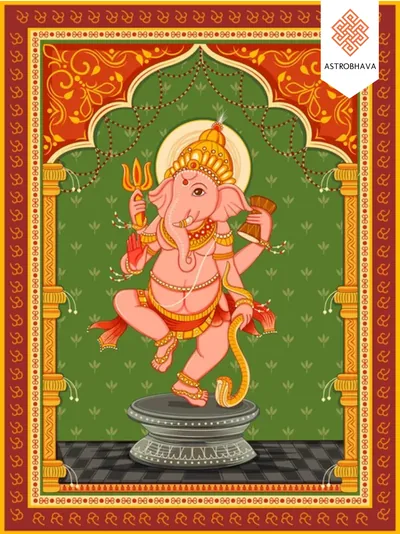
Rinamochana Ganapathi, as worshipped at our temple
Mantra · Specifically for release from debt.
Rinamochana Ganapathi
ॐ रिं रिं रिं रिनमोचनाय नमः
In Devanagari, Tamil, Telugu, Kannada, Malayalam and English — with the meaning of every word, and the one syllable most people pronounce wrongly.
Who Rinamochana Ganapathi is
Rinamochana Ganapathi is the particular form of Ganesha whom the Mudgala Purāṇa and later Gāṇapatya paddhatis single out as the releaser from ṛṇa. The Sanskrit term ṛṇa names not only monetary debt but every unsettled obligation—ancestral, ritual, or karmic—that continues to bind the jīva. In the canonical list of thirty-two meditation forms he is distinguished by the loosened noose and the gesture of untying, attributes that mark him apart from the general obstacle-remover. His name is a transparent compound of riṇa and mocana, the act of setting free, and the form is addressed only under that compound title. Iconographic manuals describe a calm, four-armed figure whose trunk curves gently downward as if drawing a cord free of its knot, never the upward flourish of other Ganapatis.
The Severing of Ṛṇa
The Mudgala Purāṇa places Rinamochana among the thirty-two forms and supplies the episode that fixes his identity. When the gods discovered that their own sacrificial fires would not kindle, the cause was traced to a vast accumulation of unsettled ṛṇa owed to ṛṣis, ancestors, and earlier rites left incomplete. Brahmā counselled them to meditate upon Ganesha under the specific name Rinamochana. The elephant-faced lord appeared holding a noose whose loop had already been opened; with a single motion of the trunk he drew the invisible cords of obligation away from the assembled deities. The text is careful to note that the release was not a general clearing of obstacles but the precise cancellation of recorded debt. Later tantric digests of the Gāṇapatya school preserve the same narrative as the scriptural warrant for the mantra that addresses him solely as riṇamocana, underscoring that this form exists for the particular work of unbinding what has been left unpaid in the cosmic ledger.
The mantra, in six scripts
The seed mantra, and the form most devotees chant daily. No initiation is required — it is open to anyone, including a parent chanting for a child.
“Om, to the debt-releaser, marked thrice by the seed riṃ, salutations.”
ॐ
oṃ — the primordial syllable
रिं
riṃ — seed-syllable of release
रिं
riṃ — seed-syllable of release
रिं
riṃ — seed-syllable of release
रिनमोचनाय
riṇamocanāya — to the one who releases from debt
नमः
namaḥ — salutations
Aim is the mantra, in a sense. The rest is address and salutation; the seed syllable carries the goddess. Where a practitioner has been given a very short practice, it is often Aim alone.
The syllable people get wrong
The syllable riṃ that opens the mantra is routinely flattened to a short English “rim,” losing the nasalised long vowel that must resonate through the soft palate. Equally common is the reduction of the retroflex ṇ in riṇa to a plain dental n, so that the word for debt becomes indistinguishable from ordinary nasals and the name itself is no longer heard.
When Rinamochana Ganapathi is chanted
Weekday. Tuesday
Questions
In the vocabulary of the Mudgala Purāṇa, riṇa denotes every form of unsettled obligation, material or subtle, while mocana is the act of unbinding. The compound therefore names the form whose sole scriptural function is the release of that specific bondage.
Traditional dhyāna-ślokas give him a noose whose loop hangs open rather than closed, and a trunk that curves downward in the gesture of drawing a cord free, marks that appear in no other meditation form of the list.
The Purāṇic usage is wider: ancestral offerings left undone, vows unfulfilled, and the subtle residues of prior actions are all gathered under the single term ṛṇa that this Ganapati is said to loosen.
Not sure a mantra is enough?
Have your chart read before you decide
Chanting is yours to do, and free. But which deity your situation calls for — and whether a mantra alone is the right response — depends on your chart. Sometimes it is; sometimes it is not.
Brahmashree Shivaaya
Guru, Head of Astrological & Spiritual Solutions
Over 30 years in the Guru–Sishya Parampara, from the age of five
He reads every chart himself — 60 minutes, one to one, never delegated
Charts are read only between sunrise and sunset, following tradition
Chanting is yours to do. Some things are performed for you.
Where a matter carries real weight — an examination that decides a course, a performance, a child whose studies have stalled — devotees sponsor the homa alongside their own practice. Performed individually at our Yagna Ashram in your name and gotra, on a muhurta calculated from your chart, and telecast live so you can watch it done for you.