Mantra · For study, examinations and retention of what is learned.
Vidya Ganapathi
ॐ ऐं श्रीं ह्रीं विद्यागणपतये नमः
In Devanagari, Tamil, Telugu, Kannada, Malayalam and English — with the meaning of every word, and the one syllable most people pronounce wrongly.
Who Vidya Ganapathi is
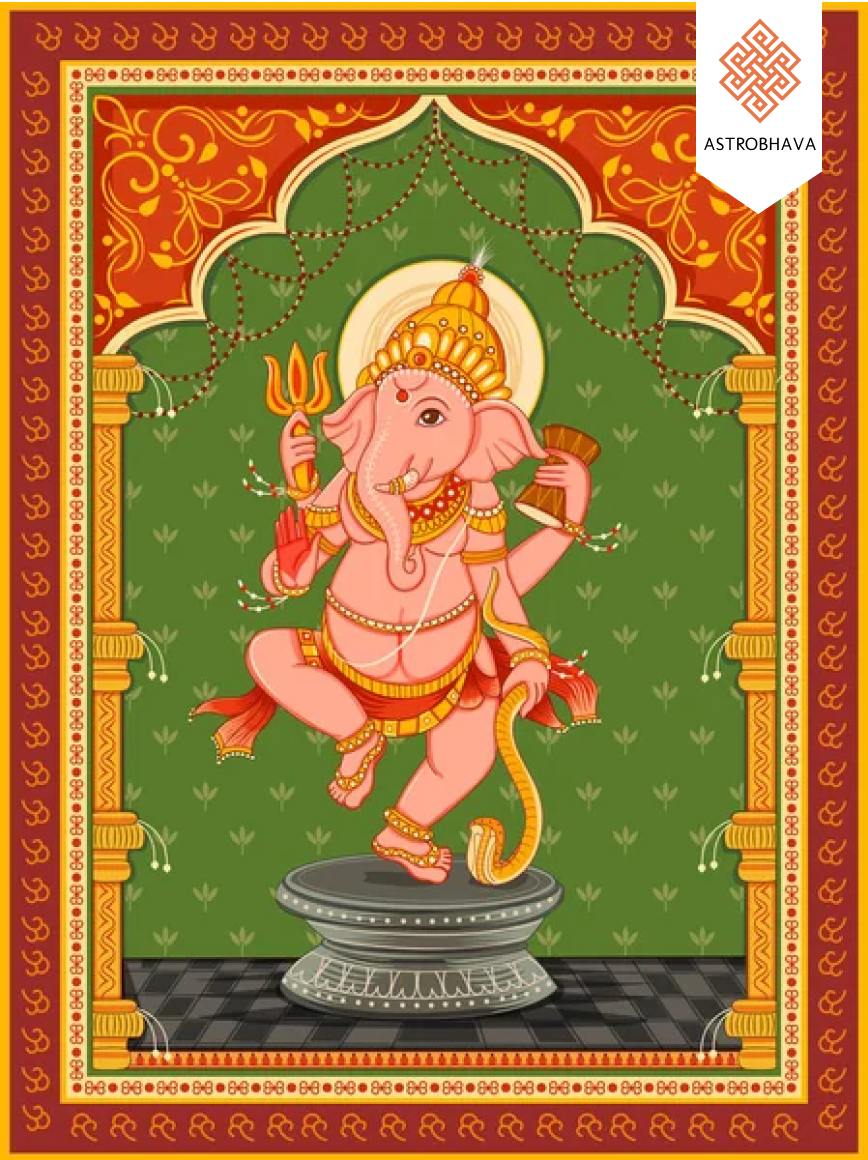
Vidya Ganapathi is the elephant-faced deity in the precise aspect that holds learning, retention and the transmission of shastra. Among the thirty-two meditative forms listed in the Mudgala Purana, Vidya Ganapati is the one whose dhyana places a manuscript and an akshamala in his hands together with the goad and noose, the trunk inclined toward the written leaf or toward a vessel of nectar. The form is distinguished from Buddhi or Siddhi Ganapati by this explicit link to letters and to the steady holding of what has been heard. Temple traditions in parts of Tamil Nadu, Karnataka and Andhra keep separate processional images or wall paintings under this name where students and teachers gather. The mantra belonging to him therefore carries either the word vidyā itself or the bijas that tantric lists assign to speech and intellect, marking the address as proper to this form alone.
Restoration of the Vedic Sequence
The Mudgala Purana, one of the two Puranas devoted entirely to Ganapathi, catalogues thirty-two forms for contemplation and supplies each with a characteristic narrative. Vidya Ganapati appears in that catalogue as the aspect contemplated when the issue is not outer hindrance but the recovery of knowledge that has become disordered. The Purana relates that after a period of cosmic confusion the gods found the continuous sequence of Vedic mantras broken in their own memory. They turned to meditation on Vidya Ganapati, who is described as restoring the order of the syllables and the links between metrical lines so that recitation could resume. The episode contains no battle and no demon; it is a quiet re-establishment of interior order within sacred learning itself. Later Smarta and Ganapatya paddhatis therefore place the mantra of this form at the commencement of a new shastra or when a teacher prepares to expound a text that has grown unclear. The form remains distinct from Sarasvati: it is Ganapathi as the lord who keeps the path of study free of forgetfulness and internal dislocation, the same deity who once held the unbroken thread of the Veda for the gods.
The mantra, in six scripts
The seed mantra, and the form most devotees chant daily. No initiation is required — it is open to anyone, including a parent chanting for a child.
“Om. The bijas aiṃ, śrīṃ, hrīṃ. To Vidya Gaṇapati, salutation.”
ॐ
oṃ — the primal sound
ऐं
aiṃ — bija of speech and learning
श्रीं
śrīṃ — bija of radiance
ह्रीं
hrīṃ — bija of interior energy
विद्यागणपतये
vidyāgaṇapataye — to Gaṇapati of knowledge
नमः
namaḥ — salutation
Aim is the mantra, in a sense. The rest is address and salutation; the seed syllable carries the goddess. Where a practitioner has been given a very short practice, it is often Aim alone.
The syllable people get wrong
In vidyāgaṇapataye the conjunct dyā demands that the tongue contact the palate for the 'd' and release at once into the palatal 'y' without an intervening vowel. Speakers often insert a break, saying 'vid-yā' or anglicise it to 'vidya' as in 'video', losing both the stop and the long final ā. The mis-division is almost universal when the word is taken from plain Roman spellings that omit diacritics and write only 'vidya'.
When Vidya Ganapathi is chanted
Weekday. Tuesday
Questions
The Mudgala Purana assigns each of the thirty-two forms a distinct set of attributes and a distinct dhyana. Buddhi Ganapati is visualised with a pot of nectar and gestures that emphasise discernment; Vidya Ganapati is visualised with an open manuscript and the rosary of syllables, the emphasis falling on retention and the transmission of what has been studied. The mantras follow the iconography: where Buddhi formulas stress the word buddhi or related bijas, the Vidya formulas incorporate vidyā or the speech-bija aiṃ, so that the address itself names the precise aspect under contemplation.
In the tantric lists that accompany the Ganapatya paddhatis, aiṃ is the established bija of articulated knowledge and of Sarasvati’s domain, śrīṃ carries the sense of luminous fullness, and hrīṃ the sense of inward heat that fixes attention. When these three are placed before vidyāgaṇapataye they do not create a different deity; they specify that the Ganapathi being addressed is the one whose field is precisely the luminous, heated retention of learning. The same name without those bijas would remain correct yet less exact for this form.
The Atharvashirsha speaks of Ganapathi as the seer of the Gayatri and as the one who dwells in the cavity of the heart where the Vedas are retained. Commentators in the Vidya-Ganapati stream read those lines as the Upanishadic ground for the later Puranic form. They do not claim that the Upanishad itself uses the title Vidya Ganapati; rather they hold that the form catalogued in the Mudgala Purana is the meditative crystallisation of the Upanishad’s statements about memory and sacred speech.
Not sure a mantra is enough?
Have your chart read before you decide
Chanting is yours to do, and free. But which deity your situation calls for — and whether a mantra alone is the right response — depends on your chart. Sometimes it is; sometimes it is not.
Brahmashree Shivaaya
Guru, Head of Astrological & Spiritual Solutions
Over 30 years in the Guru–Sishya Parampara, from the age of five
He reads every chart himself — 60 minutes, one to one, never delegated
Charts are read only between sunrise and sunset, following tradition
Chanting is yours to do. Some things are performed for you.
Where a matter carries real weight — an examination that decides a course, a performance, a child whose studies have stalled — devotees sponsor the homa alongside their own practice. Performed individually at our Yagna Ashram in your name and gotra, on a muhurta calculated from your chart, and telecast live so you can watch it done for you.