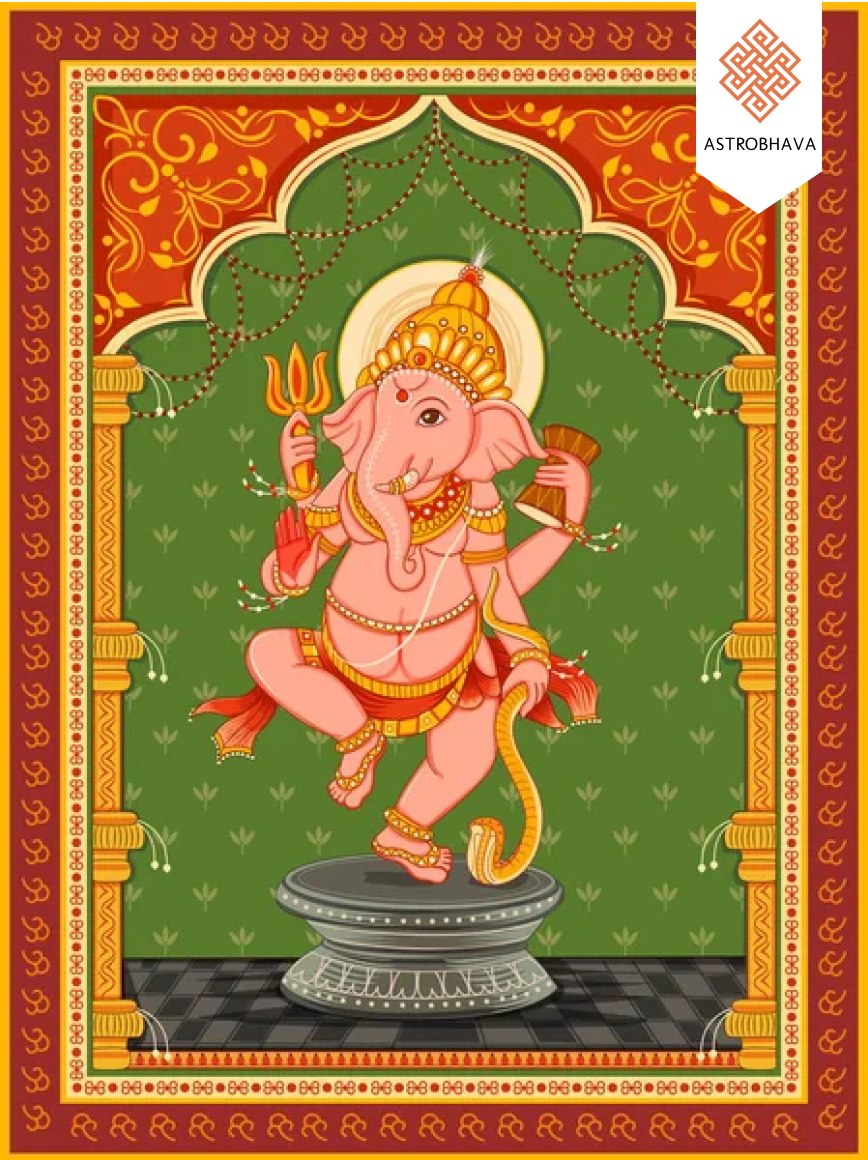
Ganapathi Mula Mantra, as worshipped at our temple
Mantra · The foundational mantra. Chanted at the start of any undertaking.
Ganapathi Mula Mantra
ॐ गं गणपतये नमः
In Devanagari, Tamil, Telugu, Kannada, Malayalam and English — with the meaning of every word, and the one syllable most people pronounce wrongly.
Who Ganapathi Mula Mantra is
Ganapathi addressed through the mula mantra is the elephant-headed deity whose title gaṇapati names him master of the troops that surround Shiva. In the opening of the Ganesha Purana and in the Ganapati Atharvashirsha he is the one remembered before any other utterance is formed. The mantra joins the seed gaṃ to the dative gaṇapataye and the salutation namaḥ, the shortest complete address recognised by the ritual handbooks of the Ganapatya and Smarta streams. The dhyana that accompanies this root formula shows the familiar four-armed figure bearing goad, noose, broken tusk and modaka, the mouse as vehicle. Unlike the thirty-two specialised forms of the Mudgala Purana, the mula does not fix him in a single mood or office; it simply names him at the point where invocation itself begins.
Tusk as Stylus for Vyasa
The Mahabharata tradition, elaborated in the Ganesha Purana and recalled in several regional recensions, recounts that Vyasa required a scribe capable of receiving the entire epic without a break in dictation. He turned to Ganapathi, who consented on the single condition that the recitation never pause. When the ordinary writing instrument proved unequal to the speed and length of the work, Ganapathi broke his own right tusk and used it as a stylus, continuing without interruption. Whenever Vyasa needed a moment to shape the next passage, he would interpose a particularly compact or enigmatic verse, giving himself time while Ganapathi considered its sense. The episode, preserved across the Ashvalayana references and later Puranic retellings, presents Ganapathi as the deity who makes unbroken sacred speech possible. Commentaries on the Ganesha Atharvashirsha therefore treat the seed gaṃ inside the mula mantra as the sonic counterpart of that same steadfast attention. The root formula is placed first in liturgical sequences because the lord who once wrote the epic without stopping is addressed, before any other verse, by his simplest name and bija.
The mantra, in six scripts
The seed mantra, and the form most devotees chant daily. No initiation is required — it is open to anyone, including a parent chanting for a child.
Aim is the mantra, in a sense. The rest is address and salutation; the seed syllable carries the goddess. Where a practitioner has been given a very short practice, it is often Aim alone.
The syllable people get wrong
The seed gaṃ ends in an anusvāra, a nasal resonance that stays in the nose and soft palate. It is commonly misread as a full labial 'm', producing 'gam' with closed lips, so the phrase becomes 'gam ga-na-pa-ta-ye'. The closed 'm' collapses the bija into an ordinary consonant and is especially frequent when the mantra is first learned from undotted Roman script.
When Ganapathi Mula Mantra is chanted
Weekday. Tuesday
Festival. Gaṇeśa Caturthī
Questions
Mula means root. Within the paddhatis that govern Ganapathi worship, oṃ gaṃ gaṇapataye namaḥ is treated as the irreducible sonic identity of the deity, the formula from which longer hymns, kavacas and dhyana verses are said to branch. The Ganesha Atharvashirsha opens by equating the deity with the fundamental sound, and later ritual manuals therefore set this short sequence at the head of any extended liturgy. It is not an abbreviated stotra; it is the seed-plus-name unit that the tradition regards as complete in itself.
The Ganapati Atharvashirsha, preserved in certain Atharvaveda recensions and widely adopted by Ganapatya communities, declares Ganapathi identical with the ultimate reality and isolates gaṃ as his essential bija. The mula mantra is the liturgical reduction of that teaching: the bija, the name in the dative case, and namaḥ. Maharashtrian and Tamil commentators treat the Upanishad as the philosophical ground and the four-word formula as its ordinary expression, used whenever the deity is to be named without further elaboration of attributes or narrative.
No. The Mudgala Purana enumerates thirty-two meditative forms—Bala Ganapati, Taruna Ganapati, Bhakti Ganapati, Vira Ganapati and the rest—each supplied with its own dhyana shloka and, in some cases, a distinct set of bijas. The mula mantra does not select any one of those iconographic specifications. It addresses Ganapathi in the unspecified root aspect that precedes particularisation of mood, age or cosmic function, which is why the same formula can open rites dedicated to any of the thirty-two forms.
Not sure a mantra is enough?
Have your chart read before you decide
Chanting is yours to do, and free. But which deity your situation calls for — and whether a mantra alone is the right response — depends on your chart. Sometimes it is; sometimes it is not.
Brahmashree Shivaaya
Guru, Head of Astrological & Spiritual Solutions
Over 30 years in the Guru–Sishya Parampara, from the age of five
He reads every chart himself — 60 minutes, one to one, never delegated
Charts are read only between sunrise and sunset, following tradition
Chanting is yours to do. Some things are performed for you.
Where a matter carries real weight — an examination that decides a course, a performance, a child whose studies have stalled — devotees sponsor the homa alongside their own practice. Performed individually at our Yagna Ashram in your name and gotra, on a muhurta calculated from your chart, and telecast live so you can watch it done for you.