In Devanagari, Tamil, Telugu, Kannada, Malayalam and English — with the meaning of every word, and the one syllable most people pronounce wrongly.
Who Dhundhi Ganapathi is
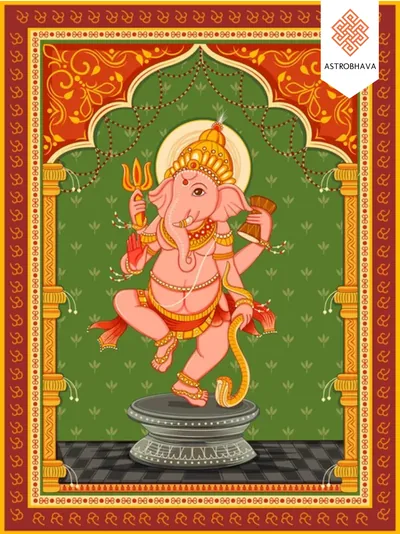
Dhundhi Ganapathi is the seeker-form of Ganesha whose name is formed from the verbal root dhundh, “to search out.” Within the Mudgala Purāṇa’s catalogue of thirty-two meditation aspects he is the one who recovers what has slipped from sight—an object, a path, or a forgotten insight. Iconographic descriptions show the goad and noose held not in restraint but in the attitude of retrieval, and the trunk raised as if testing the air. The same form is known in Kashi as Dhundiraja, yet the mantra addresses the universal aspect rather than the local image. He stands apart from the general remover of obstacles by the single, precise activity of bringing the lost back into presence, an activity the texts never assign to any other Ganapati.
The Search for the Hidden Flame
Local tradition of Varanasi, corroborated by the broader narrative cycles of the Mudgala Purāṇa, recounts that the sacrificial fire of the gods once vanished into the dense thickets of ignorance. The deities, unable to kindle a single offering, turned to Ganesha and called him by the name Dhundhi, the seeker. He manifested with trunk lifted in inquiry and, moving through the obscuring forest, located the hidden flame and restored it to the altar. A parallel strand tells that Pārvatī, during the cosmic dance, let fall a jewelled ornament that disappeared into the folds of time; she invoked the same form, and Dhundhi recovered it. The Purāṇa lists him distinctly among the thirty-two, assigning him no other function than this work of retrieval. Temple lore surrounding the Dhundiraja shrine in Kashi elaborates the episode, presenting the deity as eternally engaged in the quiet labour of finding what has wandered or been concealed, thereby fixing the scriptural identity of the form addressed by the Dhundhi mantra.
The mantra, in six scripts
The seed mantra, and the form most devotees chant daily. No initiation is required — it is open to anyone, including a parent chanting for a child.
“Om, to Dhundhi Ganapati, marked twice by the seed dhuṃ, salutations.”
ॐ
oṃ — the primordial syllable
धुं
dhuṃ — seed-syllable of seeking
धुं
dhuṃ — seed-syllable of seeking
धुण्डिगणपतये
dhuṇḍigaṇapataye — to Dhundhi Ganapati
नमः
namaḥ — salutations
Aim is the mantra, in a sense. The rest is address and salutation; the seed syllable carries the goddess. Where a practitioner has been given a very short practice, it is often Aim alone.
The syllable people get wrong
The conjunct ṇḍ inside dhuṇḍi is almost always simplified to the ordinary English cluster “nd” of the word “dandy,” omitting the retroflex nasal that requires the tongue tip to curl and strike before the stop. At the same time the initial aspirated dhu is reduced to a bare du, stripping the breath that tradition places on the opening syllable of the name.
When Dhundhi Ganapathi is chanted
Weekday. Tuesday
Questions
The name is built directly on the Sanskrit root dhundh, “to search for” or “to seek out.” In the Mudgala Purāṇa it designates the single activity of recovery that defines this meditation form.
The temple image in Varanasi bears the same epithet and is understood as a local embodiment of the universal seeker-aspect enumerated among the thirty-two forms; the mantra addresses that universal aspect rather than the stone image alone.
The Purāṇic narratives speak of both the lost sacrificial fire and the ornament of Pārvatī, yet the underlying theme is the restoration of whatever has become concealed, whether material or subtle.
Not sure a mantra is enough?
Have your chart read before you decide
Chanting is yours to do, and free. But which deity your situation calls for — and whether a mantra alone is the right response — depends on your chart. Sometimes it is; sometimes it is not.
Brahmashree Shivaaya
Guru, Head of Astrological & Spiritual Solutions
Over 30 years in the Guru–Sishya Parampara, from the age of five
He reads every chart himself — 60 minutes, one to one, never delegated
Charts are read only between sunrise and sunset, following tradition
Chanting is yours to do. Some things are performed for you.
Where a matter carries real weight — an examination that decides a course, a performance, a child whose studies have stalled — devotees sponsor the homa alongside their own practice. Performed individually at our Yagna Ashram in your name and gotra, on a muhurta calculated from your chart, and telecast live so you can watch it done for you.