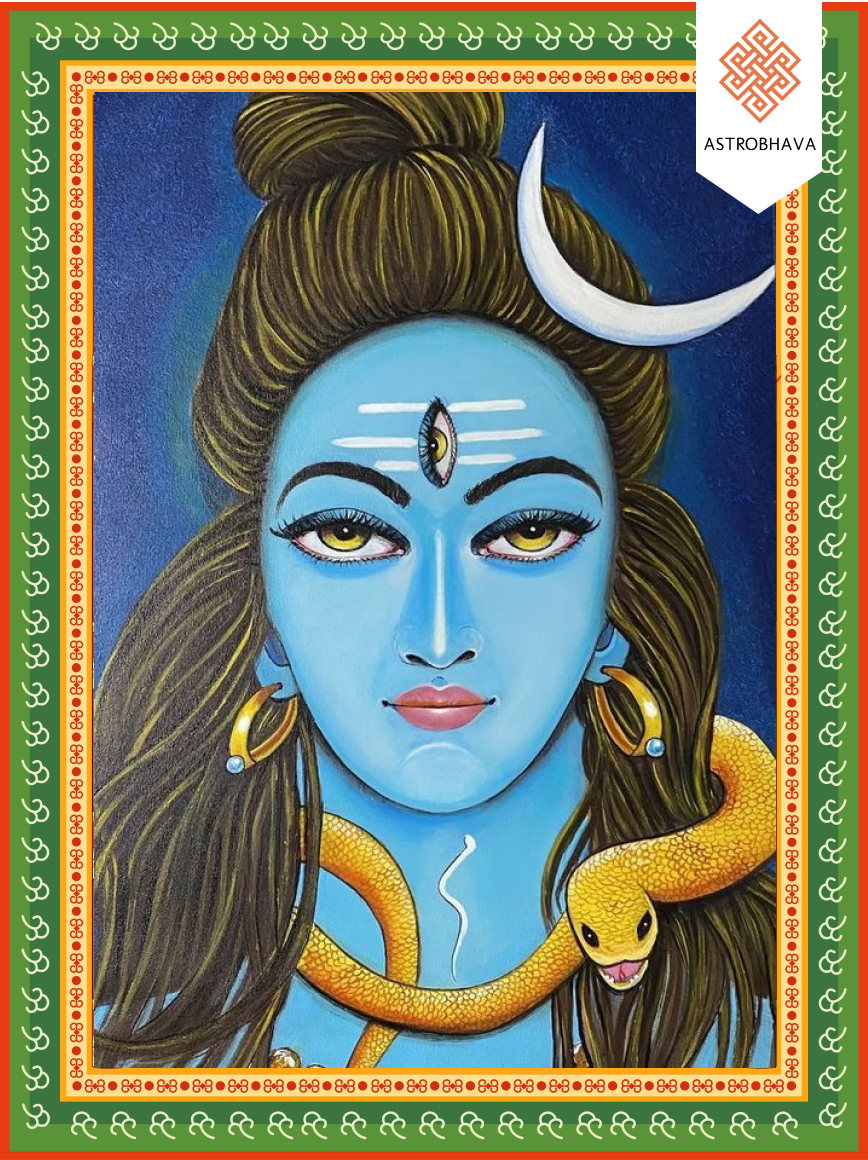
Mantra · Fifth Bhairava. For freedom from delusion.
Unmatta Bhairava
ॐ उन्मत्तभैरवाय नमः
In Devanagari, Tamil, Telugu, Kannada, Malayalam and English — with the meaning of every word, and the one syllable most people pronounce wrongly.
Who Unmatta Bhairava is
Unmatta Bhairava is the fifth of the eight Bhairavas enumerated in the Śaiva tantric cycles that map fierce emanations of Śiva onto the directions and the mātṛkās. The Sanskrit unmatta names a state of sacred intoxication in which ordinary measures of sanity collapse; joined to Bhairava it designates the form whose very presence unsettles fixed identity. Iconographic manuals of the later tantras portray him dark or ash-smeared, eyes rolling, hair unbound, holding a ḍamaru, a skull-cup, and a staff that marks the rupture of social order. He is paired with the mātṛkā Vārāhī and stationed in his appointed quarter of the aṣṭaka. Within the liturgy he is not approached as a granter of comfort but as the deity in whom delusion itself is made visible and therefore available for dissolution. His worship belongs to the same stream that preserves the other seven Bhairavas, yet his particular mood is the ungovernable clarity that follows the breaking of mental habit.
Madness After the Fifth Head
The Brahmāṇḍa Purāṇa and allied Śaiva narratives recount that when Bhairava severed the fifth head of Brahmā, the skull clung to his palm as the mark of brahmahatyā. Wandering as Kāpālika, he entered states that the texts name unmatta—divine madness in which the boundaries of pure and impure, self and other, ceased to hold. From that wandering the tradition extracts the distinct hypostasis called Unmatta Bhairava, the fifth guardian of the aṣṭa-bhairava maṇḍala. Later tantric paddhatis, drawing on the Rudrayāmala lineage, place him in the southwest or the quarter assigned by local krama, still carrying the skull and the drum whose beat is said to disorder linear thought. The episode is not told as a moral caution but as the mythic origin of a consciousness that has already stepped outside conventional sanity. In temple practice the same narrative underwrites his installation beside Vārāhī, so that the intoxication of the guardian and the boar-faced energy of the mātṛkā face one another across the sacred diagram.
The mantra, in six scripts
The seed mantra, and the form most devotees chant daily. No initiation is required — it is open to anyone, including a parent chanting for a child.
“Homage to Unmatta Bhairava, the Bhairava of sacred intoxication.”
ॐ
oṃ — the primordial syllable
उन्मत्तभैरवाय
unmattabhairavāya — to Unmatta-Bhairava
नमः
namaḥ — homage
Aim is the mantra, in a sense. The rest is address and salutation; the seed syllable carries the goddess. Where a practitioner has been given a very short practice, it is often Aim alone.
The syllable people get wrong
The cluster tt in unmatta (उन्मत्त) is a true geminate: both t-sounds must be released, giving un-mat-ta. Speakers often reduce it to a single soft t, producing un-ma-ta or un-mata, which collapses the name’s rhythmic weight and is the error most frequently heard in vernacular recitation of this mantra alone.
When Unmatta Bhairava is chanted
Weekday. Monday
Questions
In the standard aṣṭa-bhairava sequence preserved in Śaiva tantric paddhatis, Unmatta occupies the fifth place after Asitāṅga, Ruru, Caṇḍa and Krodha. The ordering is directional and liturgical rather than chronological; it fixes his seat relative to the other seven and to the mātṛkā Vārāhī with whom he is paired, so that the maṇḍala remains complete only when his quarter is acknowledged.
The kapāla he carries is continuous with the myth of the clinging fifth head of Brahmā. In Unmatta’s particular form it is read as the vessel of a consciousness that has already drunk the consequence of that act and therefore moves outside ordinary purity codes. It is not a generic Bhairava attribute here but the visible remainder of the unmatta state itself.
Kāla Bhairava is commonly the chief guardian at the threshold of Śiva temples. Unmatta Bhairava appears instead as one figure within the set of eight, installed either in a separate aṣṭa-bhairava shrine or at the compass point assigned by the local āgama. His liturgy and his pairing with Vārāhī keep him distinct from the singular, time-devouring Kāla.
Not sure a mantra is enough?
Have your chart read before you decide
Chanting is yours to do, and free. But which deity your situation calls for — and whether a mantra alone is the right response — depends on your chart. Sometimes it is; sometimes it is not.
Brahmashree Shivaaya
Guru, Head of Astrological & Spiritual Solutions
Over 30 years in the Guru–Sishya Parampara, from the age of five
He reads every chart himself — 60 minutes, one to one, never delegated
Charts are read only between sunrise and sunset, following tradition
Chanting is yours to do. Some things are performed for you.
Where a matter carries real weight — an examination that decides a course, a performance, a child whose studies have stalled — devotees sponsor the homa alongside their own practice. Performed individually at our Yagna Ashram in your name and gotra, on a muhurta calculated from your chart, and telecast live so you can watch it done for you.