Also spelled Rudra Homam
रुद्र होमThe Sri Rudram rises with the flame — a thousand-voiced prayer to the healer of healers, offered for your strength and long life.
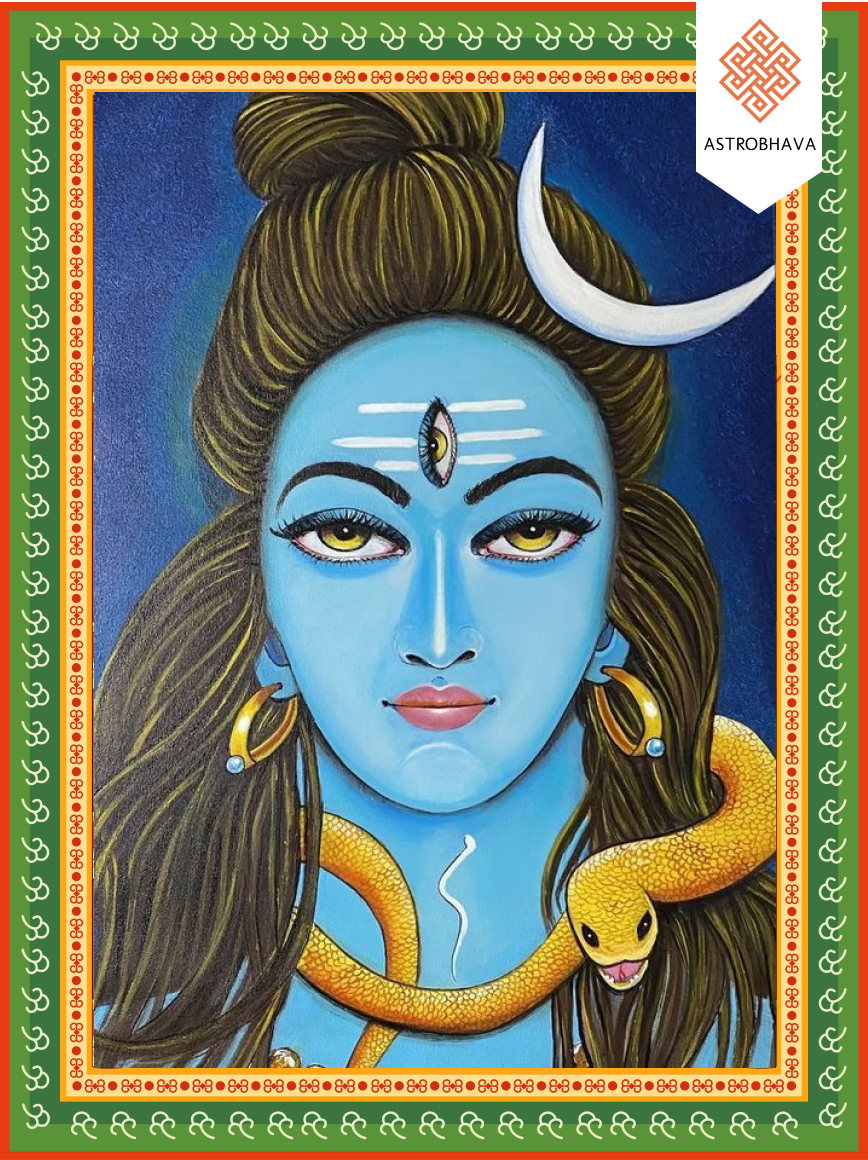
The Rudra Homa carries the Sri Rudram, the heart of the Krishna Yajur Veda, into fire. Each anuvaka names Rudra — as the lord of forests and rivers, of physicians and herbs, of the fierce and the utterly gentle — and each naming ends in surrender. Where a rudra puja pours water and milk over the linga, the homa gives those same syllables to Agni, who carries them without delay. This is why the tradition places it among the great rites: it is not a small petition but a full recitation of the Veda's most healing hymn.
Devotees turn to the Rudra Homam when the body has been tired for too long, when recovery is slow, when an ailment has settled in and made itself at home. Rudra is invoked in the Veda as the bearer of medicine, the one whose hand is soothing and cooling. The homa asks him for that hand. Our priests perform it at the Yagna Ashram in your name and gotra, and you watch the fire from wherever you are.
नमस्ते रुद्र मन्यव उतोत इषवे नमः। नमस्ते अस्तु धन्वने बाहुभ्यामुत ते नमः॥ (Namaste rudra manyava utota iṣave namaḥ, namaste astu dhanvane bāhubhyām uta te namaḥ) Salutation to your fierce power, O Rudra, and salutation to your arrow; salutation to your bow, and salutation to your two arms.The tradition prescribes the Rudra Homa for the body's endurance and the long road of recovery. These are the intentions devotees carry to the fire.
Offered when someone is recovering, or facing a long treatment, so that the healing period is held in prayer.
Rudra is invoked as the one who restores strength to the worn. Devotees seek steadiness of energy through demanding seasons.
The Rudram is chanted traditionally for a long, unbroken life. Families book it for elders and for the newly recovered.
When an ailment has lingered for years, the homa is offered as a sustained prayer alongside — never instead of — medical care.
Rudra is invoked to disperse negative influence, planetary strain and disturbances that leave the body restless.
Cross-listed under devotion for good reason: the Rudram settles fear and quietens the mind of the one it is offered for.
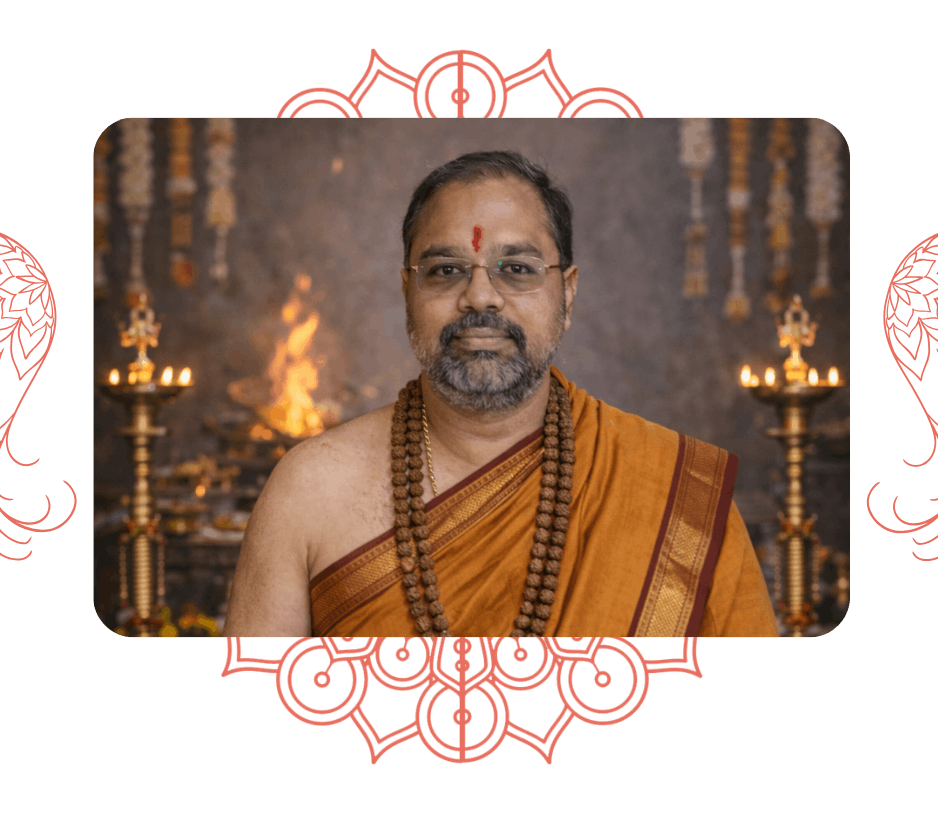
Every priest who performs your Rudra Homa is trained in a traditional Padashala and personally recruited by Brahmashree Shivaaya — Guru and Head of Astrological & Spiritual Solutions at AstroBhava. Your ritual is conducted at our own Yagna Ashram — never a rented venue — with temple rites performed across our seven temples in Tamil Nadu and Kerala.
Meet our priests →Not every fire ritual is performed at the same scale. A Maha Homa is our largest form — more priests, a longer fire, and the complete chanting sequence the rite prescribes rather than an abridged one. This is what that means in practice.
A Maha Homa is performed for one devotee and their named family, the same as any homa we conduct. What the scale changes is the weight of the offering — ten trained voices holding one hymn for two hours is a different undertaking from one voice for an hour, and it is reserved for the intentions that warrant it.
Both packages are the same rite. The complete Rudram, all thirty-one verses, over approximately two hours, with the same offerings, the same free energised Surya Yantra sealed in its silver amulet, and the same live telecast. What changes is how many trained voices carry the hymn at once.
All prices are all-inclusive — no shipping charges, no additions at checkout. See everything included →
You book — and send birth details at checkout.
Within 24–48 working hours — your muhurta is confirmed by email.
The day before — your telecast link arrives by email.
After the homa — tracking email with your personal time to wear the yantra.
Rudra's hours are the ones the tradition marks for him. We schedule your homa on the nearest of these that suits you.
Somavara belongs to Shiva, and Pradosham — the twilight of the thirteenth tithi — is held as the most receptive hour for Rudra worship.
Rudra's own birth star. Ardra days each month, and Ardra Darshan in Margazhi, are especially favoured for the Rudra Homam.
The great night of Shiva, and the Karthigai days of each month, are traditional for extended Rudram recitation into fire.
Many devotees choose their birth star, or that of the person recovering, to link the offering directly to the one it is for.
When your homa concludes, the yantra that stood in the fire is rolled and locked inside its silver amulet according to Agama vidhi — the practice by which the energies raised in a ritual are held within a consecrated object rather than dispersing. It is why a homa performed at our ashram can still reach a devotee ten thousand miles away: what the fire raised travels to you, sealed.
Your name, gotra & nakshatra — for you and up to five family members.
Watch your own homa in real time from the ashram. Streamed openly on our YouTube channel by default — or request a private, unlisted telecast at checkout.
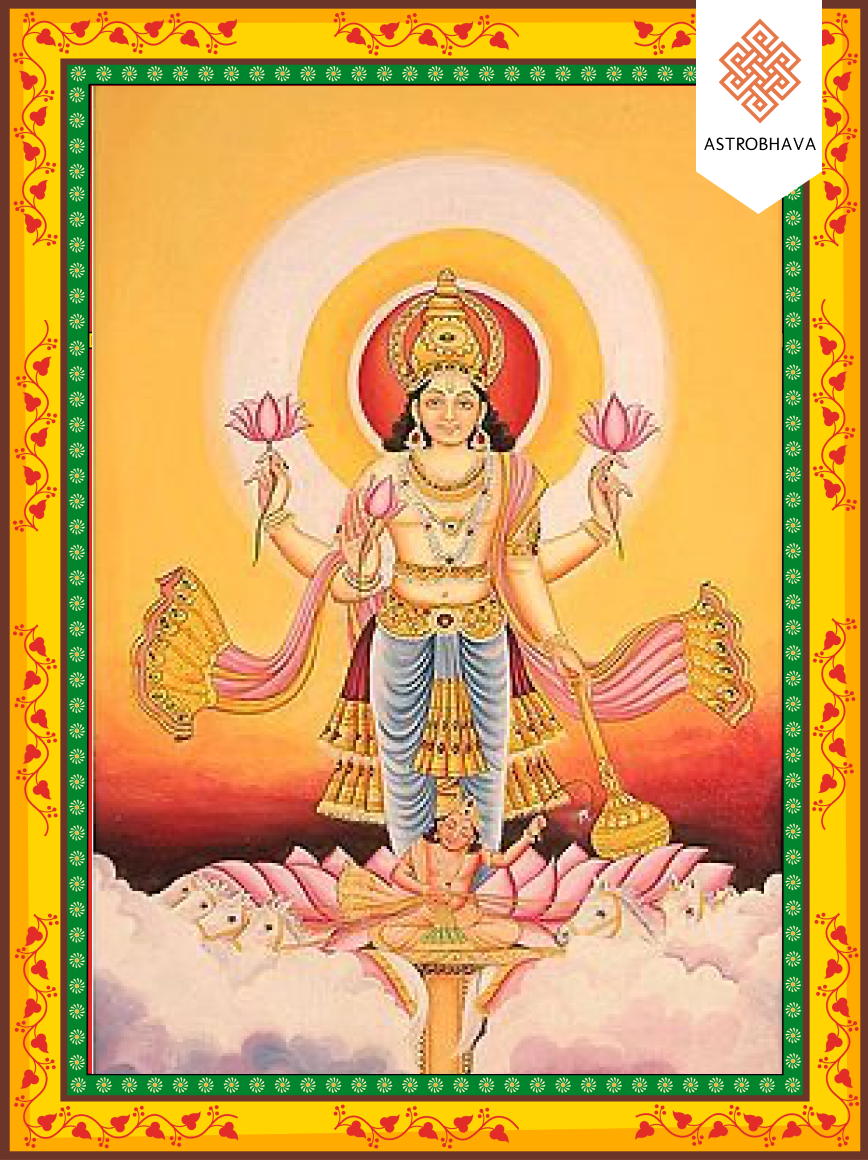
Consecrated over three days — Jala (holy-water consecration with mantras), Prana (life force through pranayama & chants) and Jeeva Pratishta (awakened with 108 recitations & offerings) — then present through your homa, receiving the energies raised in the fire. Immediately afterwards it is rolled and sealed inside a silver amulet by Agamic rite, locking those energies within, and shipped to you with your prasadam.
Sacred vibhuti, sandalwood powder & kumkum from your fire — delivered to any country.
Daily temple worship for 48 days — the 27 Nakshatras + 12 Rashis + 9 Planets — then sealed in a silver amulet of approximately 2–4 inches.
As per strict Agama vidhi, no videography is permitted inside the temple sanctum — this preserves the pure sacred energies and undisturbed divine focus of the ritual. The main homa is respectfully telecast live from outside the sanctum; the daily rituals of the 48-day Anushthan are performed with full devotion but are not telecast.
Homas are telecast openly on our YouTube channel so that devotees everywhere may witness the rituals — and because we believe you should be able to see our work before you trust us with yours. Your sankalpa names you and your family, so if you would rather your ceremony were not public, choose the private telecast option at checkout and it is streamed as an unlisted link visible only to you.
We state this plainly — transparency about what tradition forbids filming, and about what is public, is part of performing these rituals honestly.
The energised yantra is carefully rolled and sealed inside a sacred silver amulet before shipping. Wearing it is itself a small ritual — and even its timing is set for you personally.
Our astrologer marks the auspicious date and time to wear the yantra according to your birth details — sent to you in the email carrying your shipment's tracking number.
Dip the silver amulet in raw milk or Ganga jal for an hour before wearing, then clean with normal water.
Perform the wearing process facing east or north for maximum benefit.
Show lamp and incense to the amulet before wearing it.
Around your neck or waist, on a thread or chain.
Repeated offering of dheep and dhoop keeps the energisation alive.
Place the amulet at your puja altar, or keep it in your wallet.
The priest states your name, gotra and nakshatra — and those of up to five family members — with the intention this homa is performed for.
The customary invocation to Ganapati, clearing obstacles before the goddess is approached.
The fire is consecrated in the homa kunda and Agni invoked as the carrier of every offering that follows.
The Rudra Sukta and Rudra Gayatri are chanted, inviting the goddess's presence into the fire — by one, three or five priests as your package sets.
Ghee, white flowers, akshata and honey are offered in sequence with mantra — the offerings traditional to her worship.
The final complete offering seals the sankalpa stated at the opening.
Aarti is performed live on your telecast. Vibhuti, sandalwood powder, kumkum and your energised yantra are then packed and shipped free to your door.
Rudra is one of the Tridevi and the mother of the Vedas — the presiding deity of knowledge, learning, memory, speech, music and every art. She is depicted in white upon a white lotus, holding the veena, a book, a rosary and a water pot, with the swan of discernment beside her.
In this homa, her grace — Rudra Kataksham — is invoked through fire with your own name and birth details spoken in the sankalpa.
Her full mythology, the beeja mantra and Rudra Gayatri word by word, and how devotees chant at home — on our Rudra Mantra guide.
Read the Mantra Guide →Sarathi, our free AI ritual guide, recommends the traditional ritual for your situation instantly. For a full reading of your chart, book a live session with our astrologers — the fee is fully credited when you book any ritual.
Book your Rudra Homa, watch it performed live from our Yagna Ashram, and receive your energised yantra anywhere in the world.
Choose Your Package