In Devanagari, Tamil, Telugu, Kannada, Malayalam and English — with the meaning of every word, and the one syllable most people pronounce wrongly.
Who Mahamrityunjaya is
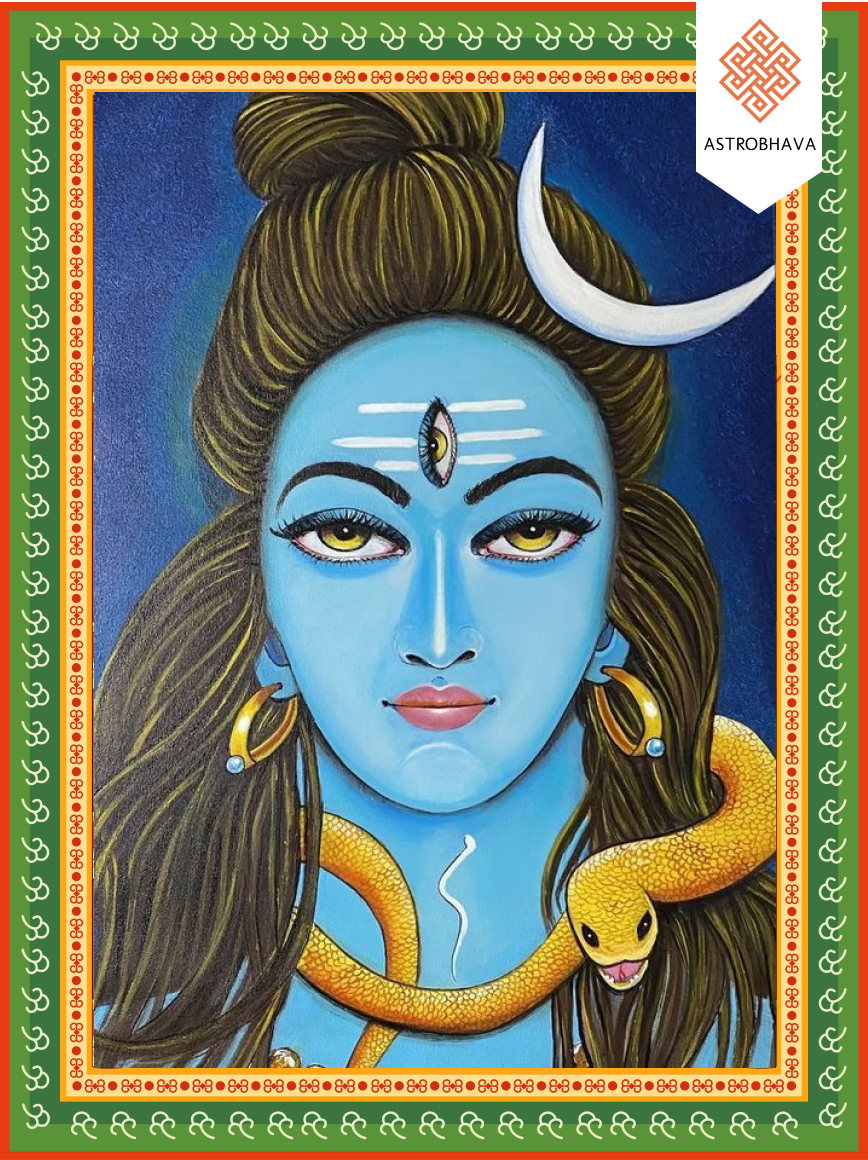
Tryambaka, the three-eyed Rudra of the Veda, is the form of Shiva addressed in the Mahamrityunjaya mantra. The name itself records the three eyes that tradition assigns to him: the sun, the moon, and the fire of insight that burns between them. In the Rigvedic hymn from which the mantra is drawn he is invoked as the fragrant one who increases nourishment, the liberator who loosens the bond of death as a cucumber is severed from its vine. Later Shaiva literature identifies this same Tryambaka with the ascetic of Kailasa whose throat holds the halahala poison and whose gaze can still the movement of time. The mantra therefore does not address a generic Shiva but this precise, three-eyed seer whose Vedic epithet already contains the imagery of release from mortality.
Markandeya and the Noose
The Markandeya Purana preserves the episode that later tradition inseparably links with the Mahamrityunjaya mantra. The sage Mrikandu, granted a choice between a long-lived dull son and a short-lived brilliant one, chose the latter. The boy Markandeya was born with a life span of sixteen years. On the appointed day Yama’s noose settled around the youth as he clung to a Shiva-linga on the seashore. Shiva, rising from the linga in the form of Tryambaka, kicked the noose aside and declared that Markandeya would remain sixteen forever. The hymn that the boy is said to have recited in that moment is the same Rigvedic verse (7.59.12) that begins tryambakaṃ yajāmahe. The Puranic narrative therefore supplies a concrete mythic frame for a mantra whose original setting is a simple Vedic offering to Rudra; the cucumber image of the hymn becomes, in the Purana, the literal severing of death’s cord.
The mantra, in six scripts
The seed mantra, and the form most devotees chant daily. No initiation is required — it is open to anyone, including a parent chanting for a child.
“We worship the three-eyed one, the fragrant, the increaser of fullness; like a cucumber from its stem, may I be freed from death, not from immortality.”
ॐ
oṃ — the sacred syllable
त्र्यम्बकं
tryambakaṃ — the three-eyed one (accusative)
यजामहे
yajāmahe — we worship / we sacrifice to
सुगन्धिं
sugandhiṃ — the fragrant one
पुष्टिवर्धनम्
puṣṭivardhanam — increaser of nourishment
उर्वारुकम्
urvārukam — cucumber / gourd
इव
iva — like / as
बन्धनान्
bandhanān — from the stem / from bondage
मृत्योः
mṛtyoḥ — from death
मुक्षीय
mukṣīya — may I be released
मा
mā — not
अमृतात्
amṛtāt — from immortality
Aim is the mantra, in a sense. The rest is address and salutation; the seed syllable carries the goddess. Where a practitioner has been given a very short practice, it is often Aim alone.
The syllable people get wrong
The cluster trya in tryambakaṃ is frequently flattened to a simple tri-ya, producing triyambakam. The correct onset is a single consonant cluster trya, with the r lightly trilled before the y, so that the first syllable remains one beat rather than two.
When Mahamrityunjaya is chanted
Weekday. Monday
Festival. Maha Shivaratri, when the Mahamrityunjaya mantra is recited through the four night watches in many Shaiva temples
Questions
Tryambaka is the specific Vedic epithet that appears in Rigveda 7.59.12, the sole source of the mantra’s wording. The three eyes are already present in the oldest layer of the hymn; later Shaiva theology merely elaborates what the Veda already names. Using the title Shiva alone would erase the mantra’s textual identity and its cucumber metaphor of release, both of which belong exclusively to the Tryambaka verse.
In the agricultural world of the Rigvedic poets a ripe cucumber falls away from its vine cleanly, leaving no torn stem. The hymn places that natural separation beside the desired separation from mṛtyu. The image is therefore not ornamental; it supplies the precise physical model for the liberation the verse requests. Later Puranic storytellers retained the same vegetable when they dramatised Markandeya’s escape, showing how tightly the metaphor remains bound to this particular mantra.
No. The stotras are later compositions that expand upon the theme of conquering death and often incorporate the Vedic verse as a refrain. The Mahamrityunjaya mantra proper remains the twelve-word Rigvedic unit. Conflating the two obscures the fact that the core text is a single ṛc whose every syllable is fixed by Vedic recitation tradition.
Not sure a mantra is enough?
Have your chart read before you decide
Chanting is yours to do, and free. But which deity your situation calls for — and whether a mantra alone is the right response — depends on your chart. Sometimes it is; sometimes it is not.
Brahmashree Shivaaya
Guru, Head of Astrological & Spiritual Solutions
Over 30 years in the Guru–Sishya Parampara, from the age of five
He reads every chart himself — 60 minutes, one to one, never delegated
Charts are read only between sunrise and sunset, following tradition
Chanting is yours to do. Some things are performed for you.
Where a matter carries real weight — an examination that decides a course, a performance, a child whose studies have stalled — devotees sponsor the homa alongside their own practice. Performed individually at our Yagna Ashram in your name and gotra, on a muhurta calculated from your chart, and telecast live so you can watch it done for you.