Mantra · Saturday. For discipline, and during Sade Sati.
Shani — Saturn
ॐ शं शनैश्चराय नमः
In Devanagari, Tamil, Telugu, Kannada, Malayalam and English — with the meaning of every word, and the one syllable most people pronounce wrongly.
Who Shani — Saturn is
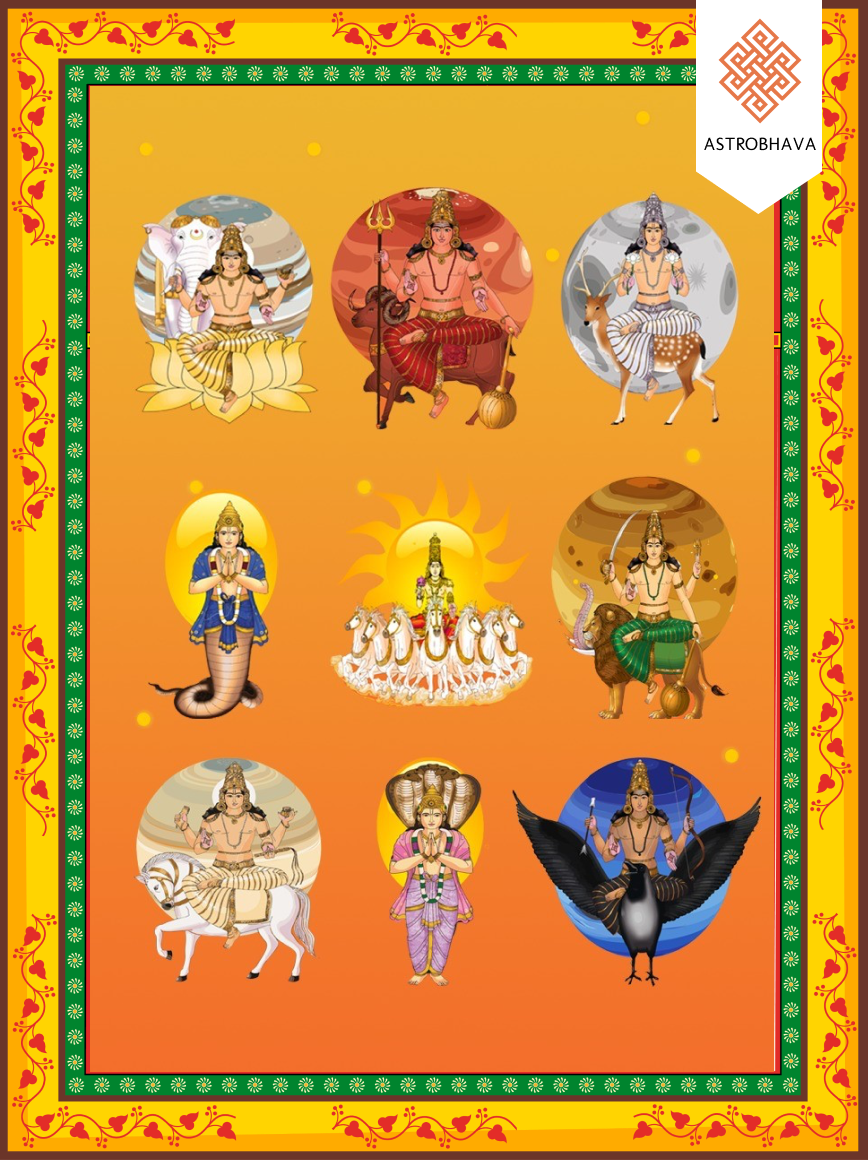
Shani, or Śanaiścara, is the planetary deity of Saturn, the slow-moving son of Sūrya and the shadow-goddess Chhāyā. Jyotiṣa knows him as the lord of Saturday, the western direction, and the deep markers of endurance, labour, and the ripening of prior action. Iconographic sources give him a dark complexion, iron ornaments, and a vulture or crow as mount; his gaze is said to be downward and unhurried. Among the grahas he alone is portrayed as the impartial dispenser of consequence, neither favouring the devas nor the asuras. His very name, ‘the slow-goer’, records the long arc of his transit and the measured pace at which tradition holds that karma becomes visible.
Son of the Shadow Goddess
The Śani Māhātmya and passages in the Skanda Purāṇa narrate Shani’s birth from Sūrya and Chhāyā. When Saṃjñā, the true consort of the Sun, could no longer bear her husband’s brilliance, she fashioned a double from her own shadow and departed. That double, Chhāyā, bore Shani. At the moment the infant opened his eyes, the Sun’s chariot faltered and a darkness fell across the sky; Sūrya, enraged, was restrained only by the gods’ intervention. Later cycles tell how Shani’s steady glance fell upon the newborn Ganeśa during a rare alignment, causing the child’s head to wither so that it later required replacement by an elephant’s. The same unblinking regard is said to have tested kings and sages alike, stripping away what was unearned. These episodes establish Shani not as a figure of malice but as the graha whose nature is to reveal the weight already present, moving at the pace of years rather than of days.
The mantra, in six scripts
The seed mantra, and the form most devotees chant daily. No initiation is required — it is open to anyone, including a parent chanting for a child.
“Salutation to Śanaiścara, joined with the seed-syllable śaṃ.”
ॐ
oṃ — the sacred syllable
शं
śaṃ — seed-syllable śaṃ
शनैश्चराय
śanaiścarāya — to Śanaiścara, the slow-mover
नमः
namaḥ — salutation
Aim is the mantra, in a sense. The rest is address and salutation; the seed syllable carries the goddess. Where a practitioner has been given a very short practice, it is often Aim alone.
The syllable people get wrong
In śanaiścarāya the diphthong ai inside the sequence naiś is routinely collapsed by speakers into a single short e, producing the flattened ‘shanesh-charāya’. Both vowel colours of the ai must be retained in rapid succession before the palatal sibilant of the following cluster is sounded.
When Shani — Saturn is chanted
Festival. Shani Jayanti and Śani Trayodaśī
Questions
The name is a compound of śanais, ‘slowly’, and cara, ‘moving’. It records the planet’s long sidereal period and, by extension, the unhurried manner in which tradition understands the fruition of action under his influence. No other graha bears a name that so directly describes its celestial pace.
Chhāyā is the shadow-form created by Saṃjñā when she left Sūrya. The Purāṇas present her as Shani’s mother, and the darkness associated with his birth is traced to her nature as shadow. This parentage distinguishes Shani from the other children of the Sun and supplies the mythic ground for his dark complexion and heavy regard.
Texts repeatedly describe Shani’s glance as downward, steady, and capable of withering what is unripe or unearned. The episode of the infant Ganeśa and the faltering of Sūrya’s chariot at Shani’s first opening of the eyes are the classic illustrations. The gaze is not portrayed as arbitrary punishment but as the visible pressure of time and consequence.
Not sure a mantra is enough?
Have your chart read before you decide
Chanting is yours to do, and free. But which deity your situation calls for — and whether a mantra alone is the right response — depends on your chart. Sometimes it is; sometimes it is not.
Brahmashree Shivaaya
Guru, Head of Astrological & Spiritual Solutions
Over 30 years in the Guru–Sishya Parampara, from the age of five
He reads every chart himself — 60 minutes, one to one, never delegated
Charts are read only between sunrise and sunset, following tradition
Chanting is yours to do. Some things are performed for you.
Where a matter carries real weight — an examination that decides a course, a performance, a child whose studies have stalled — devotees sponsor the homa alongside their own practice. Performed individually at our Yagna Ashram in your name and gotra, on a muhurta calculated from your chart, and telecast live so you can watch it done for you.