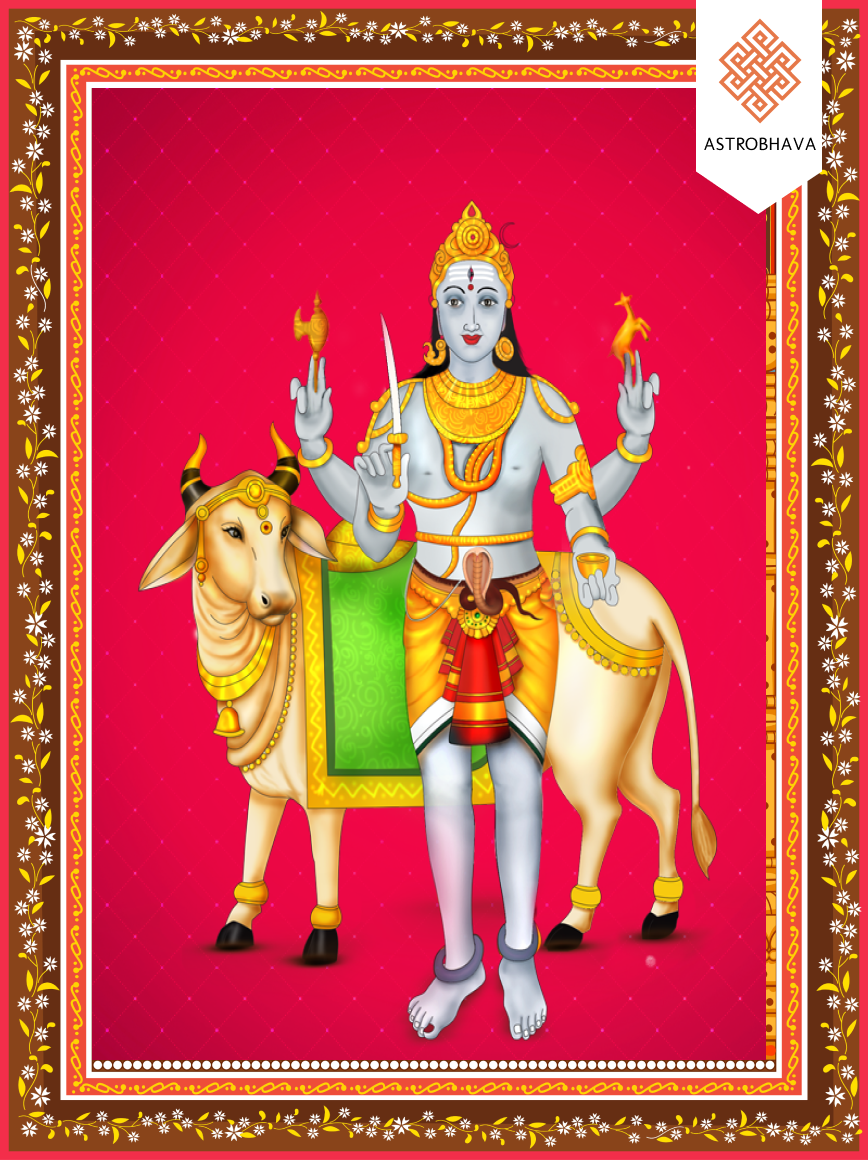
Mantra · Second Bhairava. For release from karmic burden.
Ruru Bhairava
ॐ ह्रीं रुरुभैरवाय नमः
In Devanagari, Tamil, Telugu, Kannada, Malayalam and English — with the meaning of every word, and the one syllable most people pronounce wrongly.
Who Ruru Bhairava is
Ruru Bhairava is the second of the eight Bhairavas who arise as directional guardians from the fierce body of Shiva in the Tantric classifications preserved in the Sharada Tilaka and the Rudrayamala. His name is taken from ruru, a word that names both a swift antelope of the Indian forests and a low, resonant cry. Iconographic passages assign him a smoky-blue or deep indigo complexion, four or more arms carrying trident, damaru, noose and sword, and an ox as vahana. In the circular mandala of the Ashta Bhairavas he is stationed after Asitanga and before Chanda, often in the south-western quarter. Commentaries link his antelope swiftness to the sudden cutting of subtle karmic residues that cling like hide, yet the texts speak only of his nature and station, never of any automatic result that follows his name.
The Antelope at Kapalamochana
The Rudrayamala Tantra and later digests such as the Tantrasara recount that after Bhairava severed Brahma’s fifth head the skull adhered to his palm and he wandered the cremation grounds of Varanasi as the first Kapalika. Near the tirtha later called Kapalamochana a ruru antelope, once a gandharva under curse, uttered a cry that pierced the night. That single sound drew forth a distinct portion of the wandering Bhairava; the deity took the animal’s name and form, releasing the gandharva while binding the antelope’s fleetness to the work of severing dense impressions. The same passage places Ruru Bhairava as the guardian who remains at the edge of the burning ground after the skull finally drops, watching over the threshold where residual bondage is recognised rather than bargained away. Later paddhatis retain the episode as the charter myth that distinguishes Ruru from the other seven, rooting his identity in that cry and that particular stretch of the Ganga’s bank.
The mantra, in six scripts
The seed mantra, and the form most devotees chant daily. No initiation is required — it is open to anyone, including a parent chanting for a child.
“The words offer the seed-syllable hrīṃ and salutation addressed to Ruru Bhairava.”
ॐ
oṃ — the open primordial syllable
ह्रीं
hrīṃ — the hrīṃ seed of radiant shakti
रुरुभैरवाय
rurubhairavāya — to Ruru Bhairava (dative)
नमः
namaḥ — salutation
Aim is the mantra, in a sense. The rest is address and salutation; the seed syllable carries the goddess. Where a practitioner has been given a very short practice, it is often Aim alone.
The syllable people get wrong
The doubled short u of रु-रु in Ruru is routinely lengthened by speakers into the English diphthong of “rue,” yielding “roo-roo Bhairava.” The mistake erases the two equal, clipped beats that the name requires and is almost universal when the mantra is first met only in Roman letters.
When Ruru Bhairava is chanted
Weekday. Monday
Questions
In the Sanskrit of the Tantras the stem ruru already carries the double sense of a particular deer and of a low bellowing sound. The Rudrayamala episode deliberately fuses the two: the cursed gandharva appears as the animal, yet it is the animal’s cry that summons the Bhairava portion. Thus the name records both the form seen and the sound heard at the moment of manifestation, a precision retained in later iconographic lists that still place an antelope skin or antelope emblem near Ruru’s seat.
Asitanga is described with a dark, almost black complexion and a swan vahana, while Ruru is given the smoky-blue or indigo body and the ox. Weapon sets also diverge: Asitanga commonly holds the sword, arrow, drum and rosary; Ruru is assigned trident, damaru, noose and sword. Directional placement further separates them—Asitanga in the east, Ruru most often south-west—so that even when both appear in the same Ashta Bhairava mandala the eye and the ritual compass keep them apart.
The sequential listing of the eight begins to stabilise in the Rudrayamala and is codified with directional and chromatic details in the Sharada Tilaka and the Mantra-mahodadhi. These works do not yet supply independent hymns to Ruru alone; they embed him inside the larger Bhairava cycle, giving his name, colour, vahana and quarter so that later paddhatis can extract a short mantra and a brief dhyana without altering the inherited order.
Not sure a mantra is enough?
Have your chart read before you decide
Chanting is yours to do, and free. But which deity your situation calls for — and whether a mantra alone is the right response — depends on your chart. Sometimes it is; sometimes it is not.
Brahmashree Shivaaya
Guru, Head of Astrological & Spiritual Solutions
Over 30 years in the Guru–Sishya Parampara, from the age of five
He reads every chart himself — 60 minutes, one to one, never delegated
Charts are read only between sunrise and sunset, following tradition
Chanting is yours to do. Some things are performed for you.
Where a matter carries real weight — an examination that decides a course, a performance, a child whose studies have stalled — devotees sponsor the homa alongside their own practice. Performed individually at our Yagna Ashram in your name and gotra, on a muhurta calculated from your chart, and telecast live so you can watch it done for you.