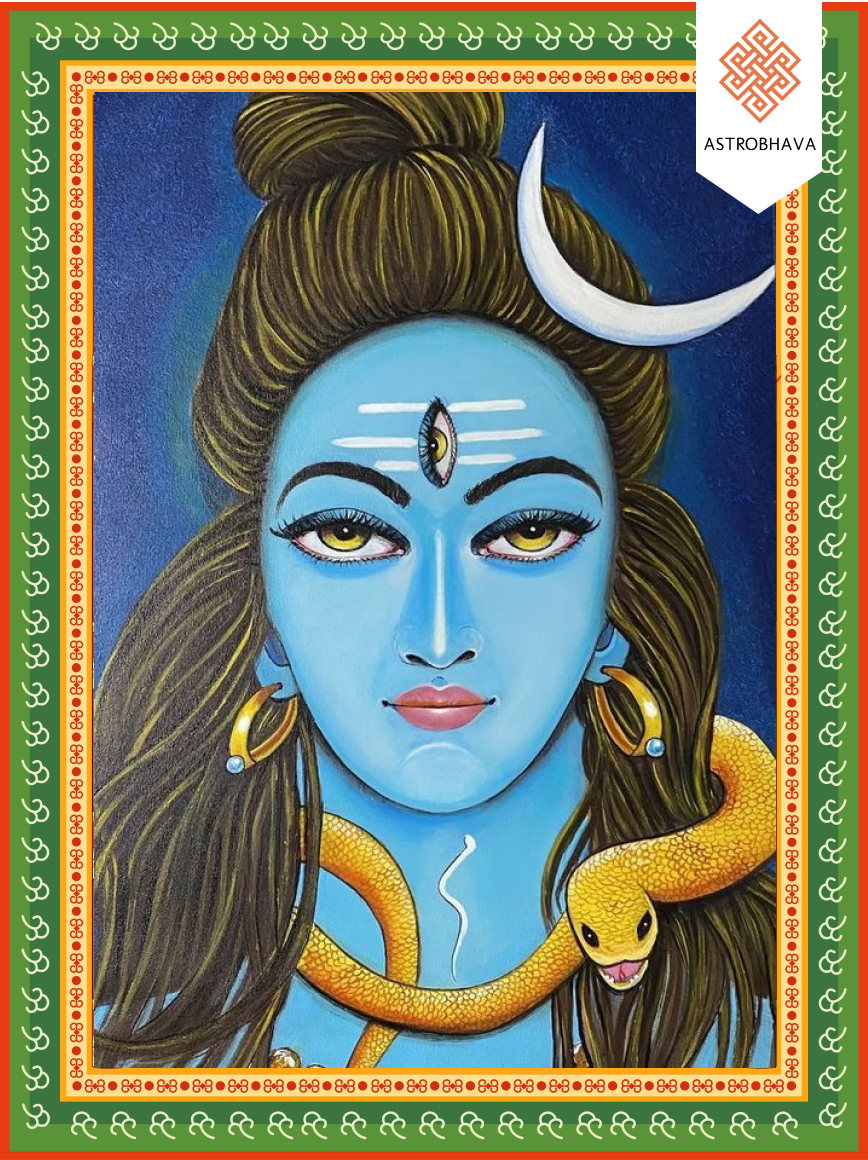
In Devanagari, Tamil, Telugu, Kannada, Malayalam and English — with the meaning of every word, and the one syllable most people pronounce wrongly.
Who Rudra Gayatri is
Rudra in the Gayatri metre is the fierce, howling aspect of the Vedic storm god who later merges with Shiva. The Rudra Gayatri does not address the pacific householder Shiva of the Puranas but the wild archer of the Yajurveda whose arrows bring both fever and healing. Tradition places this Gayatri among the secondary Gayatris that adapt the classic Savitri formula to a particular deity. Here the deity is named twice: first as Tatpurusha, the cosmic person of the Taittiriya Aranyaka, and then explicitly as Rudra. The mantra therefore stands at the junction where the abstract Purusha of the sacrificial texts meets the concrete, dread-inspiring Rudra of the forest and the mountain.
Rudra’s Arrows and the Hymn
The Shatarudriya section of the Taittiriya Samhita (4.5) and the parallel passage in the Vajasaneyi Samhita present Rudra as the archer whose thousand eyes and thousand quivers command the directions. After the gods have offended him, they propitiate him with the long litany that begins namas te rudra manyave. Within that same sacrificial milieu the Rudra Gayatri arises as a compact contemplative formula. The Brihadaranyaka and Taittiriya Aranyakas already know the pattern ‘we know X, we meditate on Y, may Z inspire us.’ When that pattern is filled with the names Tatpurusha, Mahadeva and Rudra, the resulting Gayatri inherits the atmosphere of the Shatarudriya: the deity is still the one who must be appeased, yet he is now also the inner awakener who ‘impels’ the mind. Thus the mantra carries forward the Vedic tension between terror and grace without resolving it into later bhakti sentiment.
The mantra, in six scripts
The seed mantra, and the form most devotees chant daily. No initiation is required — it is open to anyone, including a parent chanting for a child.
“We know that Supreme Person; we meditate on the Great God; may Rudra impel our (awareness).”
ॐ
oṃ — the sacred syllable
तत्पुरुषाय
tatpuruṣāya — to that Supreme Person
विद्महे
vidmahe — we know / we discern
महादेवाय
mahādevāya — on the Great God
धीमहि
dhīmahi — we meditate
तत्
tat — that
नः
naḥ — our / for us
रुद्रः
rudraḥ — Rudra
प्रचोदयात्
pracodayāt — may he impel / inspire
Aim is the mantra, in a sense. The rest is address and salutation; the seed syllable carries the goddess. Where a practitioner has been given a very short practice, it is often Aim alone.
The syllable people get wrong
In pracodayāt the retroflex ḍa is often softened to a dental da, yielding pracodayat. The correct articulation strikes the tongue tip farther back on the palate; without that retroflex the verb loses the precise phonetic shape fixed by Yajurvedic pada-patha.
When Rudra Gayatri is chanted
Weekday. Monday
Questions
Tatpurusha is the designation given to the cosmic person in the Taittiriya Aranyaka’s famous five-faced meditation on Shiva. By placing Tatpurusha in the vidmahe clause and Rudra in the pracodayāt clause, the Gayatri links the abstract sacrificial Purusha with the concrete Vedic storm god. The double naming therefore preserves two historical layers inside a single metrical unit rather than collapsing them into one later title.
No. The Rigvedic Gayatri (3.62.10) is addressed solely to Savitri. The Rudra Gayatri belongs to the class of devata-gayatris that reuse the three-line template for other deities. Its authority rests on Yajurvedic and later Smarta tradition, not on the mandala of Vishvamitra.
The Shri Rudram is a long series of namaskaras that catalogue Rudra’s manifestations and weapons. The Gayatri compresses that same deity into the contemplative triad of knowing, meditating and being impelled. One text multiplies epithets; the other interiorises the single name Rudra as the force that moves the mind.
Not sure a mantra is enough?
Have your chart read before you decide
Chanting is yours to do, and free. But which deity your situation calls for — and whether a mantra alone is the right response — depends on your chart. Sometimes it is; sometimes it is not.
Brahmashree Shivaaya
Guru, Head of Astrological & Spiritual Solutions
Over 30 years in the Guru–Sishya Parampara, from the age of five
He reads every chart himself — 60 minutes, one to one, never delegated
Charts are read only between sunrise and sunset, following tradition
Chanting is yours to do. Some things are performed for you.
Where a matter carries real weight — an examination that decides a course, a performance, a child whose studies have stalled — devotees sponsor the homa alongside their own practice. Performed individually at our Yagna Ashram in your name and gotra, on a muhurta calculated from your chart, and telecast live so you can watch it done for you.