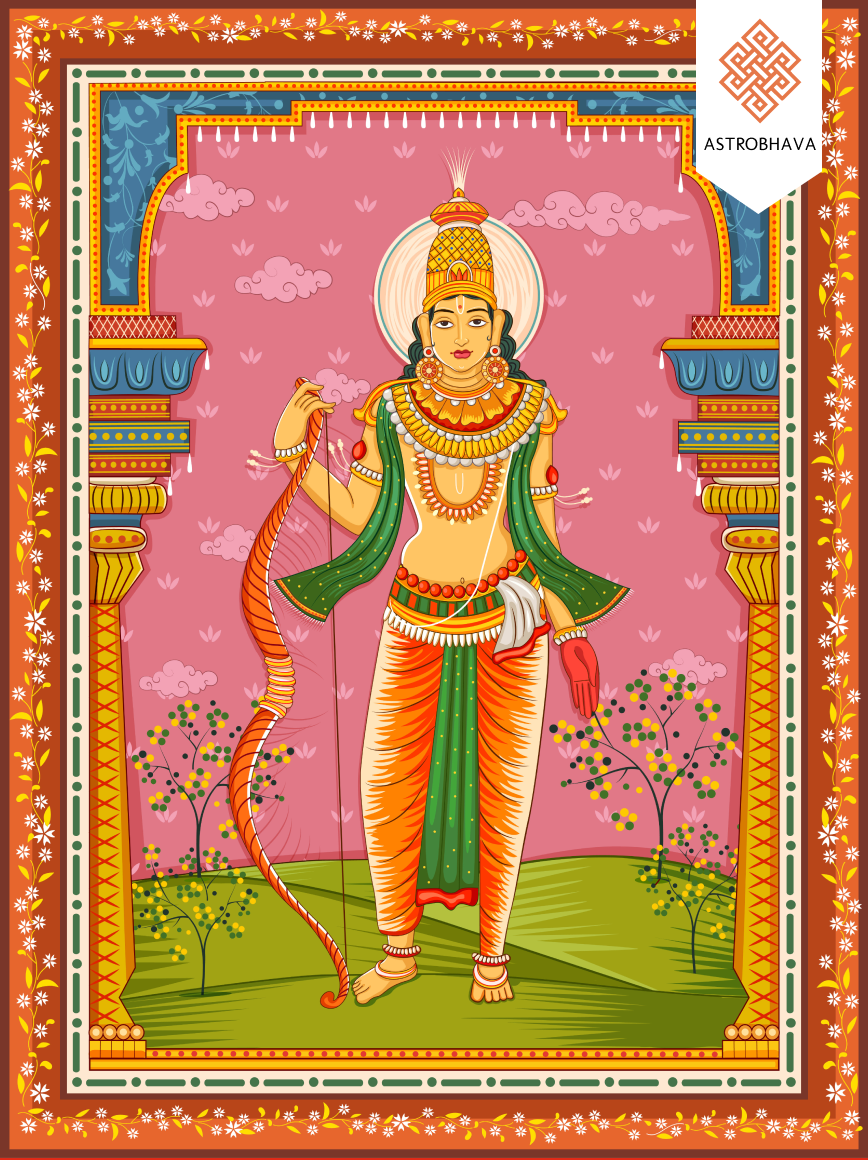
Mantra · The Taraka mantra. For dharma and steadfastness.
Rama
श्री राम जय राम जय जय राम
In Devanagari, Tamil, Telugu, Kannada, Malayalam and English — with the meaning of every word, and the one syllable most people pronounce wrongly.
Who Rama is
Rama is the seventh avatar of Vishnu, born as the eldest son of King Dasharatha of Ayodhya and queen Kausalya. He is the figure whom tradition names Maryada Purushottama, the supreme person of bounds and right conduct, whose life as told in Valmiki’s Ramayana supplies the measure of dharma in exile, in friendship, in war and in kingship. Unlike other avatars he lives an entire human lifespan under the constraints of a royal house, a forest hermitage and a final reign, never shedding the human frame until the waters of the Sarayu receive him. The Taraka mantra associated with his name is held in Smarta and Vaishnava lineages to be the name that carries the soul across the ocean of existence at the hour of departure. Temples from Ayodhya to the far south preserve his form with bow and arrow, Sita to his left, Lakshmana and Hanuman in attendance.
The Name That Ferries Across
Valmiki’s Ramayana narrates that Rama, rightful heir to the Kosala throne, accepted fourteen years of forest exile so that his father’s word to Kaikeyi might stand unbroken. Accompanied by Sita and Lakshmana he moved through Dandaka, formed alliances with the vanaras, and after Sita’s abduction by Ravana crossed to Lanka upon the bridge of stones. The war that followed ended with Ravana’s fall beneath Rama’s Brahmastra. Yet the episode that seals his identity as the Taraka is less the battle than the quiet insistence on dharma at every turn: the refusal to seize the throne by force, the protection of the sages, the grief and recovery of Sita, and the final departure into the river. Later tradition, recorded in the Padma Purana and in the Adhyatma Ramayana, holds that the utterance of his name at the threshold of death serves as the ferry across samsara, which is why the mantra itself is called Taraka.
The mantra, in six scripts
The seed mantra, and the form most devotees chant daily. No initiation is required — it is open to anyone, including a parent chanting for a child.
DevanagariSanskrit & Hindiश्री राम जय राम जय जय राम
“Glorious Rama, victory to Rama, victory victory to Rama”
श्री
śrī — glorious
राम
rāma — Rama
जय
jaya — victory
राम
rāma — Rama
जय
jaya — victory
जय
jaya — victory
राम
rāma — Rama
Aim is the mantra, in a sense. The rest is address and salutation; the seed syllable carries the goddess. Where a practitioner has been given a very short practice, it is often Aim alone.
The syllable people get wrong
The palatal ś of śrī is the snare particular to this mantra. Speakers habitually replace it with a dental s, yielding “sri rama” and losing the hushed, blade-like quality of the Sanskrit sibilant that begins the Taraka formula. The error flattens the opening into an ordinary consonant and strips the name of the precise articulation tradition requires.
When Rama is chanted
Weekday. Thursday
Festival. Rama Navami
Questions
Taraka means that which ferries across. In the Adhyatma Ramayana and in later Smriti passages, the name of Rama is described as the raft that carries the dying soul over the ocean of repeated birth. The claim is not attached to any other divine name in quite the same way; it arises from Rama’s own crossing of the ocean to Lanka and from his final walking into the Sarayu, which the tradition reads as the model of the soul’s departure. The repeated jaya in the formula is understood as the triumphant landing on the farther shore.
Valmiki shows Rama accepting exile so that Dasharatha’s promise to Kaikeyi remains intact, even though the promise itself was extracted by manipulation. He refuses to return to Ayodhya when Bharata begs him, because the fourteen years must be completed. He fights Ravana not for conquest but for the recovery of Sita and the protection of the rishis. Each decision is framed as the keeping of a boundary—maryada—rather than the pursuit of personal victory. That steady refusal to step outside the given word is what earns him the title Maryada Purushottama and what the Taraka mantra is understood to invoke.
In almost every temple image Rama stands with Sita to his left, Lakshmana slightly behind with bow ready, and Hanuman kneeling or standing in devotion. The group is not decorative; it reenacts the forest companionship and the alliance that made the crossing to Lanka possible. Without Sita the narrative of abduction and recovery disappears; without Lakshmana the unbroken fraternal loyalty vanishes; without Hanuman the bridge and the leap cannot be told. The full icon therefore carries the entire epic in stillness, and the mantra is often recited before this assembled presence.
Not sure a mantra is enough?
Have your chart read before you decide
Chanting is yours to do, and free. But which deity your situation calls for — and whether a mantra alone is the right response — depends on your chart. Sometimes it is; sometimes it is not.
Brahmashree Shivaaya
Guru, Head of Astrological & Spiritual Solutions
Over 30 years in the Guru–Sishya Parampara, from the age of five
He reads every chart himself — 60 minutes, one to one, never delegated
Charts are read only between sunrise and sunset, following tradition
Chanting is yours to do. Some things are performed for you.
Where a matter carries real weight — an examination that decides a course, a performance, a child whose studies have stalled — devotees sponsor the homa alongside their own practice. Performed individually at our Yagna Ashram in your name and gotra, on a muhurta calculated from your chart, and telecast live so you can watch it done for you.