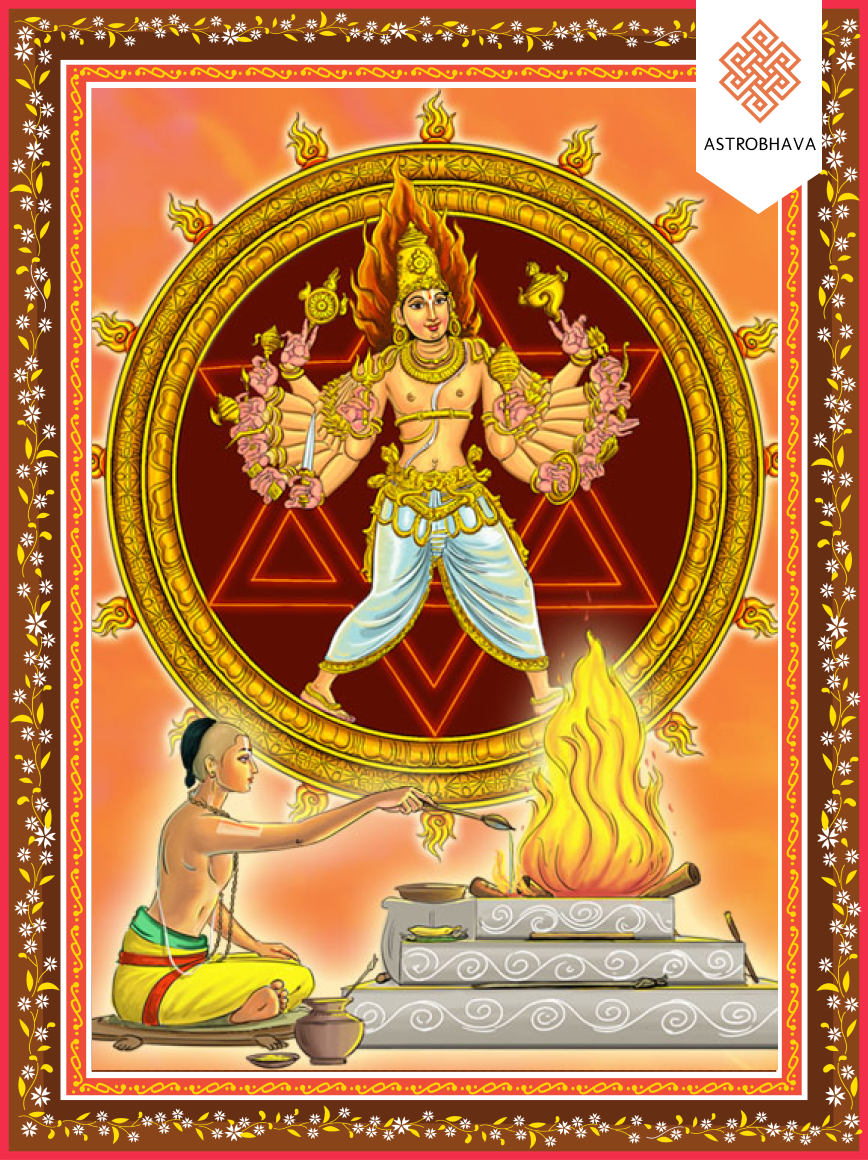
Ashtakshara — Om Namo Narayanaya, as worshipped at our temple
Mantra · The eight syllables. The central Vaishnava mantra.
Ashtakshara — Om Namo Narayanaya
ॐ नमो नारायणाय
In Devanagari, Tamil, Telugu, Kannada, Malayalam and English — with the meaning of every word, and the one syllable most people pronounce wrongly.
Who Ashtakshara — Om Namo Narayanaya is
Narayana is the deity whose name the Ashtakshara mantra carries in its eight syllables, the resting place of all beings and the one who reclines upon the waters of origin. In the Pancharatra and Vaishnava Smriti traditions he is the supreme form toward which the mantra turns, distinct from yet inclusive of the avataras. The name itself is explained as nara plus ayana: the goal and abode of humankind, or the one whose path is the waters. The Ashtakshara is therefore not a generic praise but the precise eight-syllable address that Vaishnava lineages regard as the primary means of approaching that abode. It stands at the centre of initiation, temple liturgy, and private japa within Sri Vaishnava, Madhva, and related communities, always directed to Narayana as the single refuge named by those syllables.
The Mantra Given by Narayana
The Narada Pancharatra and the Ahirbudhnya Samhita recount that the eight-syllable mantra was revealed by Narayana himself to the sage Narada when the latter sought the most direct means of reaching the Lord’s feet. In one episode Narayana, reclining on Ananta in the milky ocean, uttered the formula oṃ namo nārāyaṇāya and declared that these eight syllables contain his own presence in sonic form. The Vishnu Purana and the later Vaishnava paddhatis echo the same claim: the Ashtakshara is not composed by human authors but is the sound-body of Narayana granted to the world through the rishi tradition. Another strand, preserved in the Lakshmi Tantra, describes Lakshmi herself requesting the mantra on behalf of beings caught in samsara; Narayana then consents that the eight syllables shall serve as the bridge. Across these sources the emphasis remains constant: the mantra’s authority rests on its origin in Narayana’s own speech, and its eight-fold measure mirrors the completeness of the deity it names.
The mantra, in six scripts
The seed mantra, and the form most devotees chant daily. No initiation is required — it is open to anyone, including a parent chanting for a child.
DevanagariSanskrit & Hindiॐ नमो नारायणाय
Tamilௐ நமோ நாராயணாய
Teluguఓం నమో నారాయణాయ
Kannadaಓಂ ನಮೋ ನಾರಾಯಣಾಯ
Malayalamഓം നമോ നാരായണായ
EnglishRoman transliterationoṃ namo nārāyaṇāya
“Om. Homage to Narayana.”
ॐ
oṃ — the sacred syllable
नमो
namo — homage
नारायणाय
nārāyaṇāya — to Narayana
Aim is the mantra, in a sense. The rest is address and salutation; the seed syllable carries the goddess. Where a practitioner has been given a very short practice, it is often Aim alone.
The syllable people get wrong
The long ā in the second syllable of nārāyaṇāya is frequently shortened by speakers who treat the name like the everyday Hindi “Narayan.” That shortening collapses the first long vowel and blurs the classical shape. Both ā sounds—after n and after y—must be held fully; the deity’s name in the mantra is nārāyaṇa, not a clipped modern form.
When Ashtakshara — Om Namo Narayanaya is chanted
Weekday. Thursday
Questions
Ashtakshara means “of eight syllables.” The traditional count is na-mo nā-rā-ya-ṇā-ya, eight units, with the initial oṃ regarded as the pranava that stands above or with the eight. Vaishnava texts consistently refer to it by this numerical name to distinguish it from other Narayana formulas of different length.
They treat the eight syllables as the sound-form of Narayana himself. The mantra is not an external petition but the deity’s own presence made audible; therefore initiation into the Ashtakshara is understood as reception of Narayana in the form of sacred sound.
Classical etymologies gloss it as the abode or resting place of nara, humankind, or as the one whose ayana, path, is the primordial waters. Within the Ashtakshara the name therefore points to the supreme refuge toward which the homage of namas is directed.
Not sure a mantra is enough?
Have your chart read before you decide
Chanting is yours to do, and free. But which deity your situation calls for — and whether a mantra alone is the right response — depends on your chart. Sometimes it is; sometimes it is not.
Brahmashree Shivaaya
Guru, Head of Astrological & Spiritual Solutions
Over 30 years in the Guru–Sishya Parampara, from the age of five
He reads every chart himself — 60 minutes, one to one, never delegated
Charts are read only between sunrise and sunset, following tradition
Chanting is yours to do. Some things are performed for you.
Where a matter carries real weight — an examination that decides a course, a performance, a child whose studies have stalled — devotees sponsor the homa alongside their own practice. Performed individually at our Yagna Ashram in your name and gotra, on a muhurta calculated from your chart, and telecast live so you can watch it done for you.