Mantra · Krishna as Rajagopala. For love and family harmony.
Rajagopala
ॐ श्रीराजागोपालाय नमः
In Devanagari, Tamil, Telugu, Kannada, Malayalam and English — with the meaning of every word, and the one syllable most people pronounce wrongly.
Who Rajagopala is
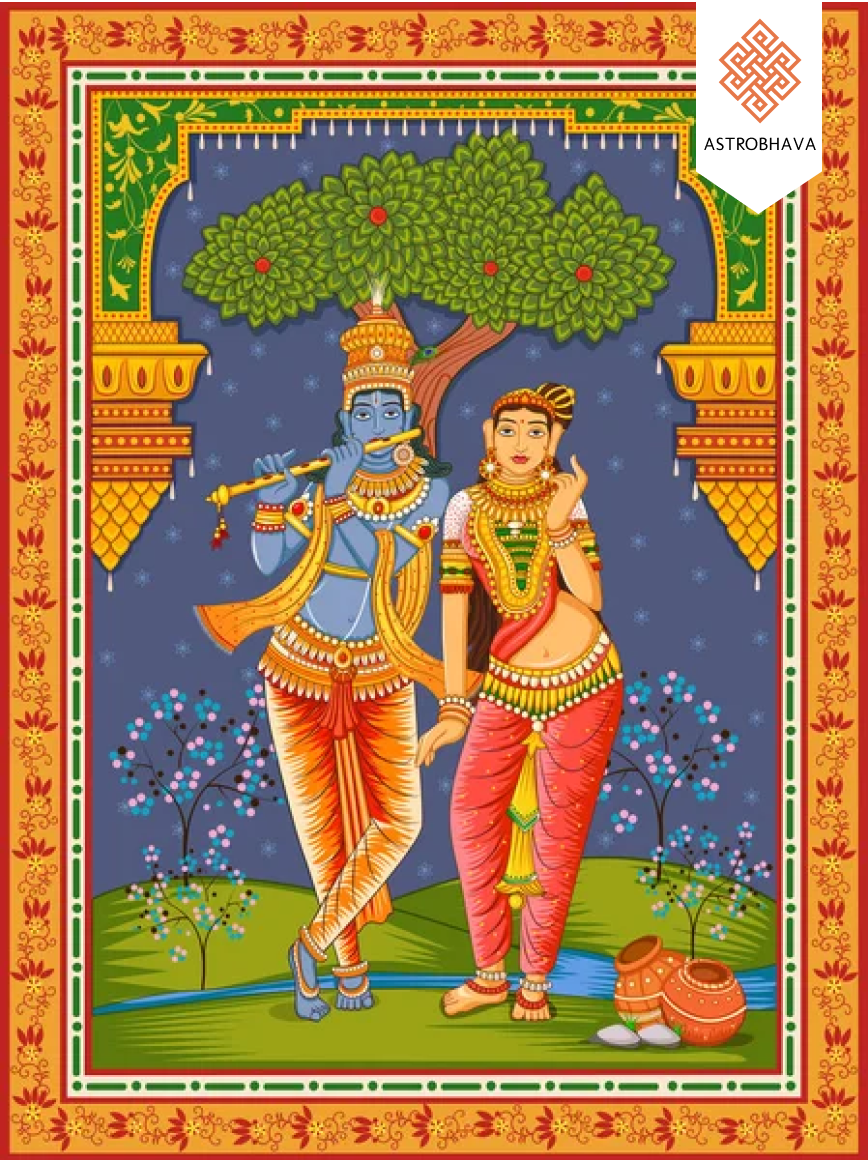
Rajagopala is Krishna beheld as the royal cowherd, the figure in whom the intimate pastoral sweetness of Gopala meets the sovereign dignity of a king. The conception is native to the Tamil Vaishnava landscape and finds its clearest embodiment in the temple of Sri Vidya Rajagopalaswamy at Mannargudi, where the deity is also called Rajamannar. There he stands as the youthful lord who holds the shepherd’s staff yet wears the bearing of rightful rule, flanked by his consorts Rukmini and Satyabhama or by the local goddesses of the shrine. Theologically the name joins rāja—the principle of generous protection and ordered kingship—with gopāla, the guardian of cows and of the cowherd community. Devotees who turn to this form contemplate the Krishna of the Vrindavan lilas without relinquishing the majesty that later belongs to Mathura and Dvaraka. The iconography favours a dark-hued, gracefully poised figure, often in tribhanga, adorned with garlands and the peacock feather, the eyes holding both playfulness and calm authority.
Govardhana and the cowherd king
The Bhagavata Purana, tenth skandha, recounts the lifting of Mount Govardhana, the episode in which the cowherd boy discloses a sovereignty that needs no earthly throne. When Indra, offended by the diversion of a sacrifice, unleashed torrential rain upon Vraja, Krishna held aloft the entire mountain for seven days and nights, sheltering cattle, cowherds and elders beneath it. The act is pastoral in setting yet royal in implication: the same youth who had been content to graze calves becomes the sole refuge of his people, receiving afterwards the title Govinda and the recognition of the celestial beings. Later South Indian tradition reads this moment as the scriptural seed of the Rajagopala conception—the cowherd who is already king because he alone can protect. The Mannargudi sthala purana elaborates the theme by narrating how the Lord took up residence in the fertile lands of the Cauvery delta as the enduring guardian of that countryside, retaining the crook of the gopa while accepting the honours due to a reigning sovereign. Thus the Puranic lila and the local legend converge upon a single figure.
The mantra, in six scripts
The seed mantra, and the form most devotees chant daily. No initiation is required — it is open to anyone, including a parent chanting for a child.
Aim is the mantra, in a sense. The rest is address and salutation; the seed syllable carries the goddess. Where a practitioner has been given a very short practice, it is often Aim alone.
The syllable people get wrong
The long ā that closes the second member of rājagopālāya must be held fully; speakers commonly shorten it to a mid-length a, producing “rajagopala” with flattened vowels and erasing the open, resonant ending that marks the dative of the royal name.
When Rajagopala is chanted
Weekday. Thursday
Festival. Panguni Brahmotsavam at Mannargudi
Questions
It unites rāja, the notion of rightful and protective kingship, with gopāla, the cowherd who guards cattle and the pastoral community, so that the one figure holds both intimate tenderness and sovereign authority.
The temple of Sri Vidya Rajagopalaswamy at Mannargudi is the principal seat of this specific conception; there the deity is enshrined and celebrated as Rajamannar, and the local sthala purana elaborates his residence as the enduring guardian of that landscape.
In that lila the cowherd boy becomes the sole shelter of his people, an act of protection that later tradition reads as the disclosure of a kingship already present within the pastoral form, thereby grounding the title Rajagopala.
Not sure a mantra is enough?
Have your chart read before you decide
Chanting is yours to do, and free. But which deity your situation calls for — and whether a mantra alone is the right response — depends on your chart. Sometimes it is; sometimes it is not.
Brahmashree Shivaaya
Guru, Head of Astrological & Spiritual Solutions
Over 30 years in the Guru–Sishya Parampara, from the age of five
He reads every chart himself — 60 minutes, one to one, never delegated
Charts are read only between sunrise and sunset, following tradition
Chanting is yours to do. Some things are performed for you.
Where a matter carries real weight — an examination that decides a course, a performance, a child whose studies have stalled — devotees sponsor the homa alongside their own practice. Performed individually at our Yagna Ashram in your name and gotra, on a muhurta calculated from your chart, and telecast live so you can watch it done for you.