In Devanagari, Tamil, Telugu, Kannada, Malayalam and English — with the meaning of every word, and the one syllable most people pronounce wrongly.
Who Rahu is
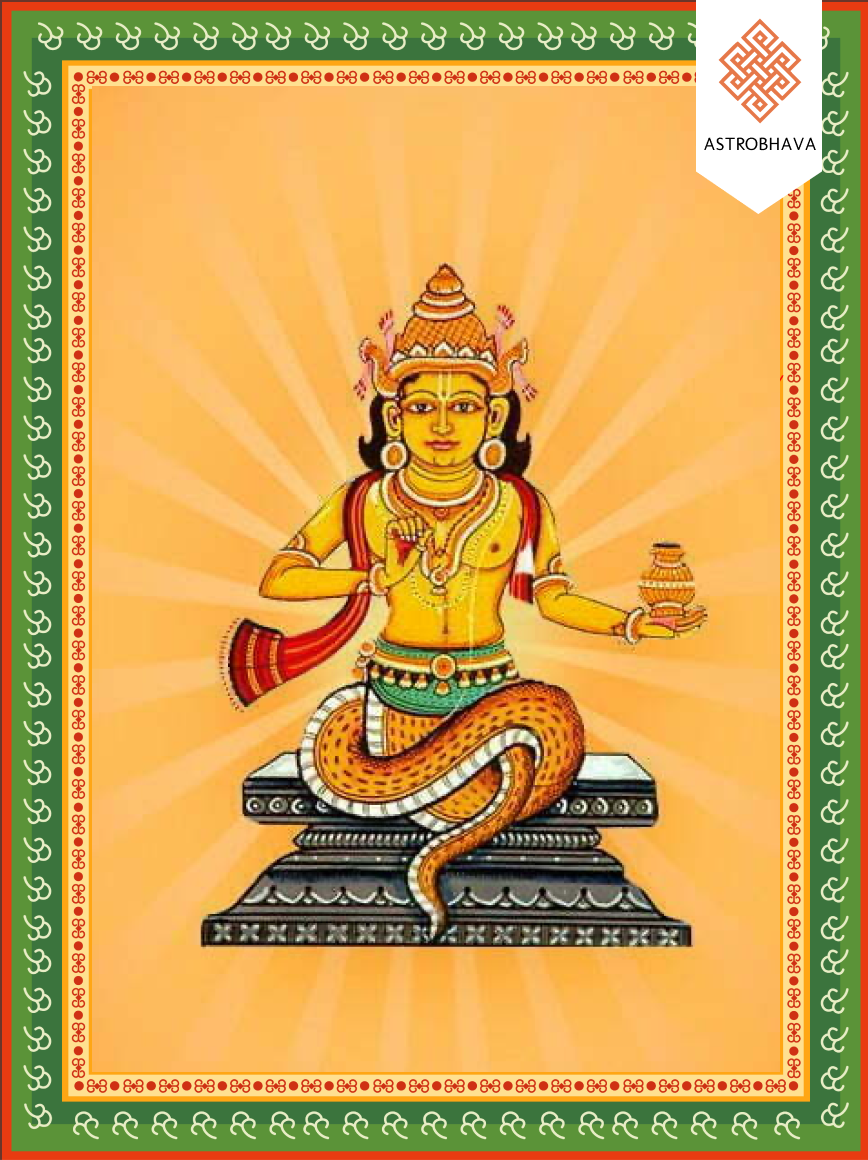
Rahu is the ascending lunar node, counted among the nine grahas yet without a physical body of his own. Puranic astronomy knows him as the immortal head of the daitya who once seized a share of amṛta. Jyotiṣa assigns him the northward crossing of the Moon’s path, the direction of sudden inversion, and the significations of smoke, eclipse, foreign connection, and the hunger that outlasts form. Iconographic manuals give him a serpentine lower half or simply a severed head with wide mouth and living eyes, mounted on a lion or a chariot of eight horses. He is neither fully deva nor fully asura after the beheading, and that liminal status is the core of his identity among the planetary deities.
The Severed Head at the Churning
The Bhāgavata Purāṇa (Canto 8) and the Viṣṇu Purāṇa recount the churning of the ocean of milk. When the amṛta at last rose and was being served to the gods by Mohinī, the daitya Svarbhānu disguised himself and took a place between the Sun and the Moon. He tasted the nectar; at that instant Sūrya and Candra recognised the intruder and alerted Viṣṇu. The discus flashed, severing Svarbhānu’s head before the amṛta could pass his throat. Because the drop had touched his tongue, the head became immortal and was thereafter known as Rahu, while the trunk became Ketu. Ever afterward Rahu pursues the Sun and the Moon across the sky, and when he overtakes them the eclipse occurs. The same texts note that Rahu’s body ends at the neck; all that remains is appetite and the memory of the stolen sip. This single episode supplies the entire mythic identity of the graha: the head that cannot die, the eternal chase, and the darkening of the luminaries.
The mantra, in six scripts
The seed mantra, and the form most devotees chant daily. No initiation is required — it is open to anyone, including a parent chanting for a child.
“Salutation to Rahu, joined with the seed-syllables bhrāṃ, bhrīṃ, bhrauṃ and saḥ.”
ॐ
oṃ — the sacred syllable
भ्रां
bhrāṃ — seed-syllable bhrāṃ
भ्रीं
bhrīṃ — seed-syllable bhrīṃ
भ्रौं
bhrauṃ — seed-syllable bhrauṃ
सः
saḥ — seed-syllable saḥ
राहवे
rāhave — to Rahu
नमः
namaḥ — salutation
Aim is the mantra, in a sense. The rest is address and salutation; the seed syllable carries the goddess. Where a practitioner has been given a very short practice, it is often Aim alone.
The syllable people get wrong
In rāhave the medial ha is a voiced glottal aspirate that speakers frequently drop altogether, allowing the long ā to slide directly into ve and producing the collapsed ‘rā-ve’. The h must be released as a distinct breathy pulse between the ā and the final syllable.
Questions
In the churning narrative the discus of Viṣṇu struck Svarbhānu after the amṛta had wet his tongue but before it reached the rest of the body. The head, having tasted immortality, continued to live; the trunk, later called Ketu, was separated. All later iconography and planetary lore therefore treat Rahu as the disembodied head that still hungers.
Because the Sun and Moon exposed the disguised daitya, Rahu is said to pursue them without rest. When his path crosses theirs, the texts speak of him swallowing the luminary for a time. The astronomical nodes mark those crossing points, so the myth and the calculation coincide in the figure of Rahu.
Rahu possesses no orb of his own and is calculated solely as the ascending node. Classical works therefore call him a chāyā-graha, a shadow planet, and read his placements for inversion, foreign or unconventional currents, and the amplification of whatever he contacts, rather than for the steady traits assigned to the embodied planets.
Not sure a mantra is enough?
Have your chart read before you decide
Chanting is yours to do, and free. But which deity your situation calls for — and whether a mantra alone is the right response — depends on your chart. Sometimes it is; sometimes it is not.
Brahmashree Shivaaya
Guru, Head of Astrological & Spiritual Solutions
Over 30 years in the Guru–Sishya Parampara, from the age of five
He reads every chart himself — 60 minutes, one to one, never delegated
Charts are read only between sunrise and sunset, following tradition
Chanting is yours to do. Some things are performed for you.
Where a matter carries real weight — an examination that decides a course, a performance, a child whose studies have stalled — devotees sponsor the homa alongside their own practice. Performed individually at our Yagna Ashram in your name and gotra, on a muhurta calculated from your chart, and telecast live so you can watch it done for you.