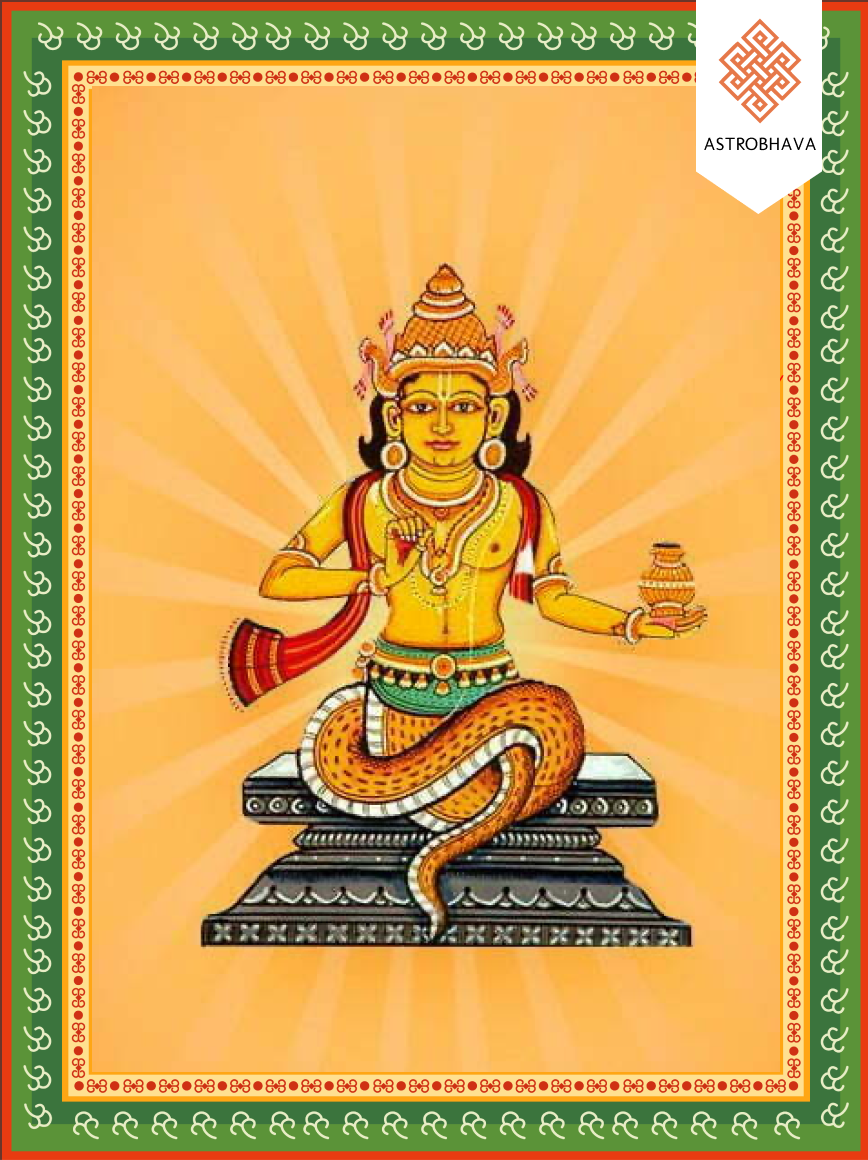
Rahu is the shadow graha, the head without a body, endlessly hungry and endlessly restless. When Rahu sits afflicted in your chart, or when his dasha or bhukti turns, life can feel strangely out of focus — decisions that will not settle, fears with no name, delays with no visible cause, people and situations that appear and vanish. The Rahu Homa is the classical Vedic response. Fire is kindled, Rahu is invoked by name, and the prescribed offerings are given so that the shadow is honoured rather than resisted.
The Rahu Homam is not an attempt to remove Rahu. Rahu is a karaka of ambition, foreign lands, research, technology and sudden rise — the tradition asks that his force be steadied, not silenced. Priests at AstroBhava's Yagna Ashram perform the rite on your behalf with your name, gotra and nakshatra spoken into the sankalpa, whether you are booking as a family, for a child, or as part of a longer Rahu ki puja observance. You watch the flames live from wherever you are.
ॐ भ्रां भ्रीं भ्रौं सः राहवे नमः Salutations to Rahu — may the shadow planet be pacified and turn his force to my good.
Why Devotees Book This
Devotees turn to the Rahu Homa when Rahu is prominent, afflicted, or running in dasha. These are the purposes the tradition assigns to the rite.
Pacifying an afflicted Rahu
Offered when Rahu is debilitated, combust, or placed in a difficult house — the rite is prescribed to settle his agitation.
Through Rahu dasha and bhukti
The eighteen-year Rahu mahadasha and its sub-periods are traditionally marked with this homa at their beginning and at difficult turns.
For Rahu-Ketu dosha in the chart
Where the shadow axis binds the chart — kala sarpa patterns, Rahu-Ketu affliction to the lagna or Moon — the homa is the classical remedy prescribed alongside a Rahu-Ketu dosh reading.
Clarity over confusion
Rahu is said to cast illusion. The rite is offered for steadiness of mind, clean judgement, and freedom from the fog of indecision.
Strengthening Rahu's benefic side
Rahu governs foreign travel, research, technology and unconventional paths. The homa asks that these significations open rather than obstruct.
Removing unnamed obstruction
For delays with no clear reason, agreements that dissolve, and repeated near-misses — the offerings are made so the path clears.
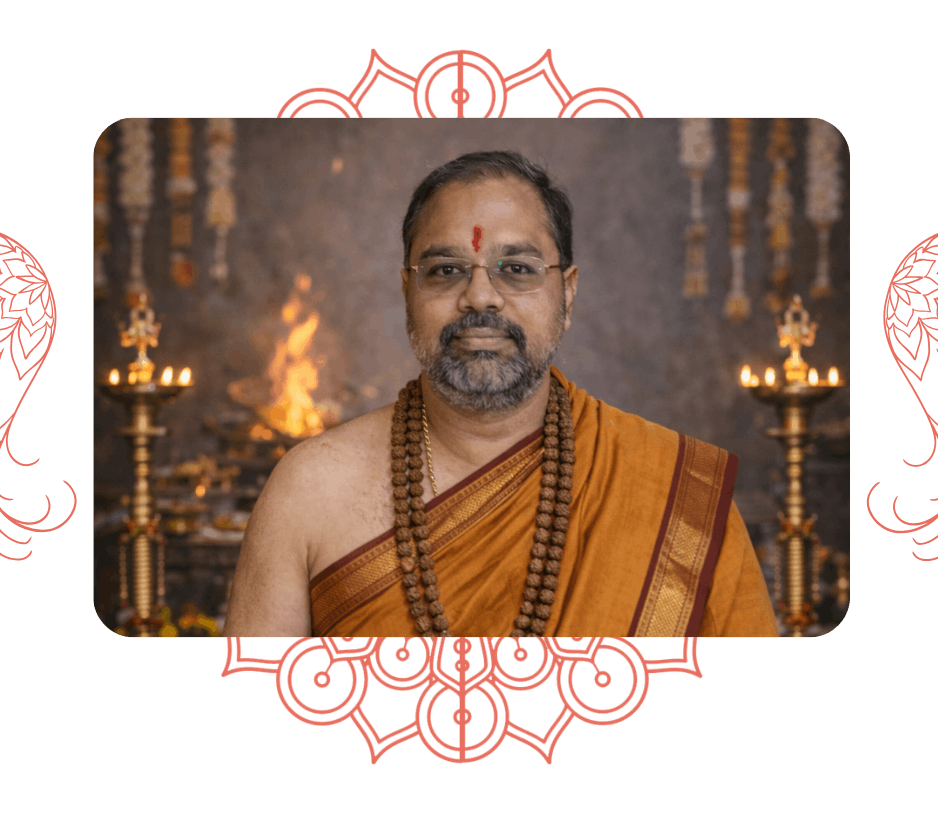
Brahmashree ShivaayaGuru, Head of Astrological & Spiritual Solutions
Who performs your homa
Under the guidance of Brahmashree Shivaaya
Every priest who performs your Rahu Homa is trained in a traditional Padashala and personally recruited by Brahmashree Shivaaya — Guru and Head of Astrological & Spiritual Solutions at AstroBhava. Your ritual is conducted at our own Yagna Ashram — never a rented venue — with temple rites performed across our seven temples in Tamil Nadu and Kerala.
Step 2 Enhance with the 48-Day Anushthan? (optional)
* Copper yantra plate approx. 1–2 inches, rolled and sealed inside a silver amulet approx. 2–4 inches. Sizes are approximate and the amulet's design varies between supplier batches — shape, metal and consecration remain the same.
Your packageTrayi Rahu Homa3 Priests + Free Yantra
—
All prices are all-inclusive — no shipping charges, no additions at checkout. See everything included →
1
You book — and send birth details at checkout.
2
Within 24–48 working hours — your muhurta is confirmed by email.
3
The day before — your telecast link arrives by email.
4
After the homa — tracking email with your personal time to wear the yantra.
Sacred Timing
Rahu answers to particular hours and days. Our priests fix the muhurat for your homa from these windows.
Saturday and Rahu Kaalam
Saturday is Rahu's day in South Indian practice, and the daily Rahu Kaalam window is the classical hour for his worship.
Ardra, Swati and Shatabhisha
The three nakshatras ruled by Rahu. A homa performed on these stars is held to reach him most directly.
Amavasya and eclipse days
The new moon, and solar or lunar eclipses, belong to the shadow grahas. These are strong days for Rahu ki puja.
At the turn of a Rahu period
The start of a Rahu mahadasha, antardasha, or a Rahu transit over your Moon or lagna — the tradition asks for the fire at these thresholds.
Every package, and the 48-day option
What you receive
The sealing of the yantra
When your homa concludes, the yantra that stood in the fire is rolled and locked inside its silver amulet according to Agama vidhi — the practice by which the energies raised in a ritual are held within a consecrated object rather than dispersing. It is why a homa performed at our ashram can still reach a devotee ten thousand miles away: what the fire raised travels to you, sealed.
Personal sankalpa
Your name, gotra & nakshatra — for you and up to five family members.
Live telecast
Watch your own homa in real time from the ashram. Streamed openly on our YouTube channel by default — or request a private, unlisted telecast at checkout.
Free energised Rahu Yantra, sealed in a silver amulet
Consecrated over three days — Jala (holy-water consecration with mantras), Prana (life force through pranayama & chants) and Jeeva Pratishta (awakened with 108 recitations & offerings) — then present through your homa, receiving the energies raised in the fire. Immediately afterwards it is rolled and sealed inside a silver amulet by Agamic rite, locking those energies within, and shipped to you with your prasadam.
Prasadam, shipped free
Sacred vibhuti, sandalwood powder & kumkum from your fire — delivered to any country.
48-Day Anushthan (optional)
Daily temple worship for 48 days — the 27 Nakshatras + 12 Rashis + 9 Planets — then sealed in a silver amulet of approximately 2–4 inches.
A note on sacred tradition
As per strict Agama vidhi, no videography is permitted inside the temple sanctum — this preserves the pure sacred energies and undisturbed divine focus of the ritual. The main homa is respectfully telecast live from outside the sanctum; the daily rituals of the 48-day Anushthan are performed with full devotion but are not telecast.
Homas are telecast openly on our YouTube channel so that devotees everywhere may witness the rituals — and because we believe you should be able to see our work before you trust us with yours. Your sankalpa names you and your family, so if you would rather your ceremony were not public, choose the private telecast option at checkout and it is streamed as an unlisted link visible only to you.
We state this plainly — transparency about what tradition forbids filming, and about what is public, is part of performing these rituals honestly.
After it arrives
How to wear your energised Rahu Yantra
The energised yantra is carefully rolled and sealed inside a sacred silver amulet before shipping. Wearing it is itself a small ritual — and even its timing is set for you personally.
01
Your auspicious time to wear it
Our astrologer marks the auspicious date and time to wear the yantra according to your birth details — sent to you in the email carrying your shipment's tracking number.
02
Purify the amulet
Dip the silver amulet in raw milk or Ganga jal for an hour before wearing, then clean with normal water.
03
Face East or North
Perform the wearing process facing east or north for maximum benefit.
04
Offer dheep & dhoop
Show lamp and incense to the amulet before wearing it.
05
Wear it
Around your neck or waist, on a thread or chain.
06
Keep the energy intact
Repeated offering of dheep and dhoop keeps the energisation alive.
07
If you prefer not to wear it
Place the amulet at your puja altar, or keep it in your wallet.
Inside the fire ritual
How your Rahu Homa is performed
01
Sankalpa
The priest states your name, gotra and nakshatra — and those of up to five family members — with the intention this homa is performed for.
02
Ganapati Puja
The customary invocation to Ganapati, clearing obstacles before the goddess is approached.
03
Agni Pratishtha
The fire is consecrated in the homa kunda and Agni invoked as the carrier of every offering that follows.
04
Rahu Avahana
The Rahu Sukta and Rahu Gayatri are chanted, inviting the goddess's presence into the fire — by one, three or five priests as your package sets.
05
Ahuti
Ghee, white flowers, akshata and honey are offered in sequence with mantra — the offerings traditional to her worship.
06
Purnahuti
The final complete offering seals the sankalpa stated at the opening.
07
Aarti & Dispatch
Aarti is performed live on your telecast. Vibhuti, sandalwood powder, kumkum and your energised yantra are then packed and shipped free to your door.
Who is invoked
Rahu — the goddess of knowledge itself
Rahu is one of the Tridevi and the mother of the Vedas — the presiding deity of knowledge, learning, memory, speech, music and every art. She is depicted in white upon a white lotus, holding the veena, a book, a rosary and a water pot, with the swan of discernment beside her.
In this homa, her grace — Rahu Kataksham — is invoked through fire with your own name and birth details spoken in the sankalpa.
Sarathi, our free AI ritual guide, recommends the traditional ritual for your situation instantly. For a full reading of your chart, book a live session with our astrologers — the fee is fully credited when you book any ritual.
The tradition prescribes three things together: the Rahu mantra chanted with count, charity in Rahu's significations, and the Rahu Homa. Fire worship is considered the most direct of the three because the offerings are given to the graha himself through Agni. Alongside it, priests commonly advise Durga upasana, feeding the needy on Saturdays, and honesty in dealings — Rahu is said to trouble crooked paths most.
Classical texts favour Rahu in the 3rd, 6th and 11th — the upachaya houses, where he is said to grow stronger with time and support courage, victory over rivals, and gains. The 10th is also read well for career ambition. Placement is only one factor; the sign, aspects, and dasha sequence matter as much, which is why a chart reading is advised before choosing a remedy.
Rahu is said to amplify whatever he touches and to obscure it at the same time. He brings sudden rise and sudden fall, foreign connections, obsession with a goal, restlessness at night, and confusion in judgement. Where he is well placed he grants unconventional success. Where afflicted, the tradition speaks of delays, anxiety, misunderstandings and matters that never quite conclude.
Rahu is calmed by acknowledgement rather than resistance. The Rahu Homa, performed on a Saturday or during Rahu Kaalam with the prescribed offerings, is the classical method. Devotees also chant the Rahu beeja mantra in counts of eighteen, keep a disciplined routine, and give in charity — sesame, black cloth, and food. Regularity matters more than quantity.
Begin with the homa to pacify the graha, then hold a steady practice. Chant the Rahu mantra daily, worship Durga or Bhairava as your family tradition directs, and keep to clear, honest commitments. Many devotees also wear an energised Rahu yantra — one is couriered to you after your homa. The tradition frames this as steady cultivation, not a single fix.
Rahu's results shift with his sign, his house, the planets aspecting him, and whether his dasha is running. Conjunction with the Moon is read as mental unrest; with the Sun, as pressure on authority and the father; with a benefic in a good house, as sudden gain. Eclipses and transits over sensitive points also intensify what he is already doing in your chart.
The 3rd, 6th and 11th houses are the ones classical astrology reads as favourable for Rahu, with the 10th also considered supportive for ambition and public standing. Even in these houses, his effects depend on the sign and the aspects he receives — so the homa is prescribed by chart, not by house alone.
The beeja mantra is ॐ भ्रां भ्रीं भ्रौं सः राहवे नमः — Om Bhraam Bhreem Bhroum Sah Rahave Namah. In Tamil: ஓம் பிராம் பிரீம் பிரௌம் ஸ: ராஹவே நம:. In Hindi it is written as ॐ भ्रां भ्रीं भ्रौं सः राहवे नमः. It means salutations to Rahu, with the prayer that the shadow planet be pacified. The traditional count is eighteen thousand, chanted in multiples of eighteen. The Vedic Rahu Gayatri is also recited during the homa by the priests.
The Rahu Homa is a fire ritual in which Rahu, the shadow graha, is invoked by his Vedic and beeja mantras and offered the prescribed dravyas through Agni. Its significance lies in addressing an affliction at its root — the graha himself — rather than only its symptoms. It is prescribed during Rahu dasha, for Rahu-Ketu dosha, and where Rahu afflicts the lagna, Moon or a key house in the chart.
Among the rahu homa benefits the tradition names: pacification of an afflicted Rahu, relief through Rahu dasha and bhukti, remedy for Rahu-Ketu dosha, clarity where there was confusion, and the opening of Rahu's benefic significations — foreign opportunity, research, technology, and unconventional gain. The rite is offered as prayer. No outcome is promised.
Anyone with Rahu prominent or afflicted in their chart — those running Rahu mahadasha or antardasha, those told they have Rahu-Ketu or kala sarpa dosha, those with Rahu conjunct the Moon or lagna, and those born under Ardra, Swati or Shatabhisha who wish to honour their ruling graha. Families also book it for a member abroad. You do not perform it yourself; our priests perform it on your behalf, with your sankalpa spoken aloud.
Saturday, and the Rahu Kaalam window of the day, are the classical choices. The nakshatras Ardra, Swati and Shatabhisha are strongly favoured, as are Amavasya and eclipse days. The turn of a Rahu dasha or a Rahu transit over your Moon is also a traditional moment. Our priests select the muhurat from your birth details and confirm the date with you before the fire is lit.
The priests begin with achamana, Ganapati puja and punyahavachana, then the sankalpa in your name, gotra and nakshatra. Rahu is invoked into the kalasha and the kunda, the fire is kindled, and the Rahu Gayatri and beeja mantra are offered with ahutis. The samagri follows Rahu's prescriptions — durva grass as his samidha, black sesame, urad dal, coconut, ghee and the navagraha dravyas. The rite closes with purnahuti, aarti and prayers for peace. In some South Indian lineages this is offered as part of a fuller rahu homam pillai observance with the Ganapati preliminary given its own weight.
Book from this page, from any country. Send your name, gotra if you know it, and birth details. Our priests fix an auspicious muhurat and confirm the date. The homa is performed at our Yagna Ashram in Coimbatore and telecast live to you — you watch from home. Afterwards, prasadam from the fire and an energised Rahu yantra are couriered to your address anywhere in the world, free of shipping cost.