In Devanagari, Tamil, Telugu, Kannada, Malayalam and English — with the meaning of every word, and the one syllable most people pronounce wrongly.
Who Purusha Suktam is
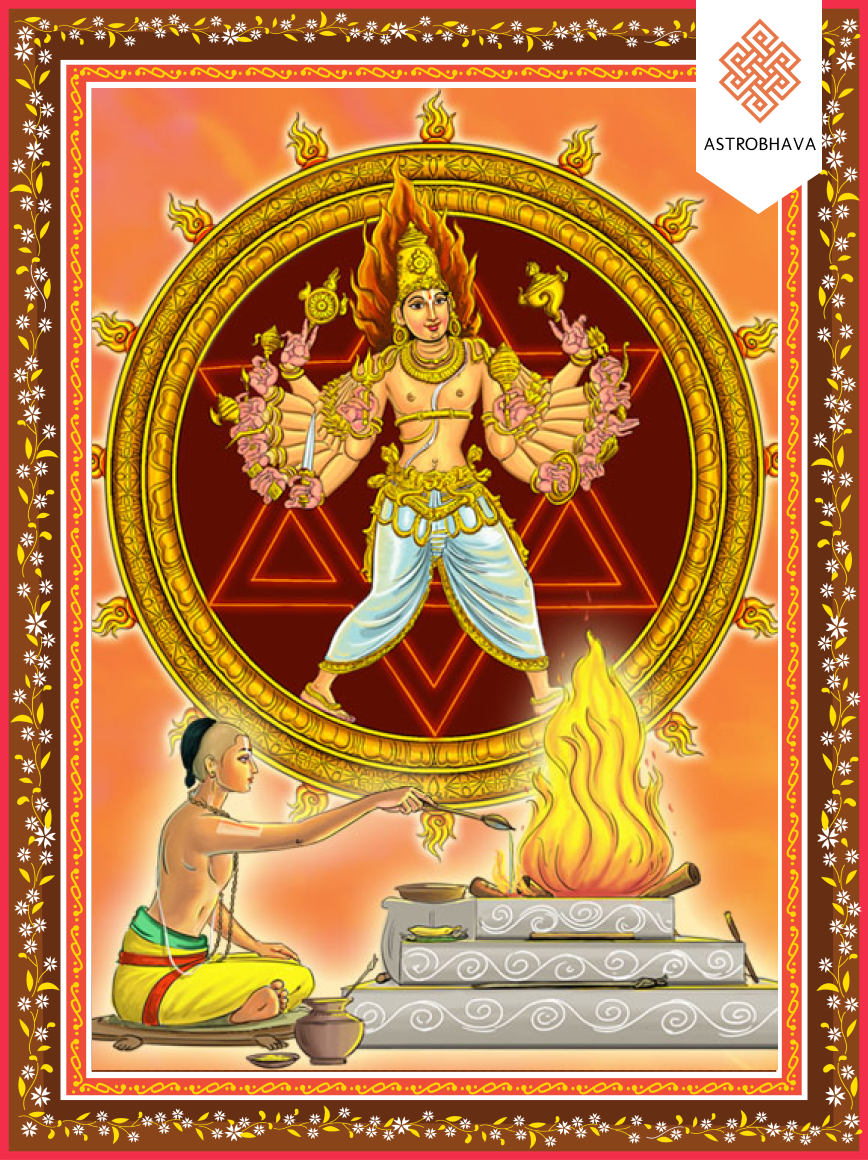
Purusha is the cosmic person of Rigveda 10.90, the being whose body is the universe and whose sacrifice generates all realms, creatures and social orders. He is described as having a thousand heads, a thousand eyes and a thousand feet, pervading the earth on every side yet extending beyond it by the measure of ten fingers. From his mouth, arms, thighs and feet arise the four varnas; from his mind the moon, from his eye the sun, from his breath the wind. Later Vedantic and Puranic reading identifies this Purusha with the supreme self that remains after all names and forms are withdrawn. The hymn is not addressed to a temple image or a mythic hero but to that primordial person whose dismemberment is the continual act of creation itself.
The Primordial Sacrifice
Rigveda 10.90, the Purusha Sukta, presents the origin of the ordered world as a sacrificial offering in which the gods, the sadhyas and the rishis bind Purusha as the victim. Spring serves as the sacrificial butter, summer as the fuel, autumn as the oblation. When they divide him, the verses say, three-quarters of his being rise upward as the immortal realm while one-quarter remains here as all living and non-living things. From that remaining quarter the hymn derives horses, cattle, goats, sheep, the verses of the Veda, the metres, and the four human estates. The Taittiriya Aranyaka and later Smriti literature re-present the same account as the archetype of every yajna: each offering re-enacts the original division of the cosmic person. The sukta therefore stands both as cosmology and as the charter for ritual itself, locating every subsequent sacrifice inside the body of Purusha.
The mantra, in six scripts
The seed mantra, and the form most devotees chant daily. No initiation is required — it is open to anyone, including a parent chanting for a child.
“The Purusha of a thousand heads, a thousand eyes and a thousand feet.”
सहस्रशीर्षा
sahasraśīrṣā — thousand-headed
पुरुषः
puruṣaḥ — the cosmic person
सहस्राक्षः
sahasrākṣaḥ — thousand-eyed
सहस्रपात्
sahasrapāt — thousand-footed
Aim is the mantra, in a sense. The rest is address and salutation; the seed syllable carries the goddess. Where a practitioner has been given a very short practice, it is often Aim alone.
The syllable people get wrong
In sahasraśīrṣā the syllable śīr contains a long ī followed at once by the retroflex ṣ. Speakers commonly shorten the vowel and dentalise the sibilant, producing a flat “shir-sha.” Both the length of ī and the tongue-curl of ṣ must be retained if the Vedic contour of the opening word is to remain intact.
When Purusha Suktam is chanted
Weekday. Thursday
Questions
Within the Rigveda the Purusha is an independent cosmological principle. Later layers—especially the Taittiriya Aranyaka, the Mahabharata and the Puranas—explicitly equate him with Narayana or Vishnu, reading the thousand-headed person as the same being who reclines upon the waters. The sukta itself does not name Vishnu; the identification is a subsequent theological development that allows the hymn to be recited inside Vaishnava worship.
The verse states that three parts of the cosmic person ascend beyond the mortal sphere while one part becomes the totality of earthly existence. Classical commentators understand this as the distinction between the unmanifest, imperishable aspect of the self and the manifest universe that can be measured, named and sacrificed. The ten fingers’ breadth by which he exceeds the world marks the margin that ritual and knowledge continually seek to cross.
It is recited at the conclusion of the purusha-medha and in certain agnishtoma sequences, and it appears among the hymns employed for the consecration of sacred ground. Its presence in the Taittiriya Aranyaka also places it inside the daily and fortnightly recitations of the Krishna Yajurveda schools, where it functions as both cosmogonic narrative and as an affirmation of the identity between the sacrificer and the cosmic person.
Not sure a mantra is enough?
Have your chart read before you decide
Chanting is yours to do, and free. But which deity your situation calls for — and whether a mantra alone is the right response — depends on your chart. Sometimes it is; sometimes it is not.
Brahmashree Shivaaya
Guru, Head of Astrological & Spiritual Solutions
Over 30 years in the Guru–Sishya Parampara, from the age of five
He reads every chart himself — 60 minutes, one to one, never delegated
Charts are read only between sunrise and sunset, following tradition
Chanting is yours to do. Some things are performed for you.
Where a matter carries real weight — an examination that decides a course, a performance, a child whose studies have stalled — devotees sponsor the homa alongside their own practice. Performed individually at our Yagna Ashram in your name and gotra, on a muhurta calculated from your chart, and telecast live so you can watch it done for you.