In Devanagari, Tamil, Telugu, Kannada, Malayalam and English — with the meaning of every word, and the one syllable most people pronounce wrongly.
Who Navagraha Stotram is
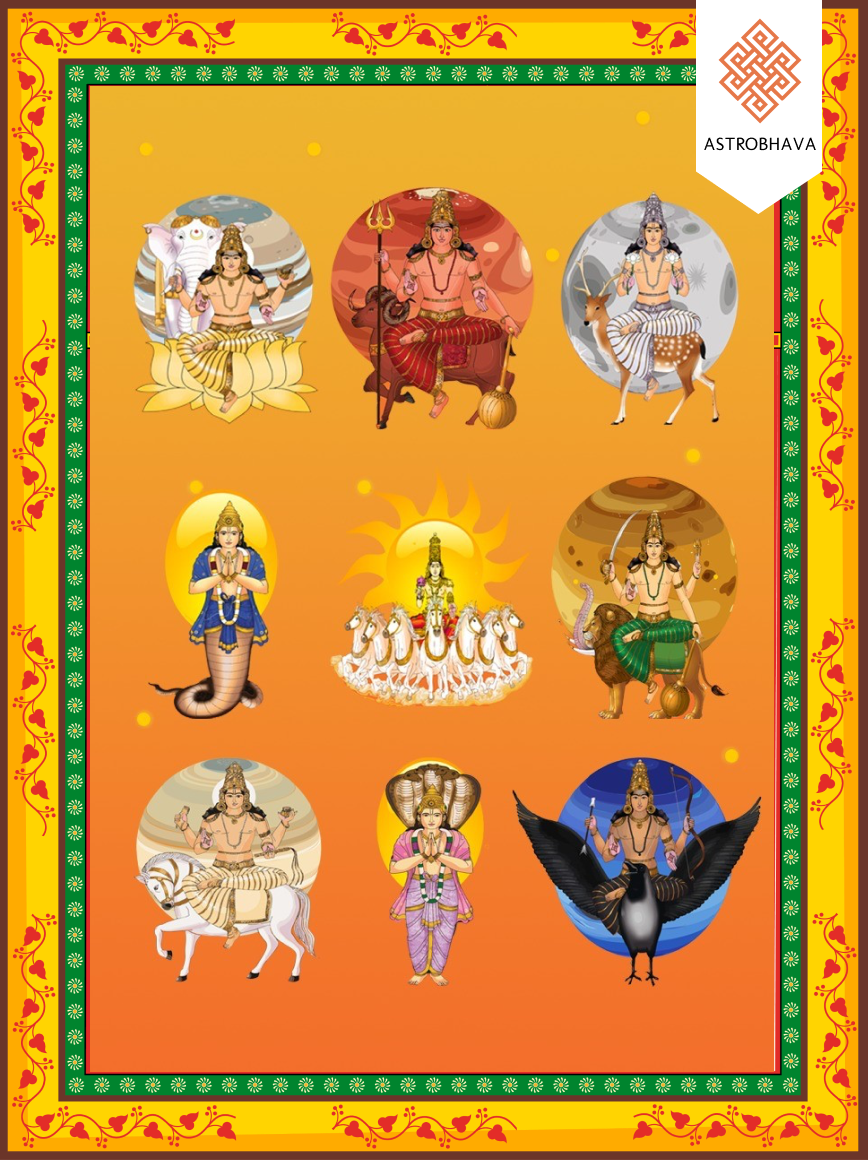
The Navagraha Stotram is the compact Sanskrit address that names all nine grahas in a single metrical breath: Surya, Chandra, Mangala, Budha, Guru, Shukra, Shani, Rahu and Ketu. Attributed in many southern manuscript colophons to Vyasa, the stotra functions as a collective salutation rather than a hymn to any one light. Each name appears in the dative, so the verse itself performs the act of offering. Temple practice places the recitation before the stone or metal Navagraha panel, where the nine figures stand on a single plinth in fixed directional order. The stotra therefore binds the separate planetary intelligences into one liturgical unit, acknowledging their joint governance of the ecliptic without isolating any single graha for independent praise.
Nine Names in One Verse
Traditional accounts preserved in smarta paddhatis and in the prefatory verses of certain South Indian palm-leaf collections state that Vyasa composed the Navagraha Stotram so that householders might honour the entire planetary court without reciting nine separate hymns. The verse opens with the luminous pair Surya and Chandra, proceeds through the five tara-grahas in the order of their weekday lordship, and closes with the two nodes Rahu and Ketu. By ending on the shadow grahas the stotra mirrors the astronomical fact that the nodes complete the set of influences recognised by classical Jyotisha. Temple legends linked to the Navagraha shrines at Kumbakonam and Tirunallar recount that the verse was first installed when the nine images were set on a common peetha, ensuring that no graha would receive homage in isolation from the others. The stotra thus became the verbal counterpart of that architectural unity.
The mantra, in six scripts
The seed mantra, and the form most devotees chant daily. No initiation is required — it is open to anyone, including a parent chanting for a child.
“Salutation to Surya, to Chandra, to Mangala, to Budha, and to Guru, Shukra and Shani, to Rahu and to Ketu.”
नमः
namaḥ — salutation
सूर्याय
sūryāya — to Surya
चन्द्राय
candrāya — to Chandra
मङ्गलाय
maṅgalāya — to Mangala
बुधाय
budhāya — to Budha
च
ca — and
गुरुशुक्रशनिभ्यश्च
guruśukraśanibhyaśca — and to Guru, Shukra and Shani
राहवे
rāhave — to Rahu
केतवे
ketave — to Ketu
नमः
namaḥ — salutation
Aim is the mantra, in a sense. The rest is address and salutation; the seed syllable carries the goddess. Where a practitioner has been given a very short practice, it is often Aim alone.
The syllable people get wrong
Inside the compound guruśukraśanibhyaśca the syllable śu of śukra begins with the palatal sibilant ś, which must be formed against the hard palate. Speakers routinely substitute the dental s, producing sukra and thereby flattening the distinct sibilant colour that the stotra gives to the name of the planet Venus.
Questions
Classical Jyotisha counts the two nodes as chaya-grahas, shadow planets that complete the set of nine. By reserving the final cadence for Rahu and Ketu the verse mirrors their astronomical status as the points where the lunar orbit crosses the ecliptic, distinct from the seven bodies that possess visible discs. The order therefore follows the traditional enumeration rather than weekday sequence alone.
The grammar is collective: every name stands in the dative and the single verb of salutation governs them all. The stotra therefore functions as one utterance directed at the entire planetary court, preserving the unity of the Navagraha panel in which the nine figures share a single stone plinth and a single ritual moment.
Individual beeja mantras isolate one graha for focused japa. The Navagraha Stotram, by contrast, refuses isolation; its purpose is the simultaneous acknowledgement of all nine influences as they stand together in the ecliptic scheme of Jyotisha and in the architecture of the Navagraha shrine.
Not sure a mantra is enough?
Have your chart read before you decide
Chanting is yours to do, and free. But which deity your situation calls for — and whether a mantra alone is the right response — depends on your chart. Sometimes it is; sometimes it is not.
Brahmashree Shivaaya
Guru, Head of Astrological & Spiritual Solutions
Over 30 years in the Guru–Sishya Parampara, from the age of five
He reads every chart himself — 60 minutes, one to one, never delegated
Charts are read only between sunrise and sunset, following tradition
Chanting is yours to do. Some things are performed for you.
Where a matter carries real weight — an examination that decides a course, a performance, a child whose studies have stalled — devotees sponsor the homa alongside their own practice. Performed individually at our Yagna Ashram in your name and gotra, on a muhurta calculated from your chart, and telecast live so you can watch it done for you.