In Devanagari, Tamil, Telugu, Kannada, Malayalam and English — with the meaning of every word, and the one syllable most people pronounce wrongly.
Who Narayana Suktam is
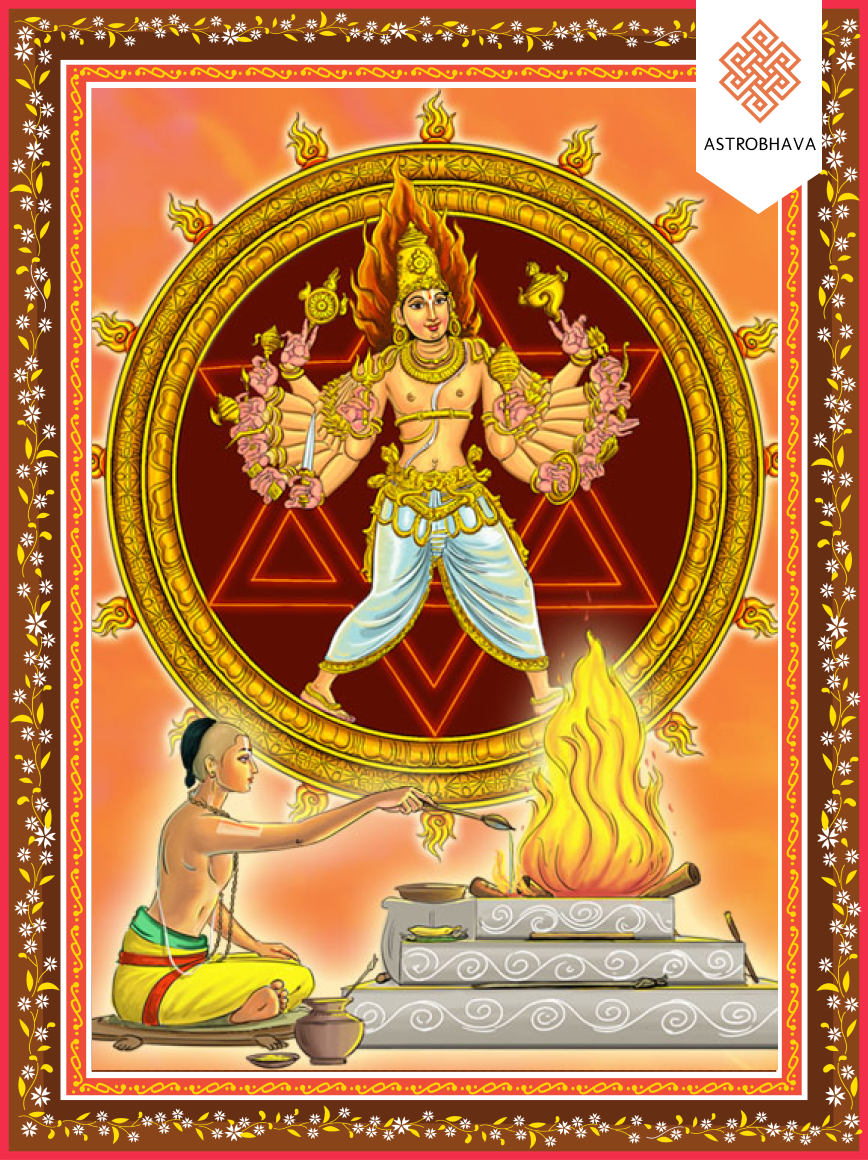
Narayana is the resting place of all beings, the one who reclines upon the waters of dissolution and from whose navel the lotus of Brahma arises. In the Narayana Sukta of the Taittiriya Aranyaka he is praised as the thousand-headed deity whose eyes are the universe, who is both within the heart the size of a thumb and beyond the farthest heaven. The name itself is traditionally derived from nara, the waters, and ayana, the abode, so that Narayana is the ground upon which the cosmic waters settle. He is not portrayed here as an avatar who descends into history but as the unchanging person who remains after names, forms and cycles have withdrawn. The sukta places him at the centre of the heart-cave, surrounded by a network of luminous channels, making the inward journey and the cosmic vision a single continuous movement.
The Heart as Dwelling
The Narayana Sukta, preserved in the tenth prapathaka of the Taittiriya Aranyaka, does not recount a battle or a childhood exploit. Instead it maps the presence of Narayana inside the human body and simultaneously across the expanse of the worlds. The seer describes a lotus of twelve digits suspended upside-down within the heart, its stalk pointing upward. In the centre of that lotus is a tiny space free of sorrow, and within that space stands the purusha who is Narayana. From him proceed the vital breaths, the senses and the mind; into him they return. The same passage identifies him with the supreme brahman, with the purusha of a thousand heads, and with the light that never sets. Later Vaishnava reading takes this interior geography as the warrant for meditating on Narayana as both the transcendent source and the intimate companion seated in the cavity of the heart, so that the recitation of the sukta becomes a guided entry into that inner chamber rather than a petition addressed to a distant deity.
The mantra, in six scripts
The seed mantra, and the form most devotees chant daily. No initiation is required — it is open to anyone, including a parent chanting for a child.
“The thousand-headed god, the universe-eyed, the all-auspicious.”
सहस्रशीर्षं
sahasraśīrṣaṃ — thousand-headed
देवं
devaṃ — god
विश्वाक्षं
viśvākṣaṃ — universe-eyed
विश्वशम्भुवम्
viśvaśambhuvam — all-auspicious
Aim is the mantra, in a sense. The rest is address and salutation; the seed syllable carries the goddess. Where a practitioner has been given a very short practice, it is often Aim alone.
The syllable people get wrong
In viśvaśambhuvam the cluster śam-bhu places a palatal sibilant directly before a labial aspirate. Speakers frequently merge the two into a single soft “shambu,” losing the distinct release of bh. The sibilant must finish before the lips close for bhu; otherwise the ancient epithet that calls him the source of all welfare is blurred.
When Narayana Suktam is chanted
Weekday. Thursday
Questions
Both hymns open with the image of a thousand-headed being and share several epithets. The Purusha Sukta of the Rigveda emphasises the sacrificial dismemberment that produces the cosmos; the Narayana Sukta of the Taittiriya Aranyaka interiorises that same person, locating him inside the heart and equating him explicitly with the supreme brahman. Traditional recitation often pairs the two, treating the Rigvedic hymn as the cosmogonic outer frame and the Aranyaka hymn as the contemplative inner application.
The sukta presents the heart as an inverted lotus of twelve digits whose pericarp contains a minute, sorrowless space. That architectural image supplies the yogic and Vedantic traditions with a precise locus for meditation: the same Narayana who pervades the outer universe is to be found in the cavity no larger than a thumb. The description is therefore both anatomical metaphor and metaphysical claim, asserting that the farthest deity is also the nearest.
Viśvaśambhu names Narayana as the one from whom all welfare and auspiciousness arise for the entire universe. Commentators linked to the Taittiriya school read it as an assurance that the same person who is the source of creation is also the source of its well-being, so that the hymn’s vision of cosmic pervasion is never separated from the quality of benevolence.
Not sure a mantra is enough?
Have your chart read before you decide
Chanting is yours to do, and free. But which deity your situation calls for — and whether a mantra alone is the right response — depends on your chart. Sometimes it is; sometimes it is not.
Brahmashree Shivaaya
Guru, Head of Astrological & Spiritual Solutions
Over 30 years in the Guru–Sishya Parampara, from the age of five
He reads every chart himself — 60 minutes, one to one, never delegated
Charts are read only between sunrise and sunset, following tradition
Chanting is yours to do. Some things are performed for you.
Where a matter carries real weight — an examination that decides a course, a performance, a child whose studies have stalled — devotees sponsor the homa alongside their own practice. Performed individually at our Yagna Ashram in your name and gotra, on a muhurta calculated from your chart, and telecast live so you can watch it done for you.