Mantra · Tuesday. For courage, property and Mangal dosha.
Mangal — Mars
ॐ क्रां क्रीं क्रौं सः भौमाय नमः
In Devanagari, Tamil, Telugu, Kannada, Malayalam and English — with the meaning of every word, and the one syllable most people pronounce wrongly.
Who Mangal — Mars is
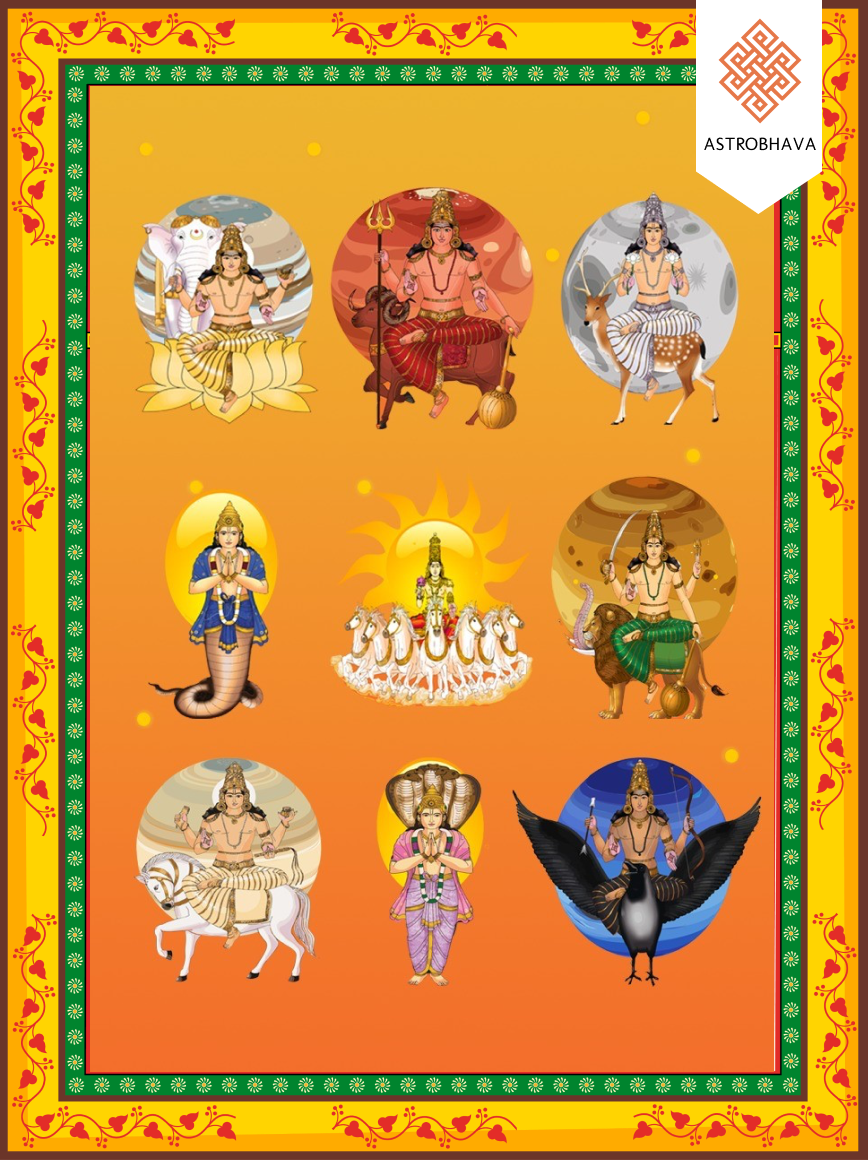
Maṅgala, also called Aṅgāraka and Bhauma, is the Navagraha deity who personifies the red planet Mars. Purāṇic tradition presents him as the son of the Earth goddess Bhūmi, born when a spark of Śiva’s ascetic fire fell upon her; hence the epithet Bhauma, “born of the Earth.” Iconographic manuals describe a four-armed figure of ruddy complexion, holding spear, mace, lotus and trident, riding a ram whose restless energy mirrors his own. He rules the southern quarter, the metal copper, and the colour red. In the jyotiṣa corpus, above all the Bṛhat Parāśara Horā Śāstra and the Sārāvalī, he is the kāraka of siblings, landed property, military courage and the martial impulse itself. His very name Aṅgāraka, “glowing charcoal,” recalls both the planet’s hue and the smouldering intensity that the tradition attributes to him alone among the grahas.
Birth from Bhūmi’s Soil
The Skanda Purāṇa and the Matsya Purāṇa preserve the account of Maṅgala’s origin. When Śiva sat in unbroken tapas upon the Himālaya, the heat of his austerity became so intense that a single drop of perspiration fell from his brow onto the earth. Bhūmidevī, the goddess of the soil, received that fiery seed and in time brought forth a radiant child whose body shone like molten copper. The infant’s first cry shook the forests; the ram that would become his mount appeared of its own accord. The gods, beholding the child’s fierce splendour, named him Aṅgāraka. Bhūmi herself nursed him until the sage Bhāradvāja took the boy into his āśrama and taught him the lore of weapons and the disciplines of kṣatriya dharma. When the child came of age he was installed among the Navagraha as the guardian of the southern sky. The same texts note that because his birth united the ascetic fire of Śiva with the patient endurance of Earth, Maṅgala forever carries both the capacity for sudden blaze and the gravity of the ground that receives it.
The mantra, in six scripts
The seed mantra, and the form most devotees chant daily. No initiation is required — it is open to anyone, including a parent chanting for a child.
“Salutation to Bhauma, preceded by the seed-syllables krāṃ, krīṃ, krauṃ and saḥ.”
ॐ
oṃ — the primal syllable
क्रां
krāṃ — seed-syllable of Maṅgala
क्रीं
krīṃ — second seed-syllable
क्रौं
krauṃ — third seed-syllable
सः
saḥ — seed-syllable of power
भौमाय
bhaumāya — to the Earth-born one
नमः
namaḥ — salutation
Aim is the mantra, in a sense. The rest is address and salutation; the seed syllable carries the goddess. Where a practitioner has been given a very short practice, it is often Aim alone.
The syllable people get wrong
In bhaumāya the diphthong au of the opening syllable bhau is the characteristic snare. Speakers commonly collapse the a-u glide into a single monophthong o, producing bhomāya. The tradition requires the full labial opening of au, so that a brief a is heard before the u colours the vowel, keeping the syllable clearly two-moraed before mā-ya.
When Mangal — Mars is chanted
Festival. Maṅgala Gaurī Vrata on Tuesdays of Śrāvaṇa
Questions
The two names arise from distinct yet complementary moments in his mythic biography. Aṅgāraka, “the ember” or “glowing coal,” is the name given by the gods at the instant of his appearance, when his body still radiated the heat of Śiva’s tapas; it emphasises the fiery, martial aspect that later jyotiṣa associates with conflict, surgery and sudden courage. Bhauma, “son of Bhūmi,” records his maternal origin and is the name preferred in ritual mantras that address him as a graha. The Skanda Purāṇa deliberately alternates the two epithets within a single chapter so that the hearer never forgets that the same deity is at once the smouldering coal and the child of the patient earth. Later digests such as the Graha-yoga-tattva preserve both names side by side, treating them as equally authoritative rather than as rivals.
Iconographic tradition, crystallised in the Śilparatna and the Devatāmūrtiprakaraṇa, states that the ram appeared spontaneously at the moment of Maṅgala’s birth, drawn by the heat that still clung to the infant’s skin. The animal’s restless butting and its readiness to charge are read as outer signs of the same energy that the planet Mars displays in the sky—swift, direct, and capable of sudden impact. Unlike the peacock of Kārttikeya or the mouse of Gaṇeśa, the ram is never explained by a later narrative episode; it is simply present from the first, as though the earth herself supplied a mount whose nature already matched the child she had borne. Temple images in Tamil Nadu and Karnataka therefore show the ram with head lowered, horns curved forward, eternally poised on the brink of movement, a visual reminder that Maṅgala’s power is kinetic rather than contemplative.
Although both deities are described as brilliant and red, the Purāṇas and the early jyotiṣa works draw a sharp line between them. Sūrya is the source of light and the soul of the solar system; his heat is steady, life-giving, and royal. Maṅgala’s heat is secondary, derived, and martial—an ember rather than the original flame. The Bṛhat Saṃhitā notes that Sūrya rides a chariot drawn by seven horses and moves on the ecliptic as sovereign, whereas Maṅgala rides a single ram and is classed among the “malefic” grahas whose influence is sharp, interrupive, and concerned with boundaries, wounds and the defence of territory. Ritual manuals therefore assign to Sūrya the centre of the Navagraha maṇḍala and to Maṅgala the southern periphery, making visible the difference between originating radiance and the secondary fire that guards the edges.
Not sure a mantra is enough?
Have your chart read before you decide
Chanting is yours to do, and free. But which deity your situation calls for — and whether a mantra alone is the right response — depends on your chart. Sometimes it is; sometimes it is not.
Brahmashree Shivaaya
Guru, Head of Astrological & Spiritual Solutions
Over 30 years in the Guru–Sishya Parampara, from the age of five
He reads every chart himself — 60 minutes, one to one, never delegated
Charts are read only between sunrise and sunset, following tradition
Chanting is yours to do. Some things are performed for you.
Where a matter carries real weight — an examination that decides a course, a performance, a child whose studies have stalled — devotees sponsor the homa alongside their own practice. Performed individually at our Yagna Ashram in your name and gotra, on a muhurta calculated from your chart, and telecast live so you can watch it done for you.