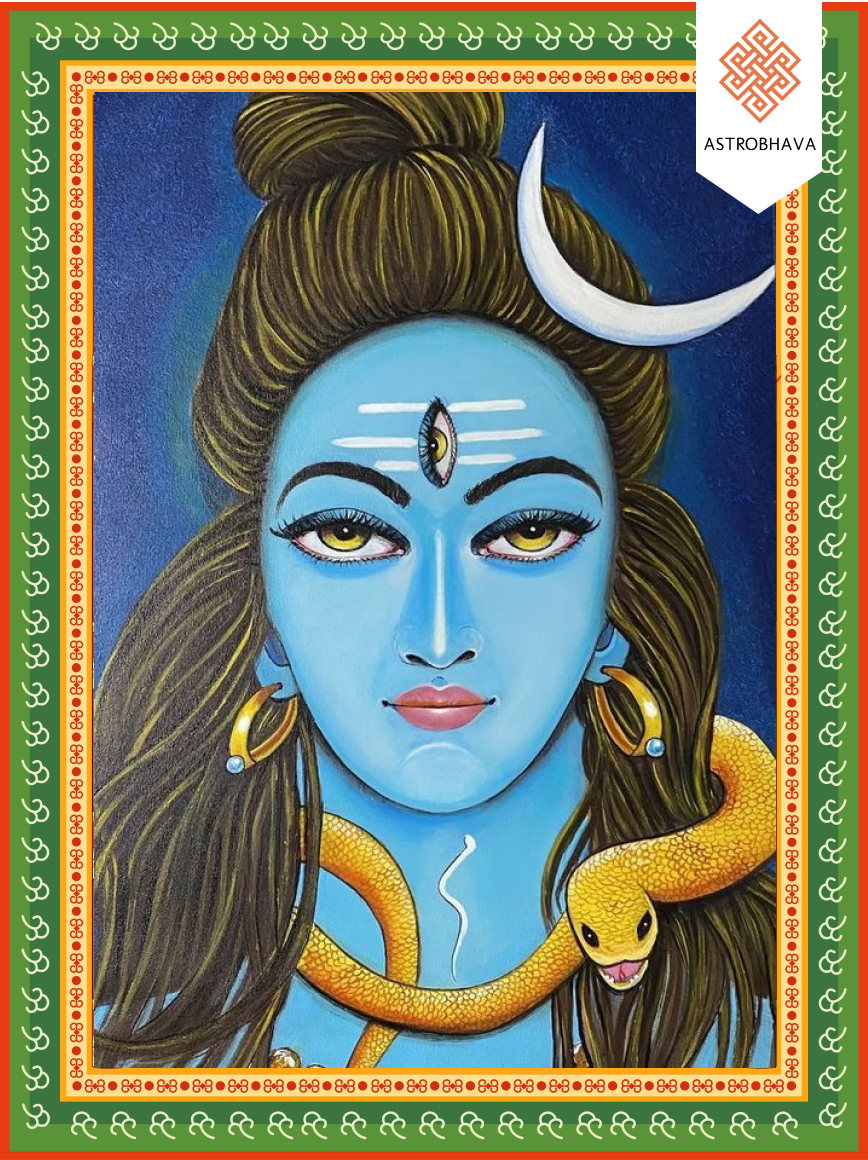
In Devanagari, Tamil, Telugu, Kannada, Malayalam and English — with the meaning of every word, and the one syllable most people pronounce wrongly.
Who Lingashtakam is
The Lingashtakam addresses Sadashiva in the form of the lingam, the aniconic shaft that Shaiva tradition holds as the primary visible mark of the formless Absolute. Unlike anthropomorphic murtis that show Shiva with matted locks, trident or bull, the lingam stands without face or limb, its curved top and squared base marking the union of pure consciousness and manifest energy. Temples from Kedarnath to Rameswaram install it as the garbha-griha’s sole focus; the eight verses of this stotra circle that stone or crystal form alone, naming it the object worshipped by Brahma and Murari, the destroyer of the sorrow born with each birth, and the eternally auspicious lingam. The hymn never shifts its gaze to Nataraja’s dance or Bhairava’s skull; every epithet returns to the silent, upright emblem itself.
The Endless Pillar of Light
The Shiva Purana and the Linga Purana recount that Brahma and Vishnu once disputed which of them was supreme. In the midst of their contention a boundless pillar of fire rose between them, without top or bottom. Vishnu took the form of a boar and dug downward for a thousand years; Brahma became a swan and flew upward the same span. Neither found an end. Returning, they met a sage who was Shiva himself and learned that the pillar was the lingam, the sign of that which precedes and outlasts every creator and preserver. Brahma’s false claim to have reached the summit brought the curse that he would lack temples on earth, while Vishnu’s honest failure won him the right to be honored beside the lingam. The Lingashtakam’s opening verse still names both gods as the first worshippers of that same shaft of light, fixing the hymn inside this primordial episode rather than any later narrative of marriage or battle.
The mantra, in six scripts
The seed mantra, and the form most devotees chant daily. No initiation is required — it is open to anyone, including a parent chanting for a child.
“I bow to that Sadashiva-lingam which is worshipped by Brahma, Murari and the gods, which shines pure and radiant, and which destroys the sorrow born of birth.”
ब्रह्म
brahma — Brahma
मुरारि
murāri — Murari (Vishnu)
सुरार्चित
surārcita — worshipped by the gods
लिङ्गं
liṅgaṃ — lingam
निर्मल
nirmala — pure
भासित
bhāsita — shining
शोभित
śobhita — radiant
लिङ्गम्
liṅgam — lingam
जन्मज
janmaja — born of birth
दुःख
duḥkha — sorrow
विनाशक
vināśaka — destroyer
लिङ्गं
liṅgaṃ — lingam
तत्
tat — that
प्रणमामि
praṇamāmi — I bow
सदाशिव
sadāśiva — Sadashiva
लिङ्गम्
liṅgam — lingam
Aim is the mantra, in a sense. The rest is address and salutation; the seed syllable carries the goddess. Where a practitioner has been given a very short practice, it is often Aim alone.
The syllable people get wrong
In liṅgaṃ the velar nasal ṅ before g is often flattened to an ordinary English “ng” as in “long,” losing the distinct ṅ contact at the soft palate; the correct touch keeps the tongue raised and the sound humming through the nose before the g is released.
When Lingashtakam is chanted
Weekday. Monday
Festival. Maha Shivaratri, when the lingam is bathed through the four night watches
Questions
Because its sole object is the lingam itself, the mark that Shaiva Agama treats as prior to every iconic form. The verses stay inside the vocabulary of purity, radiance and the ending of birth-sorrow, refusing the narrative details that belong to Nataraja or Ardhanarishvara hymns.
Sadashiva is the five-faced, ten-armed transcendental form whose lowermost face is Ishana; the lingam addressed here is understood as that same reality condensed into the aniconic shaft, so the epithet binds the silent stone to the highest philosophical category of Shaiva Siddhanta.
The text itself names only the lingam worshipped by the gods and shining without stain; tradition applies the same eight verses to stone, crystal, mercury or light-formed lingams alike, since the stotra’s concern is the principle, not the substance.
Not sure a mantra is enough?
Have your chart read before you decide
Chanting is yours to do, and free. But which deity your situation calls for — and whether a mantra alone is the right response — depends on your chart. Sometimes it is; sometimes it is not.
Brahmashree Shivaaya
Guru, Head of Astrological & Spiritual Solutions
Over 30 years in the Guru–Sishya Parampara, from the age of five
He reads every chart himself — 60 minutes, one to one, never delegated
Charts are read only between sunrise and sunset, following tradition
Chanting is yours to do. Some things are performed for you.
Where a matter carries real weight — an examination that decides a course, a performance, a child whose studies have stalled — devotees sponsor the homa alongside their own practice. Performed individually at our Yagna Ashram in your name and gotra, on a muhurta calculated from your chart, and telecast live so you can watch it done for you.