Mantra · Fourth Bhairava. For steadiness under provocation.
Krodha Bhairava
ॐ ह्रीं क्रोधभैरवाय नमः
In Devanagari, Tamil, Telugu, Kannada, Malayalam and English — with the meaning of every word, and the one syllable most people pronounce wrongly.
Who Krodha Bhairava is
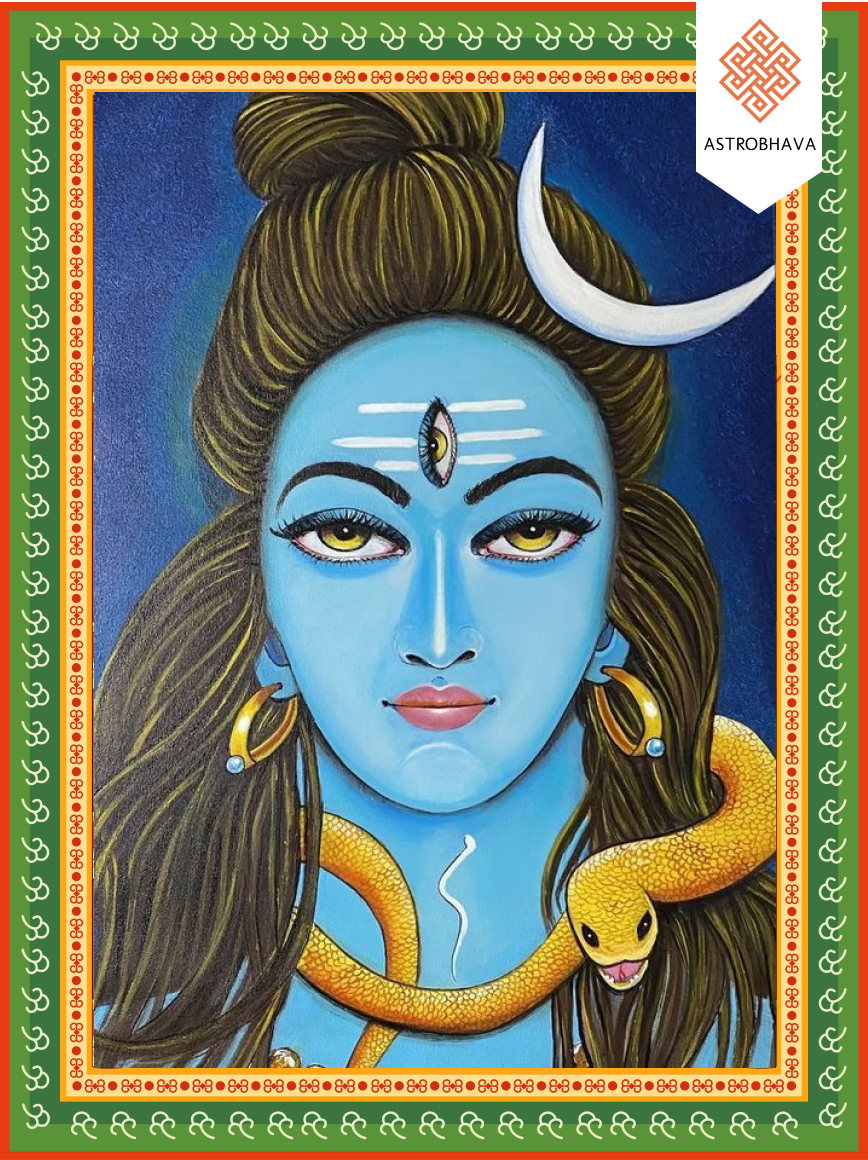
Krodha Bhairava is the fourth of the eight Bhairavas, standing after Chanda and before Unmatta in the received Tantric order. His name is identical with the Sanskrit word for wrath, krodha, yet the Agamas present him not as uncontrolled rage but as the still point that remains when provocation has been fully met. Iconographic sources give him a dark, storm-cloud complexion, hair knotted with serpents, and weapons that typically include the sword, shield, axe and skull-staff; his vahana is listed in several texts as an eagle or garuda-like bird. He is commonly assigned the western quarter of the Ashta Bhairava mandala. Tradition therefore regards him as the form in which fierce energy has already been gathered and held, yet the same tradition never claims that repetition of his mantra confers that steadiness upon the speaker.
Wrath Held at the Western Gate
The Rudrayamala’s account of the eightfold manifestation records that the fourth Bhairava did not burst outward like Chanda but condensed inward. When the original Bhairava’s anger at the lingering skull-debt rose to its height, a portion of that anger folded upon itself and became Krodha, taking for mount the eagle that can hang motionless in a gale. The text situates the event at the western edge of the cremation ground, where the wind off the river is strongest; there the new form planted the skull-staff and refused to advance or retreat. Later commentaries in the Sharada Tilaka tradition read the episode as the charter of steadiness under provocation: Krodha Bhairava is the wrath that has already chosen its ground and will not be dislodged by further insult. No lengthy combat follows; the myth ends with the planting of the staff and the assignment of the western quarter, leaving subsequent paddhatis to extract only the short mantra and the dark-hued dhyana that still identify him.
The mantra, in six scripts
The seed mantra, and the form most devotees chant daily. No initiation is required — it is open to anyone, including a parent chanting for a child.
“The words offer the seed-syllable hrīṃ and salutation addressed to Krodha Bhairava.”
ॐ
oṃ — the open primordial syllable
ह्रीं
hrīṃ — the hrīṃ seed of radiant shakti
क्रोधभैरवाय
krodhabhairavāya — to Krodha Bhairava (dative)
नमः
namaḥ — salutation
Aim is the mantra, in a sense. The rest is address and salutation; the seed syllable carries the goddess. Where a practitioner has been given a very short practice, it is often Aim alone.
The syllable people get wrong
The initial cluster क्रो in Krodha is often broken into an English “kuh-ro” or softened to “crow-da,” losing both the single-syllable kr ligature and the aspirated dha. The correct onset is a tight kro- with rounded lips, followed by a clearly breathed dha; any separation into two beats or loss of aspiration turns the name into a different word.
When Krodha Bhairava is chanted
Weekday. Monday
Questions
The charter myth in the Rudrayamala gives Krodha the eagle because that bird can remain suspended in violent wind without being driven off course. The image matches the deity’s defining act—planting the skull-staff and holding ground—whereas the peacock of Chanda signifies the first flare of heat. The two mounts are therefore kept strictly apart in every subsequent iconographic list, each preserving the distinct moment of wrath that its Bhairava embodies.
Western placement, fixed already in the early paddhatis, associates Krodha with the direction of the setting sun and of the strong river wind at Varanasi’s burning grounds. The quarter is not chosen for symbolic convenience; it is the literal edge where the myth says the staff was planted. Ritual manuals therefore light the western lamp for him and no other, keeping the geography of the original episode intact inside the mandala.
The texts repeatedly note that Krodha’s anger has already folded inward and chosen its ground; it is no longer the outward blaze of Chanda nor the scattered fury of later forms such as Unmatta. By describing the planting of the skull-staff and the motionless eagle, the Rudrayamala and Sharada Tilaka present wrath that has become a stable presence rather than a passing storm, a distinction maintained in every dhyana that follows.
Not sure a mantra is enough?
Have your chart read before you decide
Chanting is yours to do, and free. But which deity your situation calls for — and whether a mantra alone is the right response — depends on your chart. Sometimes it is; sometimes it is not.
Brahmashree Shivaaya
Guru, Head of Astrological & Spiritual Solutions
Over 30 years in the Guru–Sishya Parampara, from the age of five
He reads every chart himself — 60 minutes, one to one, never delegated
Charts are read only between sunrise and sunset, following tradition
Chanting is yours to do. Some things are performed for you.
Where a matter carries real weight — an examination that decides a course, a performance, a child whose studies have stalled — devotees sponsor the homa alongside their own practice. Performed individually at our Yagna Ashram in your name and gotra, on a muhurta calculated from your chart, and telecast live so you can watch it done for you.