In Devanagari, Tamil, Telugu, Kannada, Malayalam and English — with the meaning of every word, and the one syllable most people pronounce wrongly.
Who Hayagreeva is
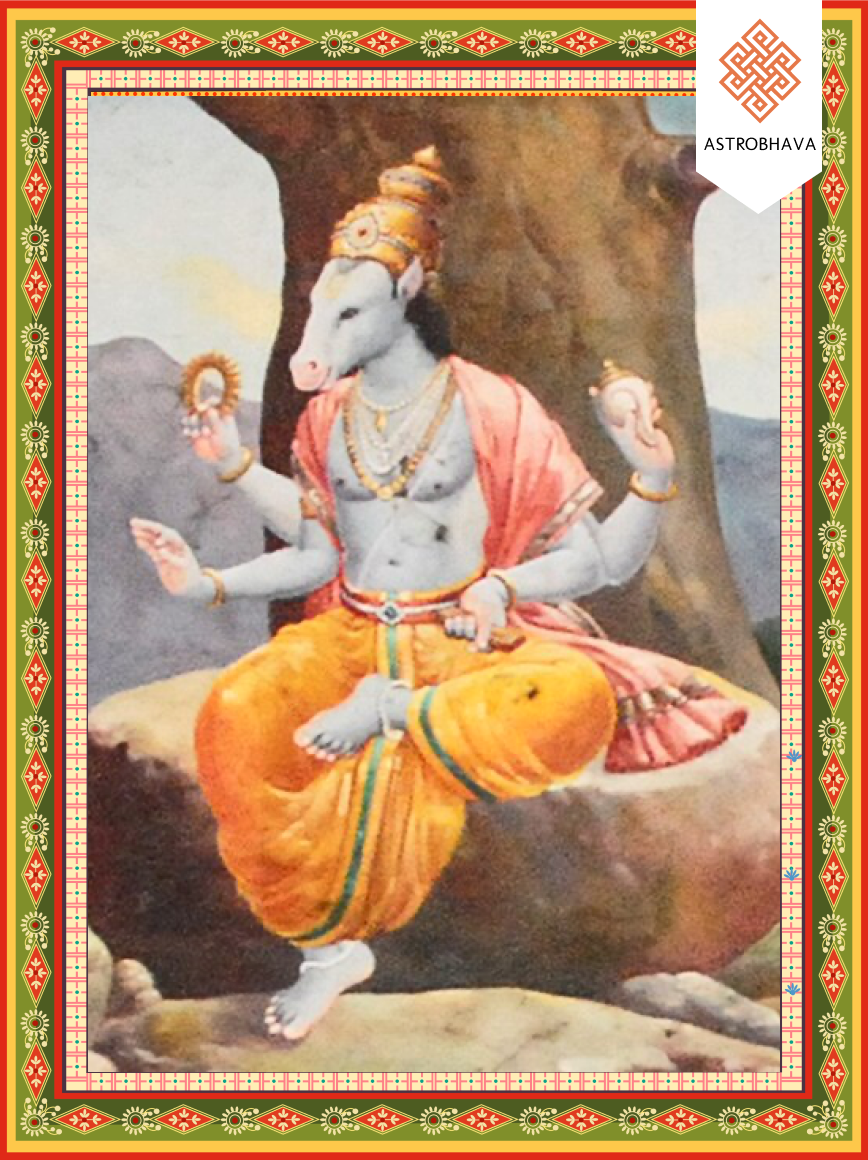
Hayagreeva is the horse-headed manifestation of Vishnu who embodies pure, unobstructed knowledge. White-complexioned, seated or standing with four arms that carry the conch, discus, and two hands in the gestures of blessing and instruction, he is the form that recovered the Vedas when they had been stolen from Brahma. Madhva, Vedanta Desika and the Sri Vaishnava acharyas regard him as the inner controller of speech and memory, the deity whose very neigh is the origin of sacred sound. Unlike other knowledge deities who remain anthropomorphic, Hayagreeva’s equine head marks the transcendence of ordinary human limitation, signalling that the highest learning arrives from a source beyond the merely human. Temples at Thiruvahindrapuram and elsewhere preserve this iconography without admixture of other avatars.
Recovery of the Stolen Vedas
The Mahabharata and the Devi Bhagavata Purana recount that two demons, Madhu and Kaitabha, born from the ear-wax of Vishnu himself, seized the Vedas while Brahma slept and hid them in the depths of the primordial waters. Distressed, Brahma appealed to Vishnu, who assumed the form of Hayagreeva—radiant white, horse-headed, luminous with the light of pure consciousness. Entering the waters, Hayagreeva defeated the demons, retrieved the four Vedas, and restored them to Brahma, thereby re-establishing the possibility of sacrificial and contemplative order. Later South Indian traditions add that the same form taught the science of mantra to selected sages, confirming that the recovery of the texts was also a recovery of their living pronunciation. The episode is nowhere transferred to another avatar; the horse head remains the exclusive signature of this restoration.
The mantra, in six scripts
The seed mantra, and the form most devotees chant daily. No initiation is required — it is open to anyone, including a parent chanting for a child.
DevanagariSanskrit & Hindiॐ हयग्रीवाय नमः
Tamilௐ ஹயக்ரீவாய நமஃ
Teluguఓం హయగ్రీవాయ నమః
Kannadaಓಂ ಹಯಗ್ರೀವಾಯ ನಮಃ
Malayalamഓം ഹയഗ്രീവായ നമഃ
EnglishRoman transliterationoṃ hayagrīvāya namaḥ
“Om, salutation to Hayagrīva”
ॐ
oṃ — Om
हयग्रीवाय
hayagrīvāya — to Hayagrīva
नमः
namaḥ — salutation
Aim is the mantra, in a sense. The rest is address and salutation; the seed syllable carries the goddess. Where a practitioner has been given a very short practice, it is often Aim alone.
The syllable people get wrong
In hayagrīvāya the opening syllable ha must be a fully voiced aspirate produced with a clear breath-pulse. Speakers repeatedly weaken it to a bare vowel or convert it into the English diphthong “hay,” so that the name begins with an open “aya-greeva” and loses the distinct equine force carried by the proper ha.
When Hayagreeva is chanted
Weekday. Thursday
Festival. Hayagriva Jayanti
Questions
Puranic narrative and later theological reflection present the equine head as the visible sign that the highest knowledge exceeds ordinary human faculties. The horse, swift and far-ranging, becomes the appropriate vehicle for the Vedas themselves when they must be recovered from cosmic concealment. Vedanta Desika’s Hayagriva Stotra elaborates that the neigh of this form is the primal nada from which all articulate speech descends, so the head is not an arbitrary hybrid but the necessary emblem of sound prior to language. No other Vishnu avatar carries this particular theriomorphic feature for this reason.
Madhvacharya is traditionally held to have received instruction from Hayagreeva, and the Dvaita lineage continues to honour the form as the giver of tattva-jnana. Within the Sri Vaishnava sampradaya, Vedanta Desika composed the celebrated Hayagriva Stotra after a visionary encounter at Thiruvahindrapuram, establishing the deity as the special patron of scholarship in that community. Both traditions therefore locate their intellectual confidence in the same horse-headed presence, though each articulates the relationship through its own doctrinal vocabulary. The convergence underscores Hayagreeva’s unique status among knowledge deities.
The Puranas and the stotra literature describe the body as pure white, luminous as crystal or autumn moonlight, to signify knowledge that is free of the staining gunas. White here is not merely an aesthetic choice but a theological statement: the form that restores the Vedas must itself be untouched by the darkness of ignorance or the rajas of demonic seizure. Temple images therefore employ white stone or apply white unguents, preserving the chromatic detail that distinguishes Hayagreeva from the dark-hued Krishna or the cloud-coloured Vishnu of other narratives. The colour remains an essential, non-negotiable attribute of this manifestation alone.
Not sure a mantra is enough?
Have your chart read before you decide
Chanting is yours to do, and free. But which deity your situation calls for — and whether a mantra alone is the right response — depends on your chart. Sometimes it is; sometimes it is not.
Brahmashree Shivaaya
Guru, Head of Astrological & Spiritual Solutions
Over 30 years in the Guru–Sishya Parampara, from the age of five
He reads every chart himself — 60 minutes, one to one, never delegated
Charts are read only between sunrise and sunset, following tradition
Chanting is yours to do. Some things are performed for you.
Where a matter carries real weight — an examination that decides a course, a performance, a child whose studies have stalled — devotees sponsor the homa alongside their own practice. Performed individually at our Yagna Ashram in your name and gotra, on a muhurta calculated from your chart, and telecast live so you can watch it done for you.