Mantra · Thursday. For wisdom, children and expansion.
Guru — Jupiter
ॐ ग्रां ग्रीं ग्रौं सः गुरवे नमः
In Devanagari, Tamil, Telugu, Kannada, Malayalam and English — with the meaning of every word, and the one syllable most people pronounce wrongly.
Who Guru — Jupiter is
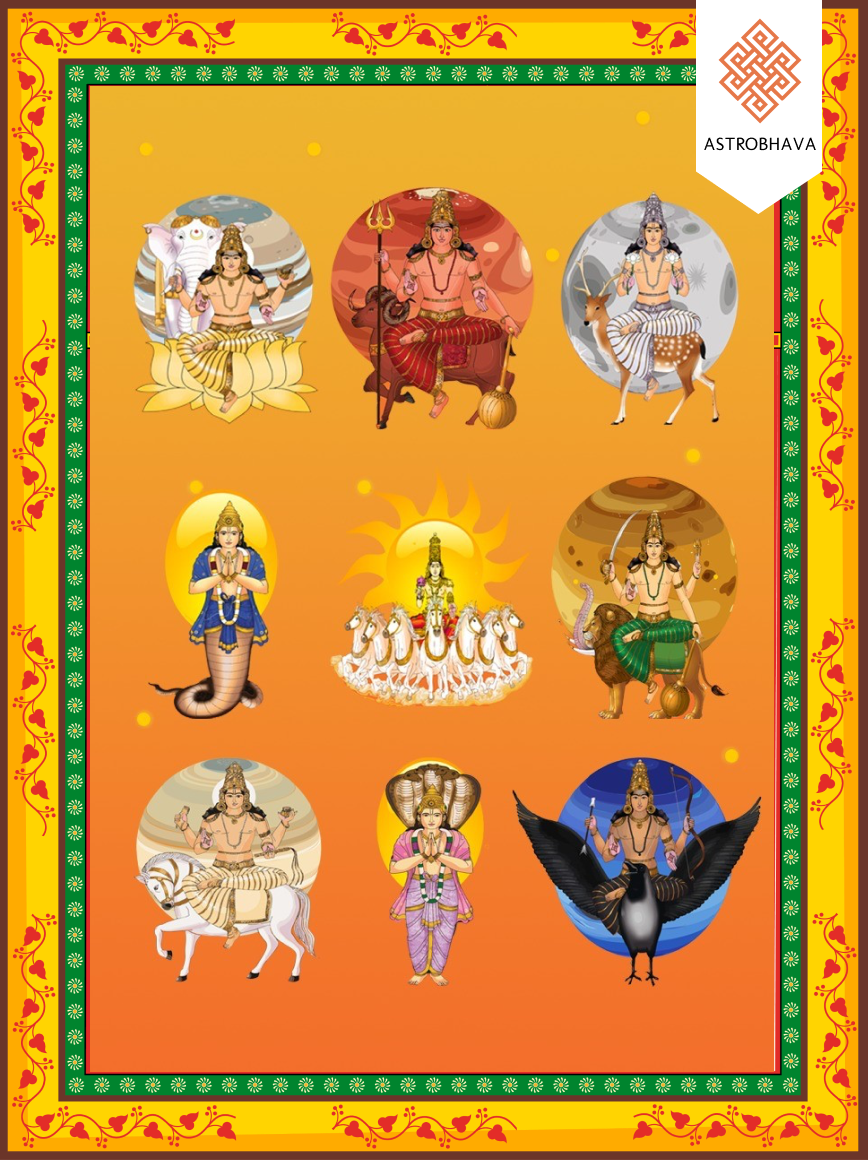
Guru, more fully Bṛhaspati, is the Navagraha deity who personifies the planet Jupiter and serves as the preceptor of the gods. Born in the line of the sage Aṅgiras, he is the embodiment of sacred speech, ritual knowledge and the expansive wisdom that upholds dharma among the devas. Iconography shows a golden-hued, four-armed figure holding a staff, a lotus, prayer beads and a water-pot, seated upon a chariot drawn by eight horses or, in simpler images, upon a white elephant. He governs the north-eastern direction, the metal gold, and the colour yellow. In jyotiṣa he is the great benefic, kāraka of children, higher learning, counsel and the capacity to grow beyond present limits. Because he is both planet and living guru to Indra’s court, every act of teaching and every expansion of understanding is felt to stand under his quiet, heavy light.
Preceptor of the Devas
The Bṛhaspati-upākhyāna preserved in the Matsya Purāṇa and echoed in the Mahābhārata tells how the gods, repeatedly worsted by the asuras who possessed the knowledge of sañjīvanī under Śukra’s guidance, approached the young Bṛhaspati, son of Aṅgiras. They begged him to become their ācārya. Bṛhaspati consented, but only after extracting the promise that the gods would never abandon the performance of yajña nor the study of the Vedas. Under his tutelage Indra regained the throne of heaven, and the sacrificial order was re-established. A later episode, found in the Bhāgavata Purāṇa, recounts that Bṛhaspati once left the court in anger when Indra failed to rise in greeting; the gods’ fortunes immediately declined until the preceptor was persuaded to return. These narratives fix his identity as the one without whose counsel even divine power collapses, and they explain why the planet Jupiter is still addressed first as Guru, the weighty teacher, before any other epithet.
The mantra, in six scripts
The seed mantra, and the form most devotees chant daily. No initiation is required — it is open to anyone, including a parent chanting for a child.
“Salutation to Guru, preceded by the seed-syllables grāṃ, grīṃ, grauṃ and saḥ.”
ॐ
oṃ — the primal syllable
ग्रां
grāṃ — seed-syllable of Guru
ग्रीं
grīṃ — second seed-syllable
ग्रौं
grauṃ — third seed-syllable
सः
saḥ — seed-syllable of power
गुरवे
gurave — to the Guru
नमः
namaḥ — salutation
Aim is the mantra, in a sense. The rest is address and salutation; the seed syllable carries the goddess. Where a practitioner has been given a very short practice, it is often Aim alone.
The syllable people get wrong
In gurave the opening syllable gu carries a short u that must remain brief and closed. Speakers often lengthen it toward gū, producing gūrave and shifting the rhythmic weight. The tradition keeps the u short so that the following ra lands cleanly, preserving the compact, authoritative cadence proper to the name of the divine preceptor.
When Guru — Jupiter is chanted
Festival. Guru Pūrṇimā
Questions
Bṛhaspati is the ancient personal name borne by the preceptor in the Ṛgveda and the early Purāṇas; it means “lord of sacred speech” or “lord of the expansive mantra.” Guru is the functional title that emphasises his relationship to the gods and, by extension, to every seeker of knowledge. Ritual mantras freely inter-change the two: the beeja-mantra addresses him as Guru, while longer stotras and the Gāyatrī dedicated to him employ Bṛhaspati. The jyotiṣa texts follow the same double usage, speaking of Guru-vāra for Thursday and of Bṛhaspati-dṛṣṭi when describing planetary aspect. The tradition treats the names as two faces of one being—one highlighting the cosmic office, the other the intimate role of teacher—rather than as competing identities.
Guru Pūrṇimā, observed on the full-moon day of Āṣāḍha, is dedicated to the principle of the teacher. Because Bṛhaspati is the archetypal guru of the gods, the day is also regarded as his festival among those who maintain Navagraha worship. In many households the planetary mantra is recited alongside the more general homage paid to living teachers and to Vyāsa. Temple records from Maharashtra and Karnataka show that on this day the yellow cloth and the chickpea offerings ordinarily reserved for the Jupiter graha are brought to the Navagraha shrine, linking the abstract celebration of discipleship to the concrete planetary form. The observance therefore sits at the intersection of the personal and the cosmic guru, without collapsing one into the other.
The Aṃśumadbhedāgama and the Śilparatna state that Bṛhaspati’s chariot is yoked to eight pale horses. Commentators link the number eight to the eight directions that his counsel must reach, and to the eight syllables of the Gāyatrī metre in which much of the Veda is framed. Unlike Sūrya’s seven horses, which mark the seven days or the seven metres, the eight of Bṛhaspati suggest completeness beyond the calendar—an all-around sovereignty of wisdom. In temple reliefs the horses are shown in quiet, measured pace rather than in the wild gallop given to the Sun’s team, visually underlining that the expansion proper to Jupiter is steady, weighty and inclusive rather than dazzling.
Not sure a mantra is enough?
Have your chart read before you decide
Chanting is yours to do, and free. But which deity your situation calls for — and whether a mantra alone is the right response — depends on your chart. Sometimes it is; sometimes it is not.
Brahmashree Shivaaya
Guru, Head of Astrological & Spiritual Solutions
Over 30 years in the Guru–Sishya Parampara, from the age of five
He reads every chart himself — 60 minutes, one to one, never delegated
Charts are read only between sunrise and sunset, following tradition
Chanting is yours to do. Some things are performed for you.
Where a matter carries real weight — an examination that decides a course, a performance, a child whose studies have stalled — devotees sponsor the homa alongside their own practice. Performed individually at our Yagna Ashram in your name and gotra, on a muhurta calculated from your chart, and telecast live so you can watch it done for you.