In Devanagari, Tamil, Telugu, Kannada, Malayalam and English — with the meaning of every word, and the one syllable most people pronounce wrongly.
Who Dhanvantari is
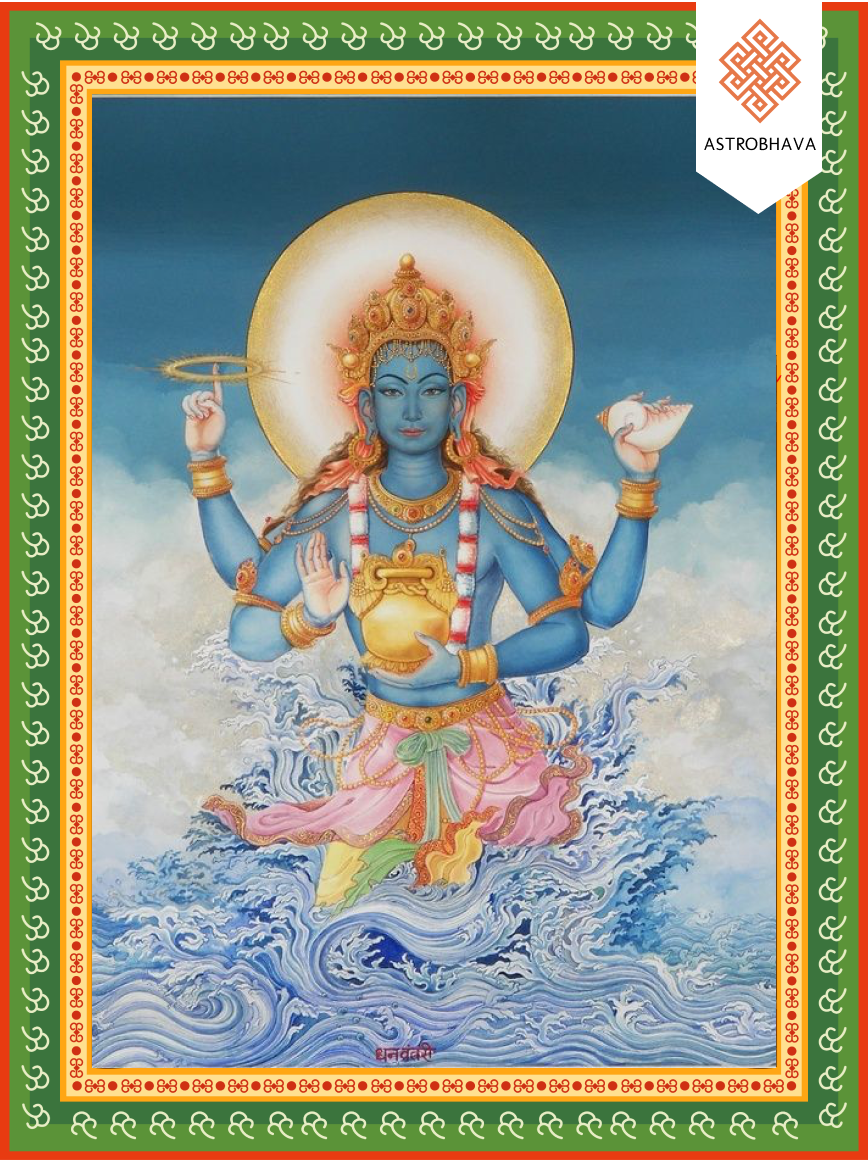
Dhanvantari is the physician of the gods, the form of Viṣṇu who rose from the ocean of milk bearing the pot of amṛta and the science of healing. He is depicted as a youthful two- or four-armed figure, dark or deep blue, holding a leech, a pot of nectar, herbs, and sometimes the cakra. Āyurvedic lineages regard him as the celestial origin of their knowledge; the Suśruta Saṃhitā opens by saluting him as the one who taught the surgical art to the sages. Unlike martial or royal avatāras, Dhanvantari’s brief is the restoration of balance within the body and the quieting of disease. The mantra addressed to him therefore names the deity who stands at the intersection of divine compassion and empirical medicine, the one who carries the kalasha of immortality yet teaches the measured use of herbs, minerals and surgical instruments.
Emergence with the Nectar Pot
During the churning of the ocean of milk, recounted in the Bhāgavata Purāṇa’s eighth skandha and in the Viṣṇu Purāṇa, successive treasures emerged: the cow Surabhi, the horse Uccaiḥśravas, the elephant Airāvata, the Kaustubha jewel, the pārijāta tree, and then Dhanvantari himself. He rose clad in white garments, adorned with garlands, carrying in his hands the pot of amṛta that would free the gods from the fear of death. The demons immediately seized the vessel, precipitating the further intervention of Mohinī. Yet the texts pause to identify Dhanvantari as an avatāra of Viṣṇu whose specific gift is the knowledge of medicine. Later Purāṇic passages state that he incarnated again as a king of Kāśī in order to teach Āyurveda to humanity. The mantra therefore recalls not a battle but an epiphany of healing: the moment when the ocean yielded the physician who holds both nectar and the means to restore mortal bodies.
The mantra, in six scripts
The seed mantra, and the form most devotees chant daily. No initiation is required — it is open to anyone, including a parent chanting for a child.
DevanagariSanskrit & Hindiॐ नमो भगवते धन्वन्तरये
Tamilௐ நமோ பகவதே தந்வந்தரயே
Teluguఓం నమో భగవతే ధన్వన్తరయే
Kannadaಓಂ ನಮೋ ಭಗವತೇ ಧನ್ವನ್ತರಯೇ
Malayalamഓം നമോ ഭഗവതേ ധന്വന്തരയേ
EnglishRoman transliterationoṃ namo bhagavate dhanvantaraye
“Salutation to the Blessed Lord Dhanvantari.”
ॐ
oṃ — the primal syllable
नमो
namo — salutation
भगवते
bhagavate — to the Blessed Lord
धन्वन्तरये
dhanvantaraye — to Dhanvantari
Aim is the mantra, in a sense. The rest is address and salutation; the seed syllable carries the goddess. Where a practitioner has been given a very short practice, it is often Aim alone.
The syllable people get wrong
The opening syllable dhan of dhanvantaraye begins with the voiced aspirate dha, which requires an audible breathy release. Speakers commonly reduce it to an unaspirated dan, producing danvantaraye and thereby stripping the name of the aspiration that Sanskrit phonology and traditional Āyurvedic recitation both demand.
When Dhanvantari is chanted
Weekday. Thursday
Festival. Dhanteras, the thirteenth lunar day of the dark fortnight of Āśvina, when Dhanvantari is remembered as the bringer of the nectar pot and the guardian of health within the household.
Questions
The Purāṇas explicitly list him among the minor avatāras of Viṣṇu. His emergence from the same ocean that yielded Lakṣmī and the Kaustubha places him inside the Vaiṣṇava narrative of cosmic restoration. Āyurvedic texts reinforce the identification by describing him as dark-hued, four-armed, and marked with the śrīvatsa, visual signs that belong to Viṣṇu. The mantra’s use of the epithet bhagavate further anchors him within that theological frame.
The Suśruta Saṃhitā opens with a salutation to Dhanvantari and presents its surgical knowledge as having been received from him by the sage Suśruta. In the narrative frame, Dhanvantari, incarnated as a king of Kāśī, expounds the eight branches of Āyurveda. Thus the mantra and the medical compendium share a common origin story: both point back to the same celestial physician who rose with the nectar pot.
He is shown holding the amṛta-kalasha as his primary attribute, often accompanied by a leech, a bundle of herbs, or the cakra. Unlike deities associated with specific diseases or with exorcism, his image emphasises the pot of immortality and the calm stance of a physician rather than a warrior or an ascetic. The mantra names precisely this figure—the one who carries nectar yet teaches the measured arts of diagnosis and treatment.
Not sure a mantra is enough?
Have your chart read before you decide
Chanting is yours to do, and free. But which deity your situation calls for — and whether a mantra alone is the right response — depends on your chart. Sometimes it is; sometimes it is not.
Brahmashree Shivaaya
Guru, Head of Astrological & Spiritual Solutions
Over 30 years in the Guru–Sishya Parampara, from the age of five
He reads every chart himself — 60 minutes, one to one, never delegated
Charts are read only between sunrise and sunset, following tradition
Chanting is yours to do. Some things are performed for you.
Where a matter carries real weight — an examination that decides a course, a performance, a child whose studies have stalled — devotees sponsor the homa alongside their own practice. Performed individually at our Yagna Ashram in your name and gotra, on a muhurta calculated from your chart, and telecast live so you can watch it done for you.