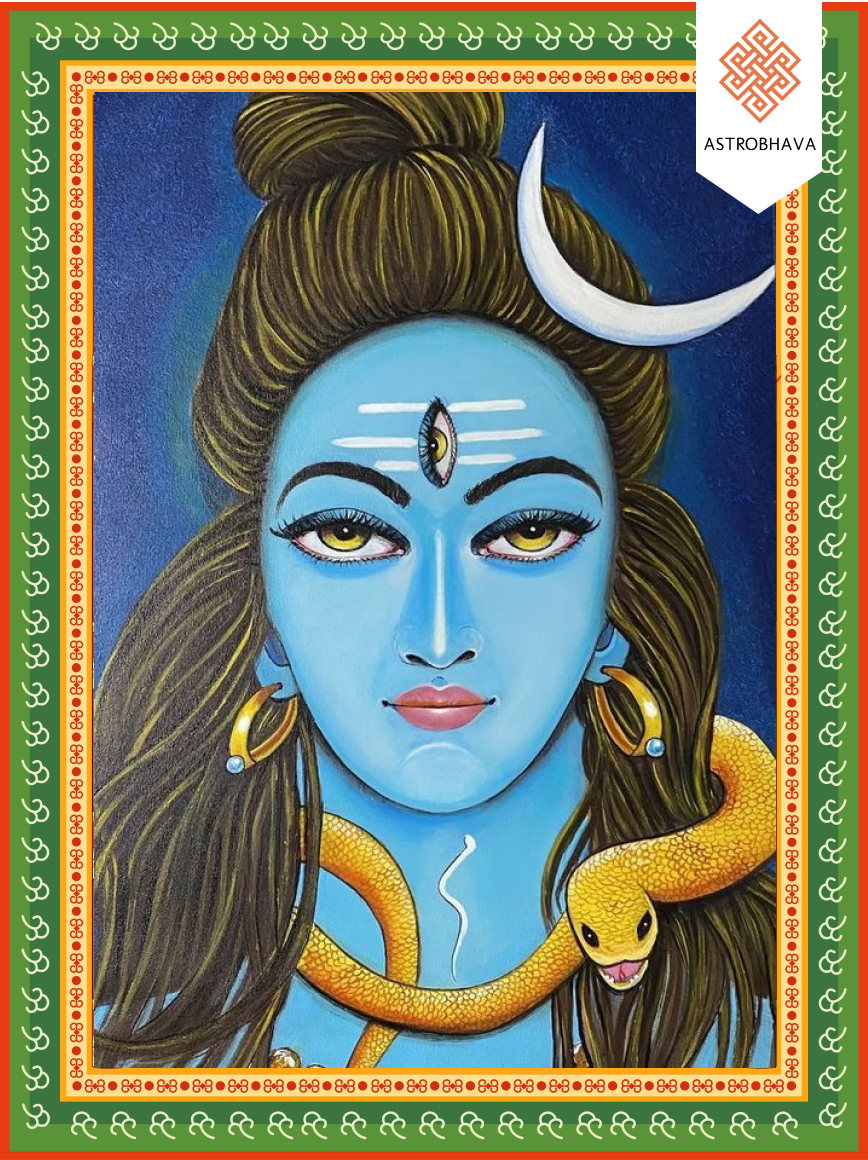
Mantra · Third Bhairava. For control of anger and impulse.
Chanda Bhairava
ॐ ह्रीं चण्डभैरवाय नमः
In Devanagari, Tamil, Telugu, Kannada, Malayalam and English — with the meaning of every word, and the one syllable most people pronounce wrongly.
Who Chanda Bhairava is
Chanda Bhairava is the third of the eight Bhairavas in the classical Ashta Bhairava sequence, emerging after Ruru and before Krodha. The name Chanda, from the root that yields caṇḍa, denotes fierce heat, sudden intensity and the ungoverned blaze of impulse. Agamic descriptions give him a tawny or flaming-red complexion, hair that rises like smoke, and attributes that include the sword, trident, skull-cup and goad; his vahana is recorded in several paddhatis as a peacock. Stationed commonly in the southern or south-eastern quarter of the mandala, he embodies the raw surge of wrath before it is either squandered or steadied. Tradition therefore places him at the precise point where anger first becomes visible as a force, yet the texts never convert that placement into a promise of mastery for the one who utters his name.
The Peacock and the Sudden Blaze
A concise episode preserved in the Kriya portions of the Rudrayamala and echoed in the Bhairava section of the Sharada Tilaka tells that when the eight forms issued from the original Bhairava, the third arose in a burst of heat so sharp that the surrounding air shimmered. A peacock, sacred to the war-god yet restless under that heat, spread its train and refused to flee; the bird’s refusal fixed the new Bhairava’s vahana and sealed his name as Chanda. The same passage notes that the peacock’s cry, harsh and abrupt, matched the deity’s own suddenness, so that later dhyana verses still call him “the one whose coming is like the peacock’s scream at noon.” No elaborate narrative of combat or curse is attached; the myth remains a brief charter of temperament and mount, sufficient to distinguish Chanda from the ox-mounted Ruru who precedes him and the eagle- or garuda-linked Krodha who follows. Ritual manuals simply restate the episode when they assign him his quarter and his red hue.
The mantra, in six scripts
The seed mantra, and the form most devotees chant daily. No initiation is required — it is open to anyone, including a parent chanting for a child.
“The words offer the seed-syllable hrīṃ and salutation addressed to Chanda Bhairava.”
ॐ
oṃ — the open primordial syllable
ह्रीं
hrīṃ — the hrīṃ seed of radiant shakti
चण्डभैरवाय
caṇḍabhairavāya — to Chanda Bhairava (dative)
नमः
namaḥ — salutation
Aim is the mantra, in a sense. The rest is address and salutation; the seed syllable carries the goddess. Where a practitioner has been given a very short practice, it is often Aim alone.
The syllable people get wrong
The retroflex ṇḍ cluster in चण्ड is almost always flattened to a dental “nd,” so that Caṇḍa becomes the everyday English “Chanda.” The tongue must curl back for the ṇ; failure to do so collapses the name’s internal heat into a softer, ordinary sound that no longer matches the fierce caṇḍa the texts intend.
When Chanda Bhairava is chanted
Weekday. Monday
Questions
In the brief charter myth the peacock does not flee the sudden heat that accompanies Chanda’s appearance; its stillness under blaze becomes the emblem of intensity that neither scatters nor collapses. Later iconographic lists therefore keep the peacock exclusively for Chanda among the eight, refusing to transfer it to Krodha or Unmatta, so that the mount itself continues to mark the precise quality of fierce, unblinking heat that defines this third Bhairava.
The Sharada Tilaka and related digests assign the tawny-to-flaming red hue specifically to Chanda as the chromatic sign of caṇḍa—heat that has become visible. The colour is not shared with Ruru’s smoky blue or Krodha’s darker, wrathful tone; it remains the signature of the moment when impulse first flares into sight, before any later steadying or dissipation. Dhyana verses simply restate the red body without converting the description into an instruction for the reciter.
Most paddhatis that follow the Rudrayamala sequence station Chanda in the southern or south-eastern quarter, immediately after Ruru’s south-western seat and before Krodha’s western or north-western station. The placement is cartographic rather than moral: it fixes the third position in the circle so that the ritualist can locate the correct lamp, colour and weapon set when the full Ashta Bhairava rite is performed.
Not sure a mantra is enough?
Have your chart read before you decide
Chanting is yours to do, and free. But which deity your situation calls for — and whether a mantra alone is the right response — depends on your chart. Sometimes it is; sometimes it is not.
Brahmashree Shivaaya
Guru, Head of Astrological & Spiritual Solutions
Over 30 years in the Guru–Sishya Parampara, from the age of five
He reads every chart himself — 60 minutes, one to one, never delegated
Charts are read only between sunrise and sunset, following tradition
Chanting is yours to do. Some things are performed for you.
Where a matter carries real weight — an examination that decides a course, a performance, a child whose studies have stalled — devotees sponsor the homa alongside their own practice. Performed individually at our Yagna Ashram in your name and gotra, on a muhurta calculated from your chart, and telecast live so you can watch it done for you.