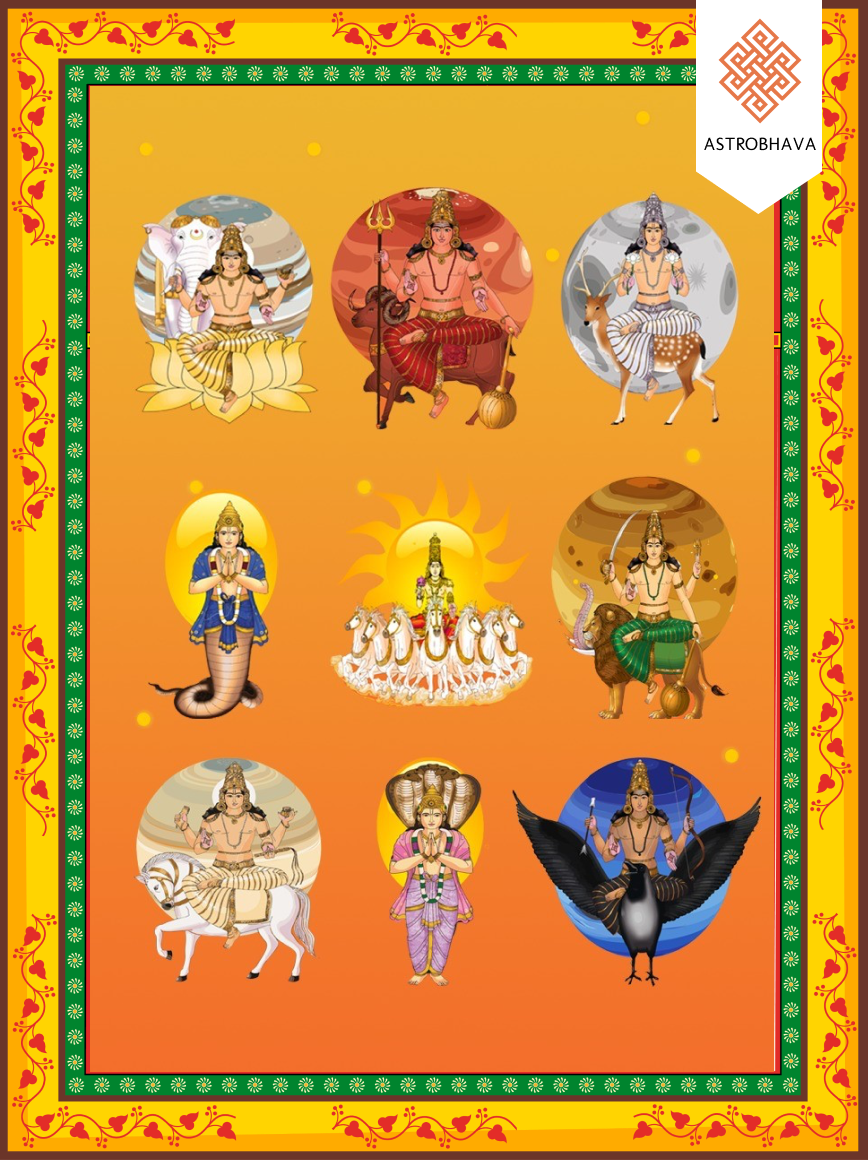
Mantra · Wednesday. For intellect, speech and commerce.
Budha — Mercury
ॐ ब्रां ब्रीं ब्रौं सः बुधाय नमः
In Devanagari, Tamil, Telugu, Kannada, Malayalam and English — with the meaning of every word, and the one syllable most people pronounce wrongly.
Who Budha — Mercury is
Budha is the Navagraha deity who embodies the planet Mercury. He is the son of Soma, the Moon god, and of Tārā, the wife of Bṛhaspati, a parentage that the Purāṇas treat as both scandal and celestial fact. Depicted as a youthful figure of green or pale-gold complexion, he holds a book, a sword, a mace and a shield, and rides a lion or, in some southern traditions, a horse. He presides over the northern direction in certain maṇḍala schemes, over the metal bronze, and over the colour green. Within jyotiṣa he is the kāraka of intellect, speech, commerce, writing and the discriminative faculty that sorts one idea from another. Because his birth straddles the households of the Moon and of the preceptor of the gods, Budha is forever the quick messenger who moves between opposing camps, translating, calculating and reconciling.
The Child of Tārā’s Choice
The Matsya Purāṇa and the Viṣṇu Purāṇa recount the episode that brought Budha into being. Tārā, consort of Bṛhaspati, was drawn to the beauty of Soma and went to live with him. A war between the gods and the asuras nearly erupted over the insult to the divine preceptor. Brahmā himself intervened, restoring Tārā to her husband. Yet she was already with child. When the boy was born, both Soma and Bṛhaspati claimed him. Tārā, after long silence, declared that Soma was the father. The child was named Budha, “the intelligent one,” and was accepted by the gods as a graha in his own right. The same texts note that Budha later married Iḷā (or Sudyumna) and became the ancestor of the Lunar dynasty through their son Purūravas. Thus the planet of intellect and speech is, in mythic genealogy, the pivot between the solar and lunar lines, the quick mind that turns conflict into lineage.
The mantra, in six scripts
The seed mantra, and the form most devotees chant daily. No initiation is required — it is open to anyone, including a parent chanting for a child.
“Salutation to Budha, preceded by the seed-syllables brāṃ, brīṃ, brauṃ and saḥ.”
ॐ
oṃ — the primal syllable
ब्रां
brāṃ — seed-syllable of Budha
ब्रीं
brīṃ — second seed-syllable
ब्रौं
brauṃ — third seed-syllable
सः
saḥ — seed-syllable of power
बुधाय
budhāya — to Budha
नमः
namaḥ — salutation
Aim is the mantra, in a sense. The rest is address and salutation; the seed syllable carries the goddess. Where a practitioner has been given a very short practice, it is often Aim alone.
The syllable people get wrong
In budhāya the syllable dhā contains a voiced aspirated dental stop. Speakers frequently drop the aspiration, reducing it to a plain d and saying budāya. The breathy release after the tongue leaves the teeth must remain audible; without it the name loses the soft, intelligent texture that the tradition links to the planet of speech.
Questions
No. Although the two names share the same Sanskrit root budh, “to awaken” or “to know,” they refer to entirely distinct figures. Budha the graha is the planetary deity of Mercury, son of Soma and Tārā, whose mythology is told in the Purāṇas and whose worship belongs to the Navagraha cycle. The Buddha Siddhārtha Gautama is the historical teacher of the fifth–fourth century BCE whose awakening is the foundation of the Buddhist path. Medieval Indian texts occasionally note the homonymy with a brief remark, yet they never conflate the two; ritual handbooks keep the graha-mantras and the Buddhist formulae in separate sections. The shared root simply reflects the high value that both traditions place on discriminative intelligence, not an identity of person.
The variation is already recorded in the mediaeval śilpa digests. The northern lists, following the Viṣṇudharmottara, assign him a lion to signify the courage required of the intellect when it must speak truth in the assembly. Certain Tamil and Kerala paddhatis substitute a horse, reading the animal’s speed and sensitivity as outer signs of Mercury’s swift orbit and of the quickness of mercantile calculation. Neither mount is accompanied by a dramatic rescue story; each is simply declared appropriate to the deity’s nature. Temple sculptors therefore follow the regional āgama under which the image is consecrated, and both forms are accepted as valid so long as the remaining attributes—the book, the green hue, the youthful face—remain constant.
Mantras and dhyāna-ślokas almost never mention Tārā or Soma by name; they address the deity simply as Budha or as Saumya, “the son of Soma.” The silence is deliberate. The Purāṇic scandal is left in the realm of narrative, while the ritual voice concentrates on the finished graha who has already taken his place in the sky. When a longer kavaca or stotra does allude to the birth, it does so only to praise the intelligence that emerged from conflict, never to reopen the question of legitimacy. Thus the worshipper encounters Budha as a settled planetary power whose complicated origin has already been resolved by the gods themselves.
Not sure a mantra is enough?
Have your chart read before you decide
Chanting is yours to do, and free. But which deity your situation calls for — and whether a mantra alone is the right response — depends on your chart. Sometimes it is; sometimes it is not.
Brahmashree Shivaaya
Guru, Head of Astrological & Spiritual Solutions
Over 30 years in the Guru–Sishya Parampara, from the age of five
He reads every chart himself — 60 minutes, one to one, never delegated
Charts are read only between sunrise and sunset, following tradition
Chanting is yours to do. Some things are performed for you.
Where a matter carries real weight — an examination that decides a course, a performance, a child whose studies have stalled — devotees sponsor the homa alongside their own practice. Performed individually at our Yagna Ashram in your name and gotra, on a muhurta calculated from your chart, and telecast live so you can watch it done for you.