In Devanagari, Tamil, Telugu, Kannada, Malayalam and English — with the meaning of every word, and the one syllable most people pronounce wrongly.
Who Bhoo Varaha is
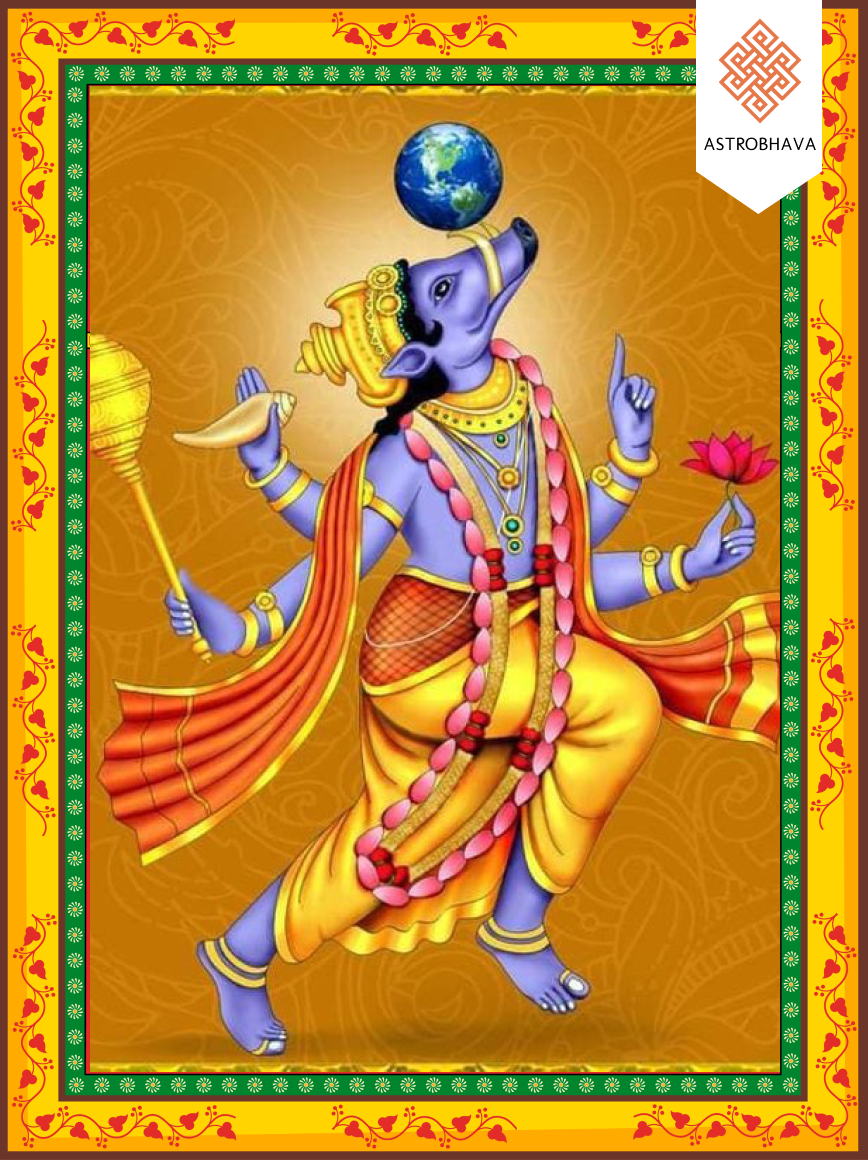
Bhoo Varaha is Vishnu’s boar incarnation, the form in which the earth herself, personified as Bhudevi, was raised from the dark waters of dissolution. Distinct from every other descent, he is defined by the single act of bearing the planet upon his curved tusk and by the permanent intimacy of the goddess who clings to him. The Vishnu Purana and the Varaha Purana present him not merely as a combatant against a demon but as the cosmic pillar that re-establishes continents, mountains and oceans in their proper stations. In temple sculpture his snout is lifted, one foot planted on the residual serpent, Bhudevi seated in the crook of his arm or balanced on the tusk. The svayambhu shrine at Srimushnam and the great relief at Mamallapuram preserve this iconography without admixture of other forms. He remains the deity whose body is the support of the soil itself.
Raising the Submerged Earth
According to the Bhagavata Purana, Canto Three, the demon Hiranyaksha seized the earth and dragged her into the depths of the single ocean that covered the worlds at the close of a kalpa. The gods appealed to Vishnu, who assumed the form of a gigantic boar, Bhoo Varaha. Diving into the waters he located Bhudevi, lifted her upon his white tusk, and rose through the flood. Hiranyaksha challenged him; the battle that followed shook the nether regions until the boar struck the demon down with his hoof. The same episode appears in the Vishnu Purana and is elaborated in the Varaha Purana, where the boar further instructs the earth goddess in the sacred knowledge of creation after she has been set once more between heaven and the underworld. Varaha then remains as her eternal support, the weight of mountains resting upon him. This is the myth that distinguishes Bhoo Varaha from every other descent of Vishnu: the rescue is not of a person or a city but of the ground itself.
The mantra, in six scripts
The seed mantra, and the form most devotees chant daily. No initiation is required — it is open to anyone, including a parent chanting for a child.
DevanagariSanskrit & Hindiॐ भूवराहाय नमः
Tamilௐ பூவராஹாய நமஃ
Teluguఓం భూవరాహాయ నమః
Kannadaಓಂ ಭೂವರಾಹಾಯ ನಮಃ
Malayalamഓം ഭൂവരാഹായ നമഃ
EnglishRoman transliterationoṃ bhūvarāhāya namaḥ
“Om, salutation to the Earth-Boar”
ॐ
oṃ — the sacred syllable
भूवराहाय
bhūvarāhāya — to the Earth-Boar
नमः
namaḥ — salutation
Aim is the mantra, in a sense. The rest is address and salutation; the seed syllable carries the goddess. Where a practitioner has been given a very short practice, it is often Aim alone.
The syllable people get wrong
In bhūvarāhāya the long ū of the opening bhū is the syllable that slips. Speakers commonly shorten it to a brief u, producing “bhu-varahaya” and losing the measured duration that marks the earth-syllable itself. The error collapses the name toward an ordinary short-vowel compound and erases the sonic weight tradition assigns to the recovered world.
When Bhoo Varaha is chanted
Weekday. Thursday
Festival. Varaha Jayanti
Questions
In several Puranic tellings the boar’s primary deed is the destruction of the daitya who had taken the earth. Bhoo Varaha, however, is named and imaged for the subsequent and more lasting act: the raising and steadying of Bhudevi herself. The Varaha Purana shifts emphasis onto the dialogue between the boar and the earth goddess after she has been set upon the waters again; he becomes her teacher and her permanent support. Temple traditions at places such as Srimushnam therefore show the goddess permanently associated with him, seated or standing beside the tusk, so that the deity is never only the combatant but the bearer of the world.
Early reliefs and later bronze images consistently place the earth goddess in direct contact with the boar’s body—either balanced on the left tusk, held against the chest, or standing on the palm. The snout is turned upward as though still emerging from the flood, and the right foot may rest upon the serpent who represents the residual waters. These elements do not appear together in other Vishnu forms; they fix the eye upon the single narrative of retrieval from the cosmic ocean and upon the intimacy between the avatar and the soil.
The Bhuvarahasvami temple at Srimushnam in Cuddalore district, Tamil Nadu, maintains an unbroken tradition of worship directed specifically to the earth-bearing boar. The deity there is a svayambhu image, and the local agamas treat him as the figure of the soil’s own stability. Parallel though later shrines exist at Khajuraho and in the Varaha mandapa at Mamallapuram, where the great relief of the boar lifting Bhudevi remains one of the clearest Pallava statements of the myth. In each case the liturgy and the festival calendar revolve around the recovery of the earth rather than around a generic Vishnu cult.
Not sure a mantra is enough?
Have your chart read before you decide
Chanting is yours to do, and free. But which deity your situation calls for — and whether a mantra alone is the right response — depends on your chart. Sometimes it is; sometimes it is not.
Brahmashree Shivaaya
Guru, Head of Astrological & Spiritual Solutions
Over 30 years in the Guru–Sishya Parampara, from the age of five
He reads every chart himself — 60 minutes, one to one, never delegated
Charts are read only between sunrise and sunset, following tradition
Chanting is yours to do. Some things are performed for you.
Where a matter carries real weight — an examination that decides a course, a performance, a child whose studies have stalled — devotees sponsor the homa alongside their own practice. Performed individually at our Yagna Ashram in your name and gotra, on a muhurta calculated from your chart, and telecast live so you can watch it done for you.