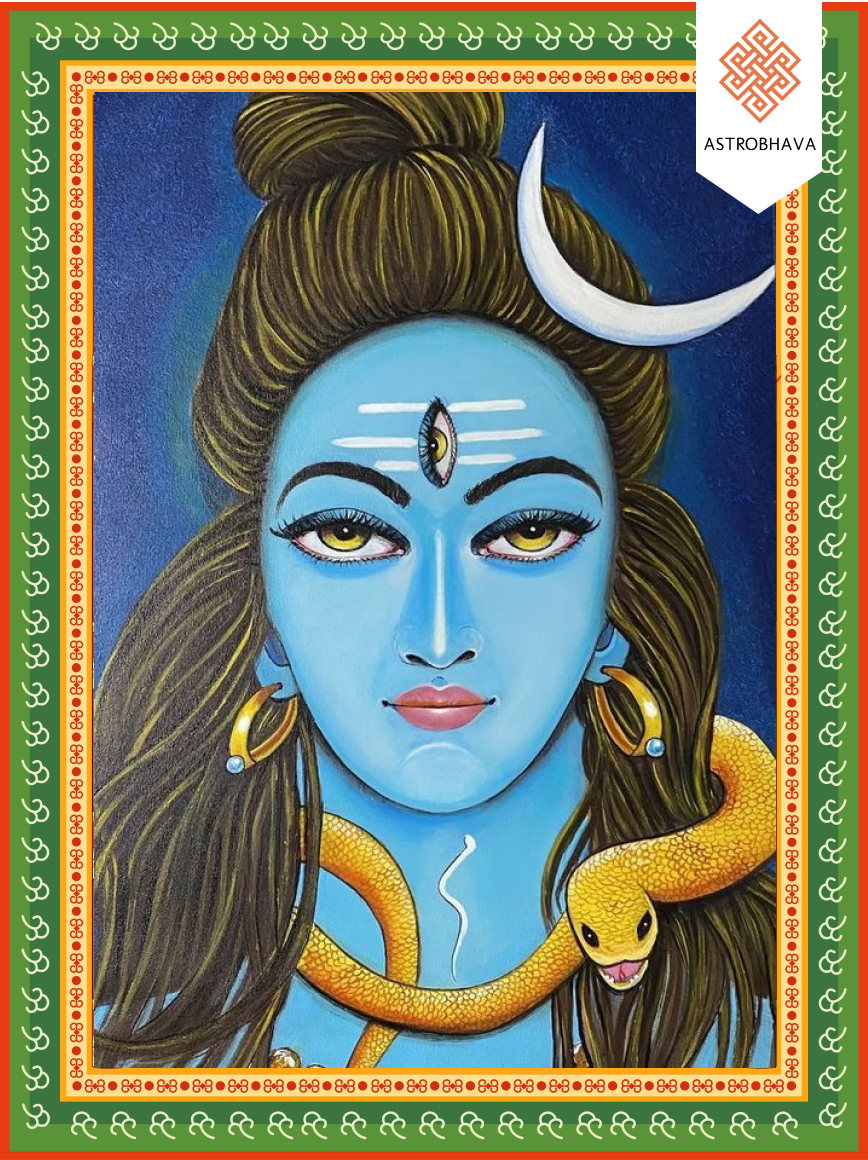
Mantra · The half-female form. For marital harmony.
Ardhanarishwara
ॐ अर्धनारीश्वराय नमः
In Devanagari, Tamil, Telugu, Kannada, Malayalam and English — with the meaning of every word, and the one syllable most people pronounce wrongly.
Who Ardhanarishwara is
Ardhanarishwara is the composite form in which the left half of the body is Devi and the right half is Shiva, a single standing figure whose vertical midline divides yet unites the two. The name itself—ardha half, nārī woman, īśvara lord—declares that neither half is accessory. In the iconography of Ellora, Elephanta, and the Chola bronzes, the left side bears the rounded breast, the curved hip, and the ornament of the Goddess, while the right side shows the broad shoulder, the matted jata, and the sacred thread of the ascetic. This is not a temporary embrace but a permanent ontological statement: the cosmos is neither purely masculine nor purely feminine, but an indivisible polarity held in one consciousness. Devotees who keep this form before them contemplate the inseparability of purusha and prakriti as a lived, bodily fact rather than an abstract doctrine.
When Sage Bhringi Circled
The Shiva Purana and the Skanda Purana recount that the sage Bhringi had vowed to circumambulate only Shiva, never the Goddess. Each time he approached Kailasa he walked a tight circle around the male form alone, pointedly ignoring Parvati. Seeing this, the Goddess withdrew her shakti from Bhringi’s body; the sage collapsed, reduced to a skeleton unable to stand. Shiva then restored him by giving him a third leg, yet the lesson remained incomplete. To demonstrate that no worship of Shiva can exclude Shakti, the Lord merged his own body with Parvati’s, becoming Ardhanarishwara. Bhringi, confronted by a single figure that was both, could no longer separate the two in his pradakshina. The same episode appears in the Tamil Tevaram hymns, where the poet-saints speak of the Lord who is ‘half Umā’ and therefore cannot be walked around as a solitary male. The form thus arises not from romantic union but from a pedagogical crisis: the refusal to acknowledge the feminine half of divinity forced divinity itself to display that half as inseparable flesh.
The mantra, in six scripts
The seed mantra, and the form most devotees chant daily. No initiation is required — it is open to anyone, including a parent chanting for a child.
Aim is the mantra, in a sense. The rest is address and salutation; the seed syllable carries the goddess. Where a practitioner has been given a very short practice, it is often Aim alone.
The syllable people get wrong
The long ī inside nārī is commonly shortened, so that speakers say ‘nari’ with a quick, clipped i as in English ‘nit’. The syllable must hold the full long ī—nā-rī—before the śva of śvarāya begins. Shortening it collapses the feminine half of the name into a hasty blur and erases the very balance the form proclaims.
When Ardhanarishwara is chanted
Weekday. Monday
Festival. At the Ardhanareeswarar Temple in Tiruchengode, Tamil Nadu, the annual Brahmotsavam in the Tamil month of Vaikasi centres on the processional bronze of the half-female form, an observance unique to this murti.
Questions
Classical iconometric texts such as the Shilpa Ratna and the Karanagama prescribe the left side for the feminine principle and the right for the masculine, following the traditional association of vama with Shakti and dakshina with Shiva. The division is therefore canonical, not arbitrary.
Yes. The Tevaram hymns of Appar and Sambandar already address the Lord as ‘one whose left is the Lady’, and the Tirumandiram of Tirumular contains explicit meditations on the single body that is both.
In temple liturgy the form is treated as a distinct murti with its own dhyana verses and offerings, yet theologically it is understood as the revelation that Shiva and Shakti were never two. The distinction is ritual, not ontological.
Not sure a mantra is enough?
Have your chart read before you decide
Chanting is yours to do, and free. But which deity your situation calls for — and whether a mantra alone is the right response — depends on your chart. Sometimes it is; sometimes it is not.
Brahmashree Shivaaya
Guru, Head of Astrological & Spiritual Solutions
Over 30 years in the Guru–Sishya Parampara, from the age of five
He reads every chart himself — 60 minutes, one to one, never delegated
Charts are read only between sunrise and sunset, following tradition
Chanting is yours to do. Some things are performed for you.
Where a matter carries real weight — an examination that decides a course, a performance, a child whose studies have stalled — devotees sponsor the homa alongside their own practice. Performed individually at our Yagna Ashram in your name and gotra, on a muhurta calculated from your chart, and telecast live so you can watch it done for you.