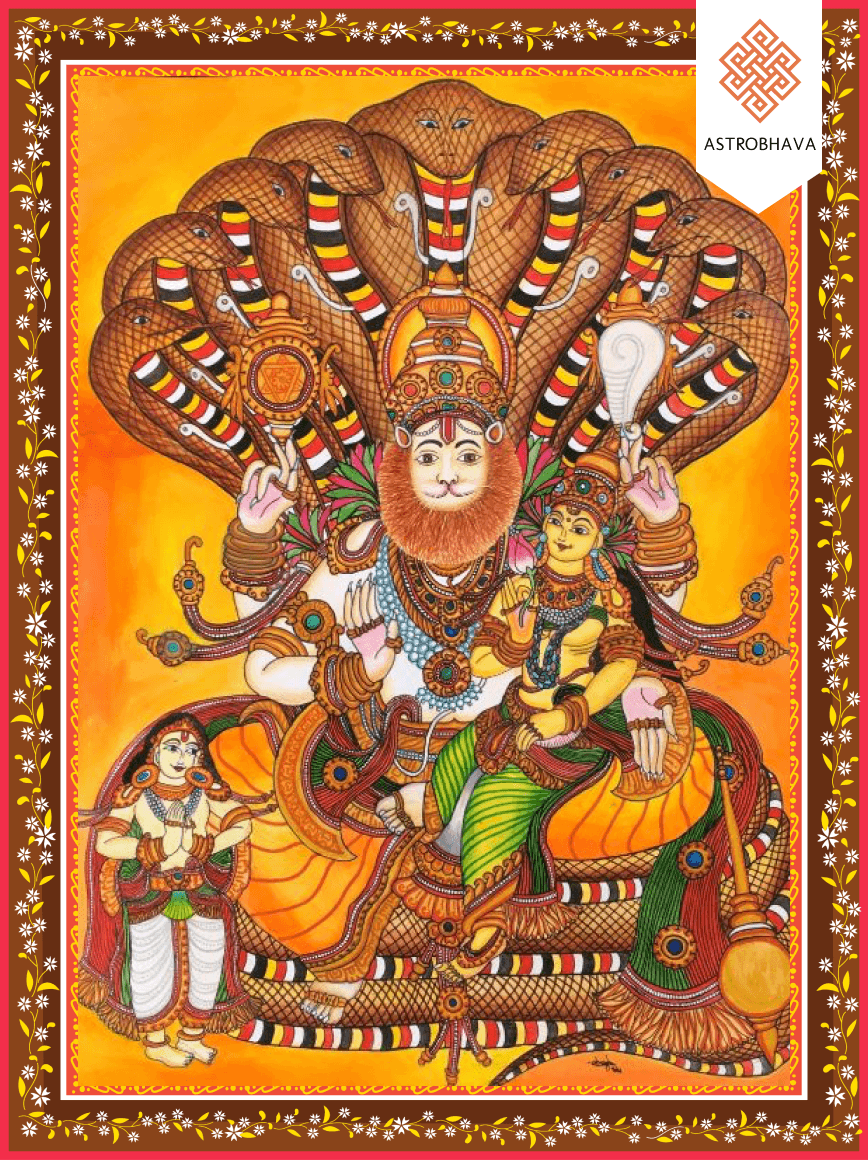
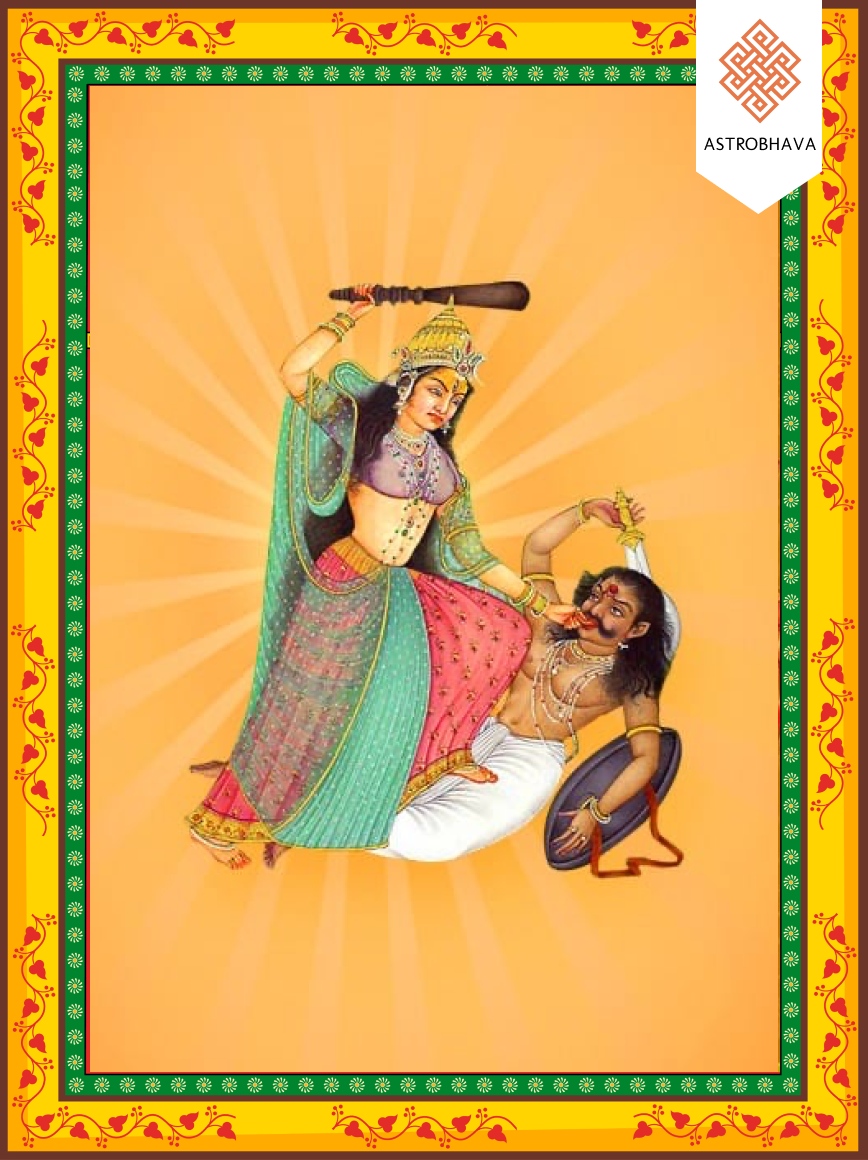
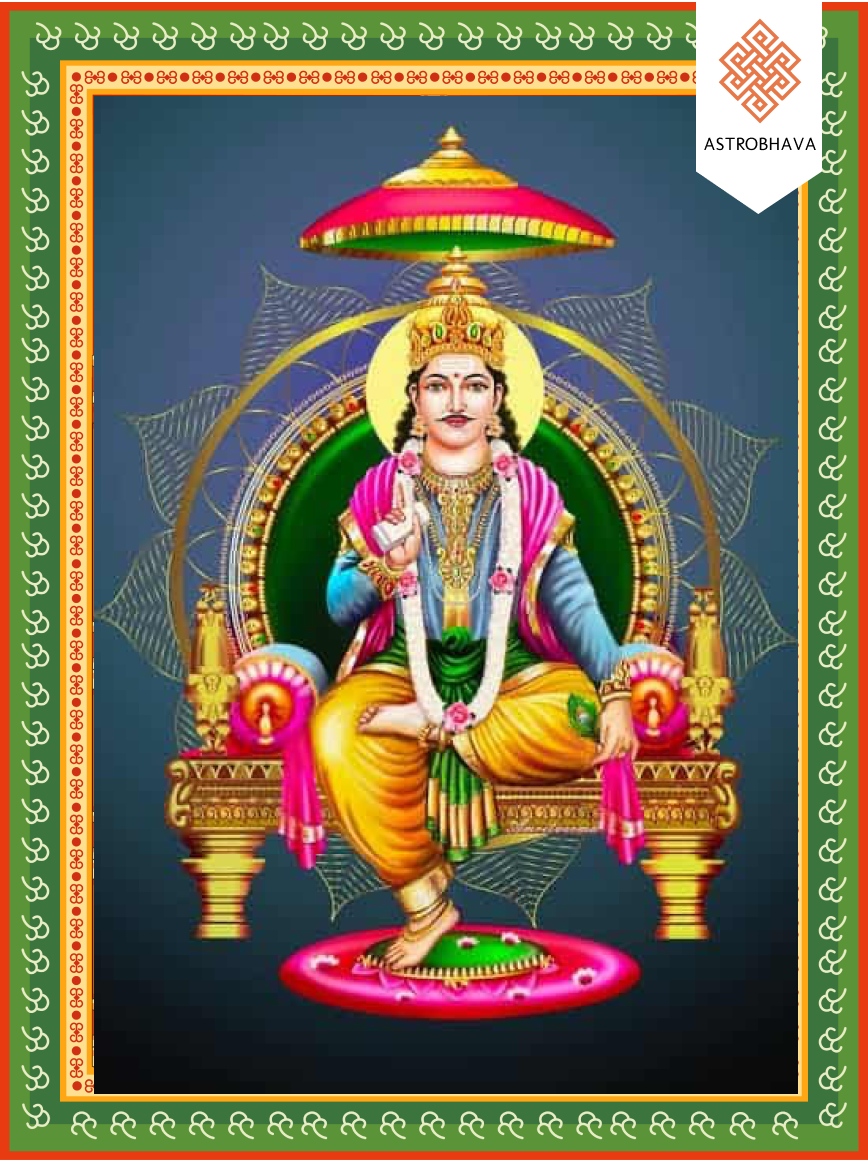
The Narasimha Homa is a fire offering to the man-lion form of Vishnu, the one who appeared at dusk on a threshold to keep a vow that seemed impossible to keep. That story is why this homa is turned to in legal matters. Hiranyakashipu's boon was a legal document in everything but name — airtight, precisely worded, drafted to leave no opening. Narasimha did not break it. He found the space inside it.
When a case drags, when papers pile up, when the other side seems to hold every clause, devotees offer this homa. Priests kindle the fire at our Yagna Ashram, invoke Narasimha with his fierce mantras, and offer ghee, wood and herbs in your name and gotra. The tradition prescribes this rite for protection from hostile intent, for clarity of speech before authority, and for the steadiness to keep standing while a verdict is awaited. You watch the fire live, wherever in the world you are.
उग्रं वीरं महाविष्णुं ज्वलन्तं सर्वतोमुखम् । नृसिंहं भीषणं भद्रं मृत्युमृत्युं नमाम्यहम् ॥ I bow to Narasimha — fierce and valiant, the great Vishnu, blazing and facing every direction, terrifying yet auspicious, the death of death itself.
Why Devotees Book This
Among the narasimha homam benefits named in tradition, these are the ones devotees facing legal matters come for.
Relief in pending court cases
Offered when a matter is stuck — adjournment after adjournment, no date that holds. The rite is prescribed for movement where things have stalled.
Protection from hostile intent
Narasimha is invoked as the guardian who appears when the opponent seems untouchable. Devotees seek his shelter through false accusation and pressure.
Clarity before authority
Traditionally undertaken before a hearing, a deposition or a signing — for a steady voice and an unclouded mind when you must speak for yourself.
Strength through a long fight
Litigation wears people down. The homa is offered for the endurance to keep showing up, and for sleep that returns at night.
Untangling documents and clauses
The lore of Narasimha is the lore of a loophole found. Devotees offer this rite over property disputes, contracts and inheritance knots.
Freedom from lingering fear
Among narasimha puja benefits, tradition places release from bhaya — the low, constant dread that a case leaves in a household.
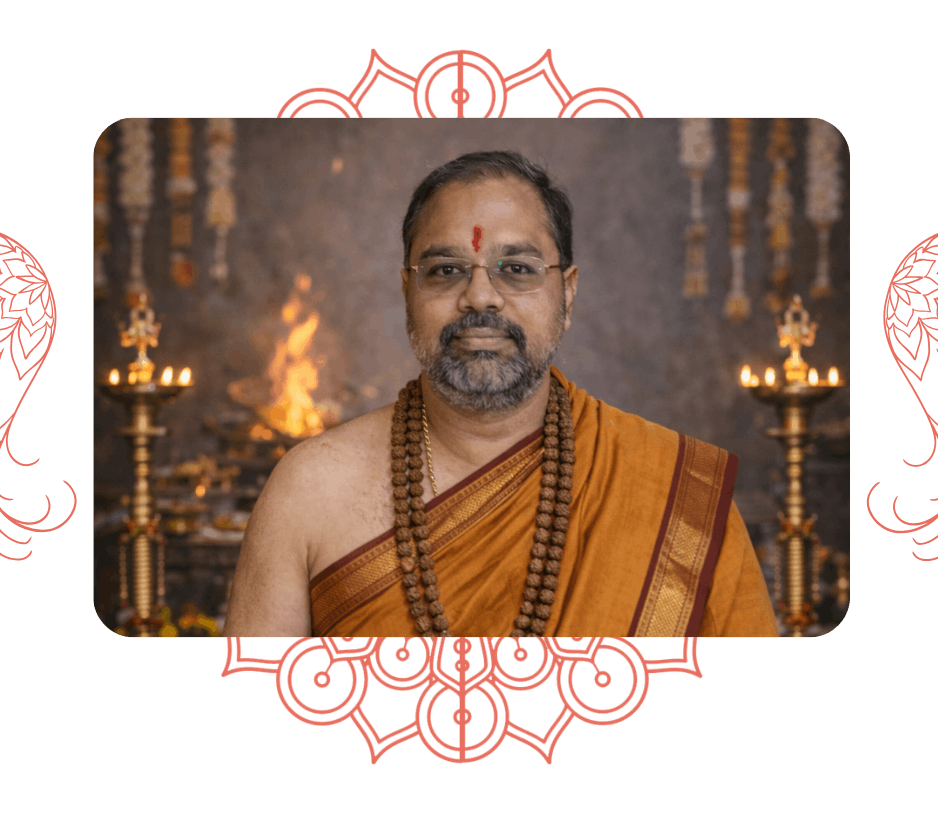
Brahmashree ShivaayaGuru, Head of Astrological & Spiritual Solutions
Who performs your homa
Under the guidance of Brahmashree Shivaaya
Every priest who performs your Narasimha Homa is trained in a traditional Padashala and personally recruited by Brahmashree Shivaaya — Guru and Head of Astrological & Spiritual Solutions at AstroBhava. Your ritual is conducted at our own Yagna Ashram — never a rented venue — with temple rites performed across our seven temples in Tamil Nadu and Kerala.
Step 2 Enhance with the 48-Day Anushthan? (optional)
* Copper yantra plate approx. 1–2 inches, rolled and sealed inside a silver amulet approx. 2–4 inches. Sizes are approximate and the amulet's design varies between supplier batches — shape, metal and consecration remain the same.
Your packageTrayi Narasimha Homa3 Priests + Free Yantra
—
All prices are all-inclusive — no shipping charges, no additions at checkout. See everything included →
1
You book — and send birth details at checkout.
2
Within 24–48 working hours — your muhurta is confirmed by email.
3
The day before — your telecast link arrives by email.
4
After the homa — tracking email with your personal time to wear the yantra.
Sacred Timing
Certain days carry Narasimha's presence more strongly. Our priests fix the muhurat for you from your birth details and your case dates.
Narasimha Jayanti
Vaishakha Shukla Chaturdashi, at sandhya — the exact hour of his appearance. The most powerful narasimha swamy pooja day of the year for this homa.
Swati nakshatra
Narasimha's own birth star. Priests favour it each month for the homa, particularly for matters already before a court.
Saturday and Chaturdashi
Saturday belongs to Vishnu's fierce forms; Chaturdashi carries the threshold energy of his advent. Both are held suitable for legal intent.
Before a hearing date
Many devotees book the homa in the days immediately preceding a listed hearing, a judgement date or the filing of a critical document.
Every package, and the 48-day option
What you receive
The sealing of the yantra
When your homa concludes, the yantra that stood in the fire is rolled and locked inside its silver amulet according to Agama vidhi — the practice by which the energies raised in a ritual are held within a consecrated object rather than dispersing. It is why a homa performed at our ashram can still reach a devotee ten thousand miles away: what the fire raised travels to you, sealed.
Personal sankalpa
Your name, gotra & nakshatra — for you and up to five family members.
Live telecast
Watch your own homa in real time from the ashram. Streamed openly on our YouTube channel by default — or request a private, unlisted telecast at checkout.
Free energised Narasimha Yantra, sealed in a silver amulet
Consecrated over three days — Jala (holy-water consecration with mantras), Prana (life force through pranayama & chants) and Jeeva Pratishta (awakened with 108 recitations & offerings) — then present through your homa, receiving the energies raised in the fire. Immediately afterwards it is rolled and sealed inside a silver amulet by Agamic rite, locking those energies within, and shipped to you with your prasadam.
Prasadam, shipped free
Sacred vibhuti, sandalwood powder & kumkum from your fire — delivered to any country.
48-Day Anushthan (optional)
Daily temple worship for 48 days — the 27 Nakshatras + 12 Rashis + 9 Planets — then sealed in a silver amulet of approximately 2–4 inches.
A note on sacred tradition
As per strict Agama vidhi, no videography is permitted inside the temple sanctum — this preserves the pure sacred energies and undisturbed divine focus of the ritual. The main homa is respectfully telecast live from outside the sanctum; the daily rituals of the 48-day Anushthan are performed with full devotion but are not telecast.
Homas are telecast openly on our YouTube channel so that devotees everywhere may witness the rituals — and because we believe you should be able to see our work before you trust us with yours. Your sankalpa names you and your family, so if you would rather your ceremony were not public, choose the private telecast option at checkout and it is streamed as an unlisted link visible only to you.
We state this plainly — transparency about what tradition forbids filming, and about what is public, is part of performing these rituals honestly.
After it arrives
How to wear your energised Narasimha Yantra
The energised yantra is carefully rolled and sealed inside a sacred silver amulet before shipping. Wearing it is itself a small ritual — and even its timing is set for you personally.
01
Your auspicious time to wear it
Our astrologer marks the auspicious date and time to wear the yantra according to your birth details — sent to you in the email carrying your shipment's tracking number.
02
Purify the amulet
Dip the silver amulet in raw milk or Ganga jal for an hour before wearing, then clean with normal water.
03
Face East or North
Perform the wearing process facing east or north for maximum benefit.
04
Offer dheep & dhoop
Show lamp and incense to the amulet before wearing it.
05
Wear it
Around your neck or waist, on a thread or chain.
06
Keep the energy intact
Repeated offering of dheep and dhoop keeps the energisation alive.
07
If you prefer not to wear it
Place the amulet at your puja altar, or keep it in your wallet.
Inside the fire ritual
How your Narasimha Homa is performed
01
Sankalpa
The priest states your name, gotra and nakshatra — and those of up to five family members — with the intention this homa is performed for.
02
Ganapati Puja
The customary invocation to Ganapati, clearing obstacles before the goddess is approached.
03
Agni Pratishtha
The fire is consecrated in the homa kunda and Agni invoked as the carrier of every offering that follows.
04
Narasimha Avahana
The Narasimha Sukta and Narasimha Gayatri are chanted, inviting the goddess's presence into the fire — by one, three or five priests as your package sets.
05
Ahuti
Ghee, white flowers, akshata and honey are offered in sequence with mantra — the offerings traditional to her worship.
06
Purnahuti
The final complete offering seals the sankalpa stated at the opening.
07
Aarti & Dispatch
Aarti is performed live on your telecast. Vibhuti, sandalwood powder, kumkum and your energised yantra are then packed and shipped free to your door.
Who is invoked
Narasimha — the goddess of knowledge itself
Narasimha is one of the Tridevi and the mother of the Vedas — the presiding deity of knowledge, learning, memory, speech, music and every art. She is depicted in white upon a white lotus, holding the veena, a book, a rosary and a water pot, with the swan of discernment beside her.
In this homa, her grace — Narasimha Kataksham — is invoked through fire with your own name and birth details spoken in the sankalpa.
Sarathi, our free AI ritual guide, recommends the traditional ritual for your situation instantly. For a full reading of your chart, book a live session with our astrologers — the fee is fully credited when you book any ritual.
Yes. Narasimha is fierce in form but gentle to those who take refuge in him, and household worship of him is an old and settled practice across South India. Lamp, water, tulsi, a simple naivedya and the Narasimha mantra are enough. Many families also read the Narasimha Kavacham. His fierceness is directed outward, at what threatens the devotee — never at the home that honours him.
Bathe, face east, and light a lamp before his image. Offer water, sandal paste, flowers — red and yellow are favoured — and tulsi leaves, which he loves. Chant the Ugram Veeram mantra or the Narasimha Kavacham as many rounds as you can hold steady. Offer panakam, cooked rice or fruit as naivedya, then sit quietly for a minute before rising. For narasimha pooja at home during a court matter, many devotees keep this daily until the case is decided.
Yes. Traditionally the Yoga Narasimha or Lakshmi Narasimha forms — seated, composed, with Lakshmi on his lap — are preferred for a home shrine over the fiercest battle-posture images, which are kept in temples where daily agama worship can be sustained. Whichever form you keep, worship it regularly rather than leaving it unattended.
The homa kunda is set and the fire faced according to the sankalpa and the purpose. For most Narasimha homas priests face east; for rites emphasising protection from hostility, a southward or specific directional orientation is sometimes prescribed by the tradition the officiating priest follows. At our Yagna Ashram the vedic scholars conducting your homa fix the direction, kunda shape and orientation as the shastra for that sankalpa requires — you need not arrange anything.
Narasimha homam is a Vedic fire ritual in which offerings are made into consecrated fire while the mantras of Lord Narasimha are chanted. It is classically prescribed for protection, for relief from enemies and hostile intent, and — because of the story of the boon he outwitted — for those caught in legal disputes and court proceedings.
Yes. A framed picture of Narasimha, especially Lakshmi Narasimha or the seated Yoga Narasimha, is entirely suitable for a home puja space. Keep it in the shrine or on a clean north-east wall, not in a bedroom facing the bed or in a store area, and offer a lamp before it regularly.
This is the most recommended form for a household. With Goddess Lakshmi seated on his left, Narasimha's fierceness is softened by her presence, and the pair is worshipped for both protection and prosperity. Families facing litigation often keep this form and light a lamp before it each evening.
It is a fire offering to Vishnu's man-lion avatar, the one who appeared neither by day nor night, neither inside nor outside, to honour a vow within an unbreakable condition. That precision is its significance for legal matters. Devotees offer it when a case turns on wording, on timing, on a clause — and when they need the courage to stand before a bench and be heard.
Tradition prescribes it for relief in pending court cases, protection from false accusation and hostile intent, clarity of speech before authority, endurance through long litigation, and release from the fear that a legal battle leaves behind. These are the purposes the rite is offered for; the outcome of any case rests with the court and with the divine.
Anyone with a matter before a court, tribunal or authority — a property dispute, a contract disagreement, an inheritance case, a professional inquiry. It is also offered by those facing sustained opposition or ill-will. You do not need to attend or perform anything yourself; our priests perform it on your behalf in your name, nakshatra and gotra.
Narasimha Jayanti at dusk is the foremost occasion. Swati nakshatra, his birth star, recurs each month and is strongly favoured. Saturdays and Chaturdashi tithis are also held suitable. Beyond these, most devotees ask for the homa in the days before a listed hearing or judgement date, and our panchanga scholars fix the muhurat accordingly.
Priests begin with achamana, Ganapati puja and the sankalpa taken in your name, gotra and nakshatra, stating your purpose. The kunda is prepared and Agni invoked. Narasimha is installed and worshipped with the shodashopachara. Then the principal offerings: ghee, palasha and other prescribed samidha, havis, black sesame, and herbs, made with the Narasimha mula mantra and Kavacham through the required count. Purnahuti closes the fire, followed by aarti, prasadam and the energising of your yantra. All samagri is arranged at the Ashram.
Book online from any country on this page. Send your name, birth star and gotra, and briefly mention the matter you are seeking relief in. Our scholars confirm a muhurat and share the live telecast link, so you can watch the fire wherever you are. Afterwards, prasadam and the energised yantra are couriered to your address worldwide at no extra charge. Narasimha homam cost is shown for your country on this page once you select an option.