In Devanagari, Tamil, Telugu, Kannada, Malayalam and English — with the meaning of every word, and the one syllable most people pronounce wrongly.
Who Vijaya Ganapathi is
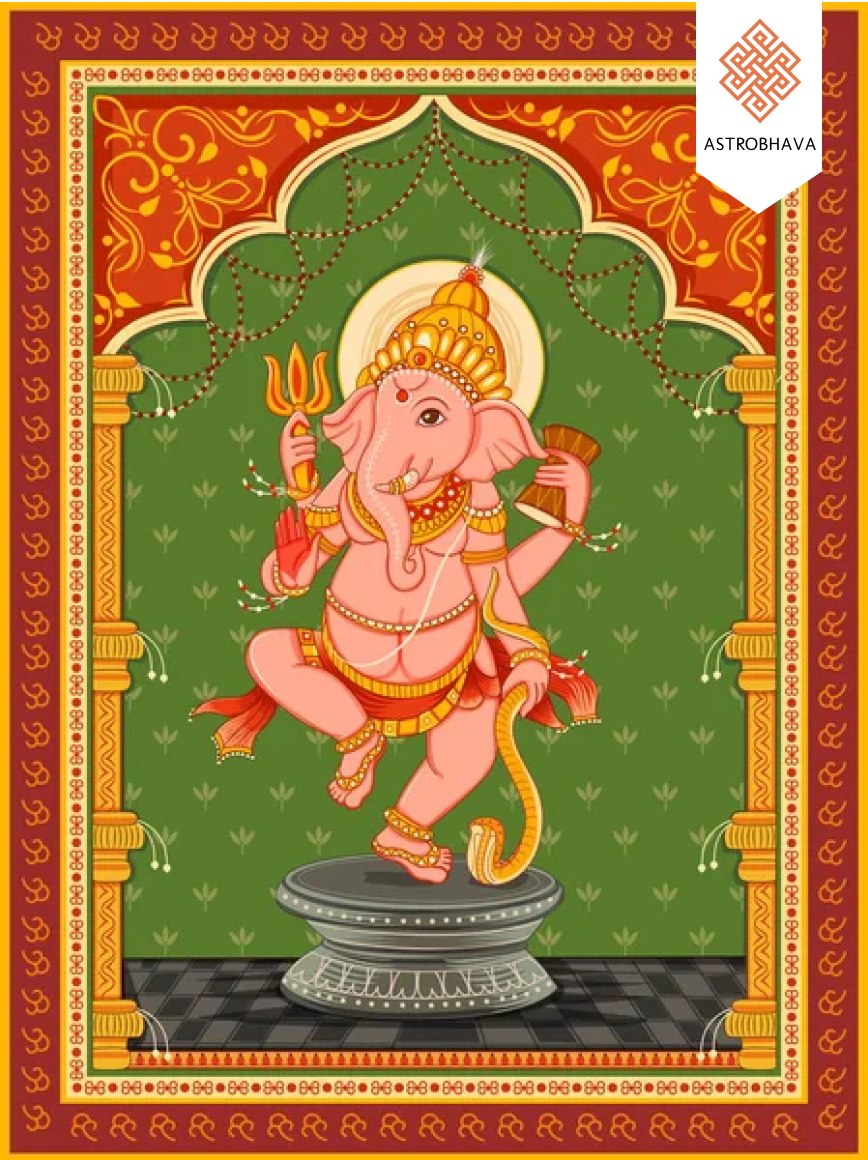
Vijaya Ganapathi is the aspect of Ganesha whose very name means the victorious one. Medieval dhyana verses portray him as red-hued, four-armed, and seated upon his mouse, holding the noose, the goad, the broken tusk and the mango. The form is invoked in the context of contests, formal disputes and any undertaking whose outcome is decided before witnesses. Unlike martial deities who brandish weapons of destruction, Vijaya Ganapathi carries the same gentle attributes found in quieter forms, the victory in question being the clear establishment of what is rightful rather than the crushing of an enemy. Sculptural manuals of the Chola and later periods record the precise disposition of the hands and the slight forward lean of the trunk that mark this murti.
The name that means victory
The Ganesha Purana and several South Indian sthala puranas speak of an occasion when the gods themselves faced an impasse that could be resolved only by a declared victor. Ganesha appeared in the red-limbed form later called Vijaya, not to wage war but to preside over the contest so that the rightful claim would stand unchallenged. In one Tamil tradition linked to a riverside shrine, two rival parties agreed to abide by the judgment rendered before the image of Vijaya Ganapathi; the deity’s presence alone was held to make falsehood impossible. The Mudgala Purana lists Vijaya among the forms whose work is the removal of the final obstruction that keeps a just result from emerging. Iconographers therefore give him the mango fruit, symbol of the sweet conclusion already contained within the struggle, rather than a sword. The mouse remains his vehicle, indicating that even victory moves by small, precise steps rather than by overwhelming force.
The mantra, in six scripts
The seed mantra, and the form most devotees chant daily. No initiation is required — it is open to anyone, including a parent chanting for a child.
Aim is the mantra, in a sense. The rest is address and salutation; the seed syllable carries the goddess. Where a practitioner has been given a very short practice, it is often Aim alone.
The syllable people get wrong
The second syllable ja in Vijaya is the plain palatal stop ज. It is often replaced by the heavier English affricate of the word judge, or even by a voiced zh sound. Tradition keeps the contact light and brief, without the trailing friction that English speakers habitually add.
When Vijaya Ganapathi is chanted
Weekday. Tuesday
Questions
Iconographic verse explains the mango as the already-sweet outcome that victory simply reveals; it is not a weapon but the fruit of a contest rightly concluded.
No. Although the name means victorious, the dhyana texts give him the same noose, goad and tusk borne by peaceful aspects; the victory is juridical and declarative rather than destructive.
Medieval dhyana slokas attached to the thirty-two forms uniformly assign a red or vermilion body to Vijaya Ganapathi, distinguishing him from golden or pure-white murtis.
Not sure a mantra is enough?
Have your chart read before you decide
Chanting is yours to do, and free. But which deity your situation calls for — and whether a mantra alone is the right response — depends on your chart. Sometimes it is; sometimes it is not.
Brahmashree Shivaaya
Guru, Head of Astrological & Spiritual Solutions
Over 30 years in the Guru–Sishya Parampara, from the age of five
He reads every chart himself — 60 minutes, one to one, never delegated
Charts are read only between sunrise and sunset, following tradition
Chanting is yours to do. Some things are performed for you.
Where a matter carries real weight — an examination that decides a course, a performance, a child whose studies have stalled — devotees sponsor the homa alongside their own practice. Performed individually at our Yagna Ashram in your name and gotra, on a muhurta calculated from your chart, and telecast live so you can watch it done for you.