In Devanagari, Tamil, Telugu, Kannada, Malayalam and English — with the meaning of every word, and the one syllable most people pronounce wrongly.
Who Vidya Rajagopala is
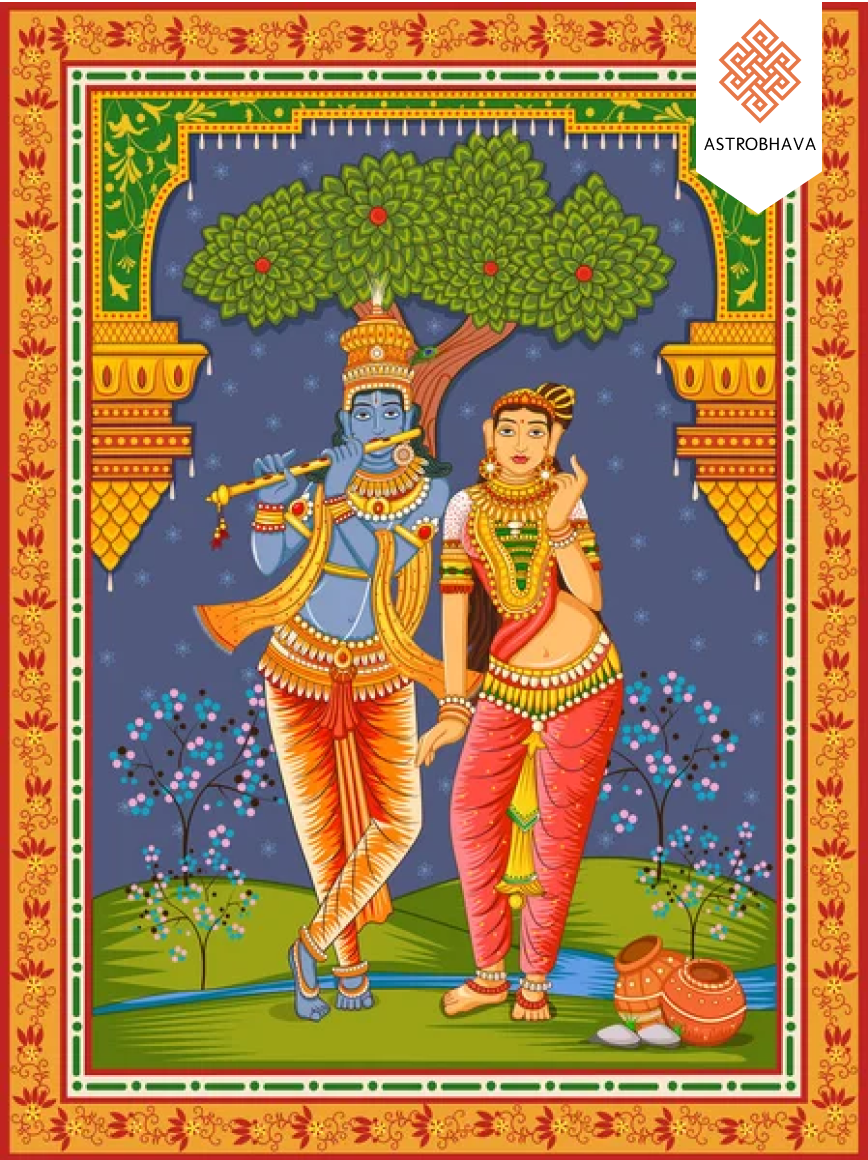
Vidya Rajagopala is a South Indian form of Krishna in which the cowherd prince appears simultaneously as sovereign and as the inner preceptor of sacred learning. Enshrined most prominently at Mannargudi in Tamil Nadu under the name Rajagopalaswamy, he is distinguished by the epithet Vidya that prefixes his pastoral title. Iconography shows him dark-hued, flute in hand, yet often accompanied by the gesture of exposition or a palm-leaf manuscript, uniting the Vrindavan lila with the dignity of a teacher of the Vedas and the arts. Sri Vaishnava and Smarta lineages regard this aspect as the deity before whom the first letters of a child were traditionally traced in rice, marking the formal entry into study. Unlike Gopala forms that dwell solely on play or romance, Vidya Rajagopala carries the quiet authority of one who has already mastered every syllable yet still wears the forest garland.
Sage and the Flute-King
The Sthala Purana preserved at the Rajagopalaswamy temple of Mannargudi recounts that a sage, having exhausted the outer limbs of knowledge, performed austerities beside the Haridra river in search of living insight. Krishna manifested not as the butter-thief of common lore but as Vidya Rajagopala, the cowherd king who held both flute and the radiance of sovereignty. The deity demonstrated that the seven notes of the flute already contain the phonetic structure of the Vedas, and that true learning arises when sound is heard as instruction rather than mere melody. Local Tamil recensions add that scholars versed in grammar and logic still approached this form to receive the final clarification that no commentary could supply. The episode, unique to this manifestation, establishes Vidya Rajagopala as the point where pastoral simplicity and intellectual depth become a single presence, a theme nowhere else attached to Krishna in quite this register.
The mantra, in six scripts
The seed mantra, and the form most devotees chant daily. No initiation is required — it is open to anyone, including a parent chanting for a child.
śrīvidyārājagopālāya — to the glorious Vidyā Rājagopāla
नमः
namaḥ — salutation
Aim is the mantra, in a sense. The rest is address and salutation; the seed syllable carries the goddess. Where a practitioner has been given a very short practice, it is often Aim alone.
The syllable people get wrong
In śrīvidyārājagopālāya the conjunct dyā of vidyā is the recurring difficulty. Speakers commonly detach the palatal glide, producing a broken vi-dyā or even vid-yā with an inserted vowel, instead of the single compact syllable in which d and y share one release before the long ā.
When Vidya Rajagopala is chanted
Weekday. Thursday
Festival. Panguni Brahmotsavam at Mannargudi
Questions
Standard Gopala icons emphasise the playful child or the romantic flute-player surrounded by gopis. Vidya Rajagopala retains the dark complexion, peacock feather and flute, yet frequently adds the vyakhyana mudra of exposition or a manuscript held in one hand. The posture is more upright, the gaze more composed, signalling the teacher rather than the dancer. Temple bronzes at Mannargudi further distinguish him by a subtle crown that blends pastoral flowers with a miniature kirita, visual shorthand for the union of cowherd and sovereign that the epithet Vidya alone conveys. No other Krishna form carries this precise combination of attributes.
The identity is anchored in the Mannargudi Sthala Purana and in later Sri Vaishnava paddhatis that list him among the archa forms suitable for the upanayana and aksharabhyasa rites. While the Bhagavata Purana supplies the general Gopala narrative, it is the regional Sanskrit and Tamil chronicles that affix the prefix Vidya and describe the deity’s role as revealer of syllabic knowledge. Smarta compilations of the eighteenth century also record him in lists of Krishna aspects invoked at the commencement of Vedic study, confirming that the compound name is not a modern invention but a recognised liturgical designation.
Mannargudi, known in inscriptions as Rajagopalapuram, developed around the temple whose moolavar is precisely this form. Medieval Chola and later Nayaka grants refer to the deity as Vidya Rajagopala or simply Rajagopala, and the town’s sacred geography—the Haridra river, the surrounding groves—is mapped onto the lila sites of the Sthala Purana. The annual Panguni festival re-enacts the royal procession of the cowherd king, reinforcing the link between the living settlement and the specific icon that bears the name Vidya. No other centre claims this exact conjunction of name, image and local legend.
Not sure a mantra is enough?
Have your chart read before you decide
Chanting is yours to do, and free. But which deity your situation calls for — and whether a mantra alone is the right response — depends on your chart. Sometimes it is; sometimes it is not.
Brahmashree Shivaaya
Guru, Head of Astrological & Spiritual Solutions
Over 30 years in the Guru–Sishya Parampara, from the age of five
He reads every chart himself — 60 minutes, one to one, never delegated
Charts are read only between sunrise and sunset, following tradition
Chanting is yours to do. Some things are performed for you.
Where a matter carries real weight — an examination that decides a course, a performance, a child whose studies have stalled — devotees sponsor the homa alongside their own practice. Performed individually at our Yagna Ashram in your name and gotra, on a muhurta calculated from your chart, and telecast live so you can watch it done for you.