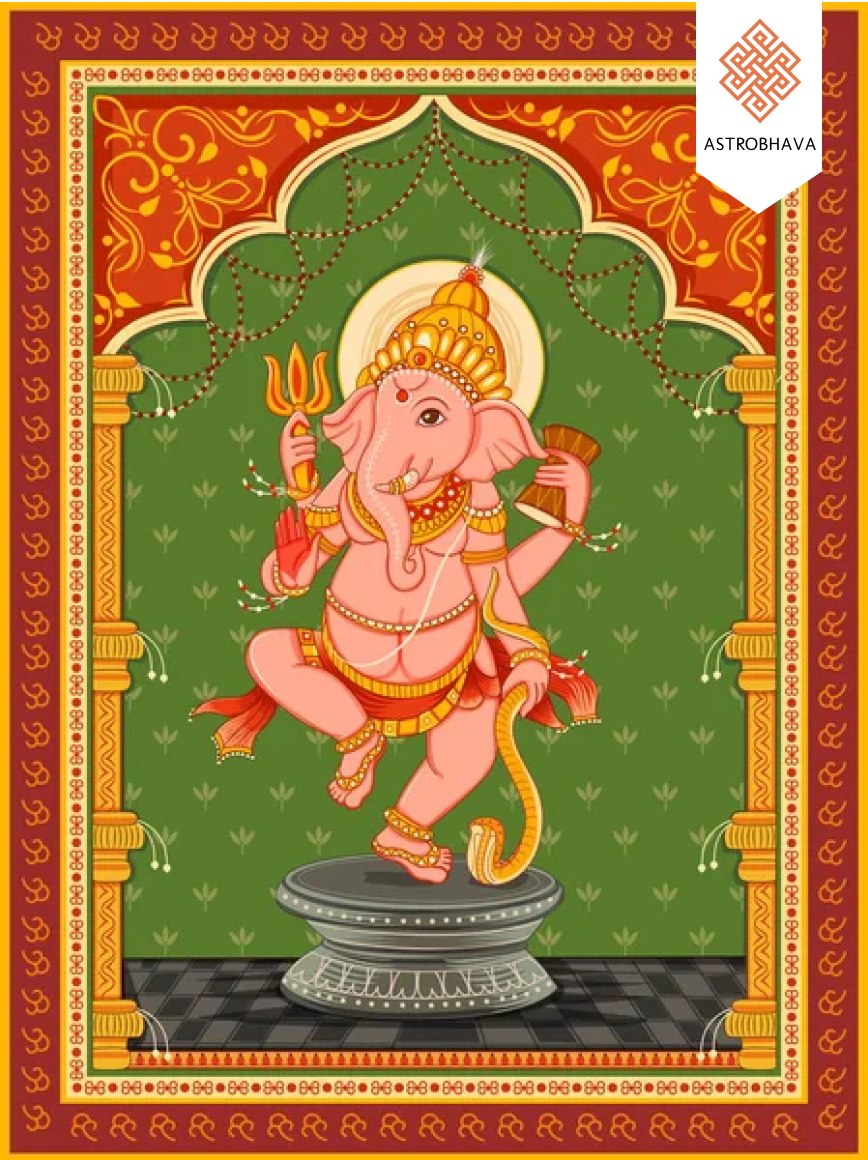
Mantra · For upward movement in career and standing.
Urdhva Ganapathi
ॐ ह्रीं ग्रीं ह्रीं ऊर्ध्वगणपतये नमः
In Devanagari, Tamil, Telugu, Kannada, Malayalam and English — with the meaning of every word, and the one syllable most people pronounce wrongly.
Who Urdhva Ganapathi is
Urdhva Ganapathi is the upward-trunked member of the thirty-two meditational forms of Ganesha set out in the Mudgala Purana and the iconographic digests that follow it. The name is built on the Sanskrit ūrdhva, that which rises or stands erect. Dhyana verses picture him vermilion-hued and three-eyed, seated with his shakti on the left thigh; the trunk itself lifts high and curls skyward instead of resting against the chest or sweeping to the side. Four hands carry the noose, the goad, a blue lily and a sheaf of ripe paddy. Among all the thirty-two aspects, only this form is defined by the vertical direction of the trunk; sculptors and painters therefore treat the raised curve as the non-negotiable mark that separates Urdhva Ganapathi from every neighbouring Ganapati.
Trunk Raised in the Mudgala List
The Mudgala Purana presents the thirty-two forms as successive supports for contemplation rather than as protagonists of separate adventure cycles. Urdhva Ganapathi enters that sequence solely through the prescription that his trunk must ascend. No lengthy narrative of battle or boon is attached to him alone; the text simply places the upward trunk among the other distinguishing attributes so that the mind may fasten on one unmistakable image. Later silpa manuals and paddhatis, drawing directly on the same puranic catalogue, repeat the rule with technical firmness: the carver is to show the trunk rising, never looped downward or held level across the body. This iconographic insistence becomes the effective ‘story’ by which the form is known. When the dhyana is recited, the raised trunk functions as the scriptural signature that keeps Urdhva Ganapathi distinct from Heramba, from Nritya Ganapati, and from the remaining members of the thirty-two. Tradition therefore treats the vertical trunk not as an optional flourish but as the visible hinge of the form’s identity whenever the name is invoked.
The mantra, in six scripts
The seed mantra, and the form most devotees chant daily. No initiation is required — it is open to anyone, including a parent chanting for a child.
“Salutations to Urdhva Ganapati, framed by the seed-syllables hrīṃ grīṃ hrīṃ.”
ॐ
oṃ — the pranava
ह्रीं
hrīṃ — seed-syllable hrīṃ
ग्रीं
grīṃ — seed-syllable grīṃ
ह्रीं
hrīṃ — seed-syllable hrīṃ repeated
ऊर्ध्वगणपतये
ūrdhvagaṇapataye — to Urdhva Ganapati
नमः
namaḥ — salutation
Aim is the mantra, in a sense. The rest is address and salutation; the seed syllable carries the goddess. Where a practitioner has been given a very short practice, it is often Aim alone.
The syllable people get wrong
The long ū that opens ūrdhva is often shortened to a quick English ‘u’, yielding ‘urdhva’ rather than the required ‘oordhva’. At the same time the conjunct rdhva is commonly flattened to ‘rdha’ or ‘rva’, so the very cluster that names the raised trunk disappears in ordinary recitation.
When Urdhva Ganapathi is chanted
Weekday. Tuesday
Questions
In the Mudgala Purana’s list of thirty-two forms the direction of the trunk is the single visual feature assigned to this aspect alone. The text offers no separate myth to explain the gesture; the upward curve is simply required so that the meditator’s eye and mind have an unambiguous mark by which to recognise the form.
References remain almost entirely inside the manuals that catalogue those thirty-two aspects. He does not take an independent role in the longer narrative cycles of the Ganesha Purana or in the epic literature, so his scriptural presence is iconographic rather than dramatic.
The dhyana shlokas describe him as raktavarṇa, of red or vermilion hue. That colour is shared with several other forms, yet it is paired only here with the lifted trunk, producing the combination that identifies him.
Not sure a mantra is enough?
Have your chart read before you decide
Chanting is yours to do, and free. But which deity your situation calls for — and whether a mantra alone is the right response — depends on your chart. Sometimes it is; sometimes it is not.
Brahmashree Shivaaya
Guru, Head of Astrological & Spiritual Solutions
Over 30 years in the Guru–Sishya Parampara, from the age of five
He reads every chart himself — 60 minutes, one to one, never delegated
Charts are read only between sunrise and sunset, following tradition
Chanting is yours to do. Some things are performed for you.
Where a matter carries real weight — an examination that decides a course, a performance, a child whose studies have stalled — devotees sponsor the homa alongside their own practice. Performed individually at our Yagna Ashram in your name and gotra, on a muhurta calculated from your chart, and telecast live so you can watch it done for you.