In Devanagari, Tamil, Telugu, Kannada, Malayalam and English — with the meaning of every word, and the one syllable most people pronounce wrongly.
Who Uddanda Ganapathi is
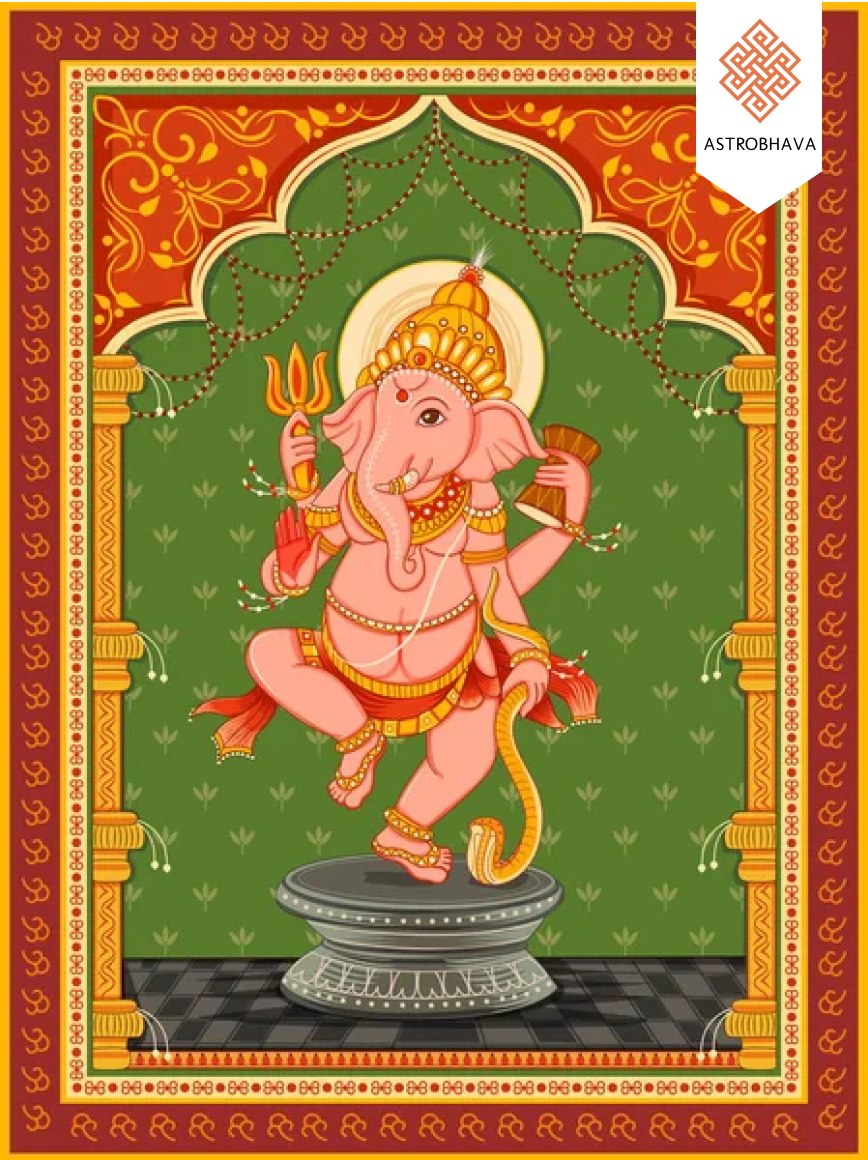
Uddanda Ganapathi is the staff-raised form counted among the thirty-two aspects of the Mudgala Purana and certain tantric paddhatis. The name uddaṇḍa means “one whose staff is lifted,” declaring perpetual readiness to correct. Iconography gives him a red complexion, three eyes, and ten arms that carry the staff held high, together with trident, discus, noose, bow, arrow, mace, lotus, broken tusk and modaka. The staff is never shown at rest; its elevation is the visual definition of the form. He is the aspect turned toward entrenched injustice rather than toward ordinary hindrance, the sudden clarity that reappears when law has been twisted into an instrument of harm. Sculptures and painted scrolls in coastal Karnataka and Kerala still isolate this ten-armed figure when the subject is the restoration of measure.
Staff Raised Over False Law
The Mudgala Purana and later tantric digests describe an age in which demon kings had rewritten dharma itself into a code that protected cruelty. The earth, unable to bear the weight of sanctioned wrong, called aloud. Ganesha arose as Uddanda, the staff already lifted above his head. He did not first negotiate; the raised rod struck the pillars of the counterfeit courts, and the weapons in his other hands scattered the armies that defended the inverted law. Yet the episode is framed as restoration, not annihilation. Once the false order lay broken, the same deity extended the modaka—the sweet of renewed equity—to those who laid down their claims. Oral versions preserved in Kerala tell of the staff becoming visible only to the guilty at the edge of a village long poisoned by feud; when the feud dissolved, the vision vanished. Uddanda Ganapathi therefore stands at the precise junction of wrath and fairness, the form whose lifted staff is the last warning before measure returns by force.
The mantra, in six scripts
The seed mantra, and the form most devotees chant daily. No initiation is required — it is open to anyone, including a parent chanting for a child.
“Salutations to Uddanda Ganapati, the lord whose staff remains raised.”
ॐ
oṃ — the primordial syllable
उद्दण्डगणपतये
uddaṇḍagaṇapataye — to the Ganapati whose staff is raised
नमः
namaḥ — salutations
Aim is the mantra, in a sense. The rest is address and salutation; the seed syllable carries the goddess. Where a practitioner has been given a very short practice, it is often Aim alone.
The syllable people get wrong
The doubled retroflex ḍḍ in uddaṇḍa is the distinctive hazard. Many speakers flatten both sounds into the ordinary dental d of English “sudden,” or insert a vowel that splits the name into u-dan-da. Each ḍ must be formed with the tongue-tip curled back to the palate, and the short a between them kept so brief that the cluster remains a single dense stroke.
When Uddanda Ganapathi is chanted
Weekday. Tuesday
Questions
Because the form’s defining function in the Mudgala Purana is continuous readiness to correct injustice; a lowered staff would imply that the possibility of redress had been suspended.
Uddanda’s narrative ends not with the enemy’s death but with the offer of the modaka once false law is broken, marking him as the restorer of equity rather than the agent of pure annihilation.
The ten arms allow the simultaneous display of the raised staff of correction and the full set of weapons and attributes—tusk, modaka, noose, discus—showing that severity and the means of renewed order are held at once.
Not sure a mantra is enough?
Have your chart read before you decide
Chanting is yours to do, and free. But which deity your situation calls for — and whether a mantra alone is the right response — depends on your chart. Sometimes it is; sometimes it is not.
Brahmashree Shivaaya
Guru, Head of Astrological & Spiritual Solutions
Over 30 years in the Guru–Sishya Parampara, from the age of five
He reads every chart himself — 60 minutes, one to one, never delegated
Charts are read only between sunrise and sunset, following tradition
Chanting is yours to do. Some things are performed for you.
Where a matter carries real weight — an examination that decides a course, a performance, a child whose studies have stalled — devotees sponsor the homa alongside their own practice. Performed individually at our Yagna Ashram in your name and gotra, on a muhurta calculated from your chart, and telecast live so you can watch it done for you.