In Devanagari, Tamil, Telugu, Kannada, Malayalam and English — with the meaning of every word, and the one syllable most people pronounce wrongly.
Who Tryakshara Ganapathi is
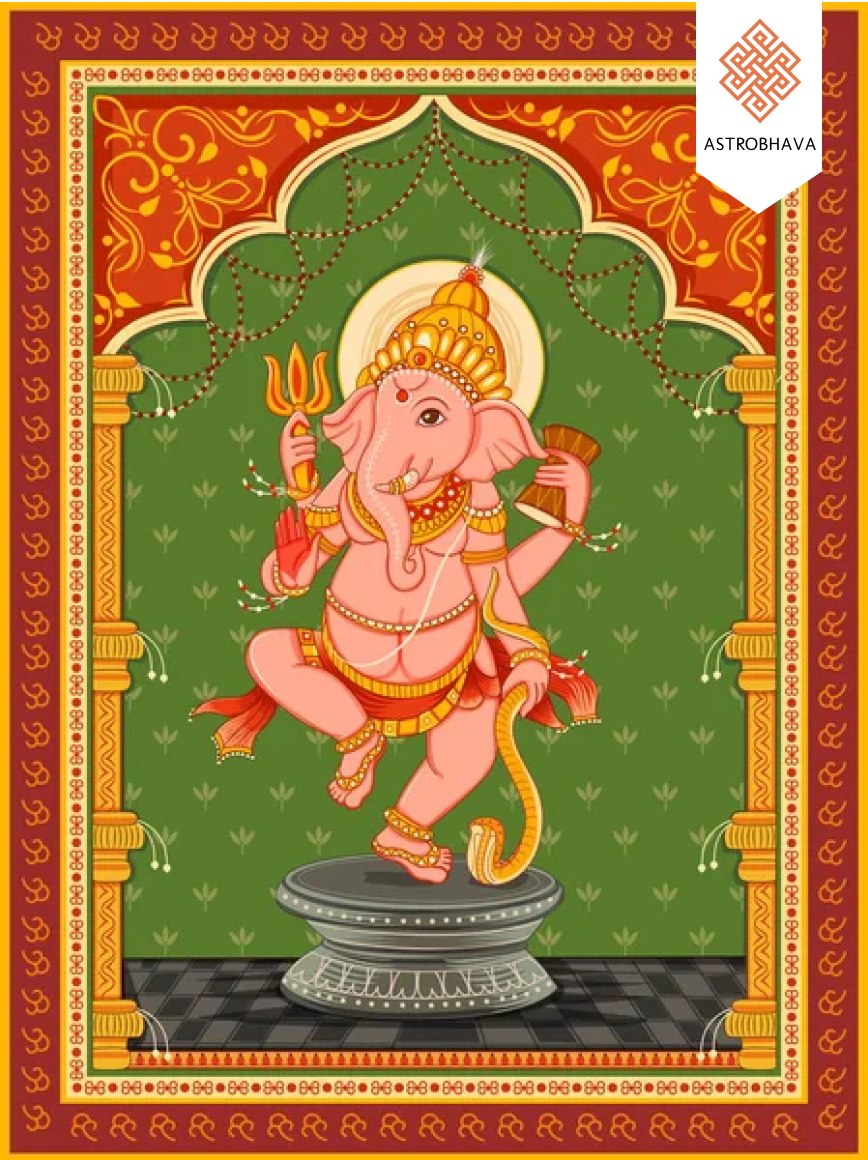
Tryakshara Ganapathi is the form of Ganesha whose entire identity is bound to three phonetic units alone. In the iconographic lists of the Mudgala Purana and the dhyana verses of the thirty-two classic forms, he is shown with a ruddy complexion, three eyes, and four arms that hold the noose, the goad, a modaka and the broken tusk. The designation Tryakshara does not describe a general quality of the elephant-headed lord; it names the precise triad of syllables that tradition assigns to this manifestation and to no other. He is contemplated as the deity in whom the three worlds contract into the single compact sound gaṃ, and his seat is given as a lotus of unstruck awareness rather than any ordinary throne or vehicle.
Three Syllables Made Visible
The Mudgala Purana recounts that the sage Mudgala, seeking a doorway into Ganesha that would not multiply into endless names, received a direct teaching from the lord himself. Ganesha appeared as Tryakshara and declared that the cosmos rests upon three irreducible sounds. Brahma, Vishnu and Rudra each claimed one syllable as their own support, yet the Purana insists the three remained inseparable within the single body of this form. The episode is not a battle narrative; it is a revelation in which the deity shows that gaṃ-na-maḥ is not a fragment of a longer formula but the whole of his presence compressed. Later Ganapatya paddhatis preserve the same account as the origin of the Tryakshara vidya, always linking the three eyes of the dhyana to the three akṣaras so that gaze and sound become one act. Iconographic digests such as the Śrītattvanidhi repeat the story whenever they list him among the thirty-two forms, confirming that the triad of syllables is his exclusive mark.
The mantra, in six scripts
The seed mantra, and the form most devotees chant daily. No initiation is required — it is open to anyone, including a parent chanting for a child.
DevanagariSanskrit & Hindiॐ गं नमः
Tamilௐ கம் நமஃ
Teluguఓం గం నమః
Kannadaಓಂ ಗಂ ನಮಃ
Malayalamഓം ഗം നമഃ
EnglishRoman transliterationoṃ gaṃ namaḥ
“Om. Salutation to the seed-syllable Gam.”
ॐ
oṃ — the praṇava
गं
gaṃ — Ganapati’s seed-syllable
नमः
namaḥ — salutation
Aim is the mantra, in a sense. The rest is address and salutation; the seed syllable carries the goddess. Where a practitioner has been given a very short practice, it is often Aim alone.
The syllable people get wrong
The anusvāra that closes gaṃ is the syllable’s own difficulty. Many speakers turn it into a hard final n, producing ‘gan’, or lengthen the vowel into ‘gaam’. The traditional close is a light nasal hum that dissolves against the soft palate without any full dental or retroflex stop, leaving the seed weightless yet complete.
When Tryakshara Ganapathi is chanted
Weekday. Tuesday
Questions
The name Tryakshara belongs only to the aspect whose mantra is the three phonetic units gaṃ-na-maḥ. Other forms carry longer formulae or different bījas; this one is defined by the triad of syllables themselves.
The Mudgala tradition links each eye to one of the three syllables, so that the deity’s gaze and the sound of the mantra are treated as a single act of perception.
Yes. The Śrītattvanidhi and several South Indian āgama paddhatis list him among the thirty-two classic forms, always with the same three-syllable mantra and the same four-armed, three-eyed description.
Not sure a mantra is enough?
Have your chart read before you decide
Chanting is yours to do, and free. But which deity your situation calls for — and whether a mantra alone is the right response — depends on your chart. Sometimes it is; sometimes it is not.
Brahmashree Shivaaya
Guru, Head of Astrological & Spiritual Solutions
Over 30 years in the Guru–Sishya Parampara, from the age of five
He reads every chart himself — 60 minutes, one to one, never delegated
Charts are read only between sunrise and sunset, following tradition
Chanting is yours to do. Some things are performed for you.
Where a matter carries real weight — an examination that decides a course, a performance, a child whose studies have stalled — devotees sponsor the homa alongside their own practice. Performed individually at our Yagna Ashram in your name and gotra, on a muhurta calculated from your chart, and telecast live so you can watch it done for you.