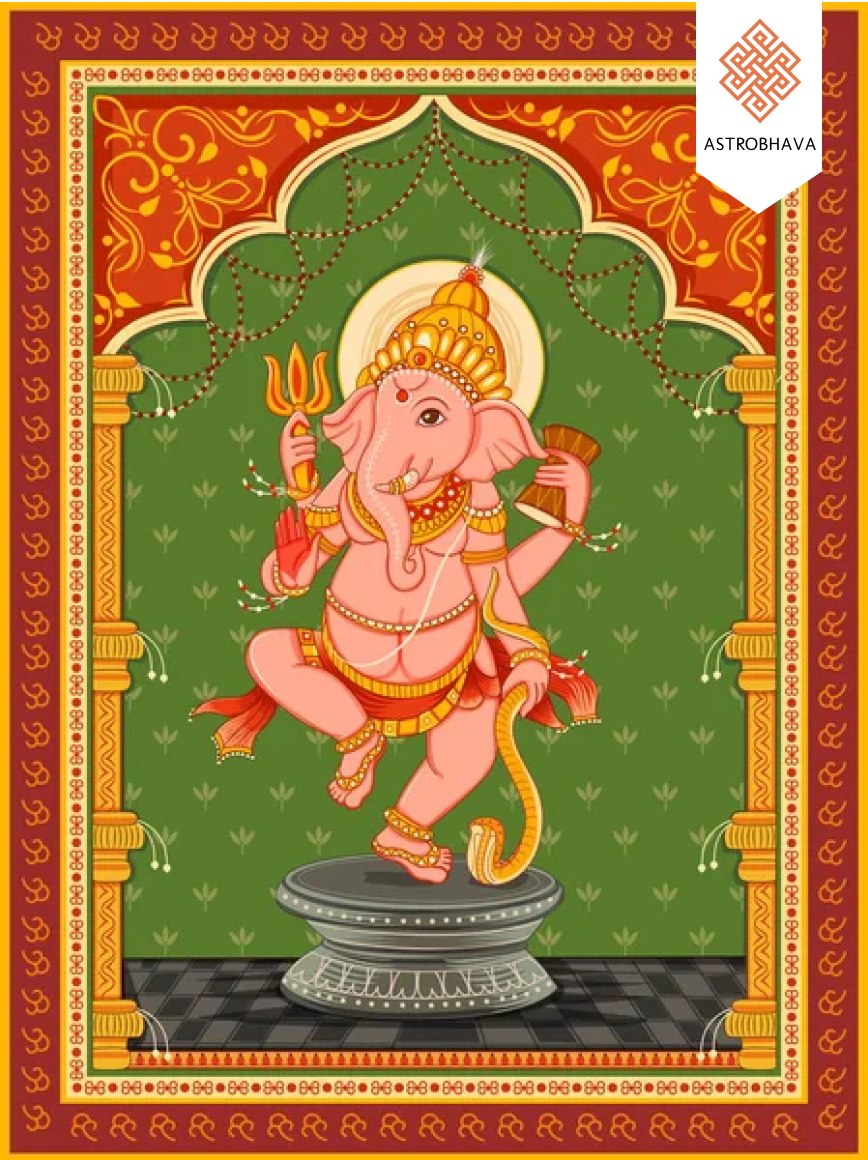
Mantra · For accomplishment of what has been begun.
Siddhi Ganapathi
ॐ सिद्धिगणपतये नमः
In Devanagari, Tamil, Telugu, Kannada, Malayalam and English — with the meaning of every word, and the one syllable most people pronounce wrongly.
Who Siddhi Ganapathi is
Siddhi Ganapathi is the aspect in which the elephant-faced lord is joined to Siddhi, the feminine principle of accomplished power. Within the classic lists of thirty-two forms, he is portrayed with four arms holding a bouquet of flowers, a ripe mango, a stalk of sugar-cane and a sesame-sweet modaka. The presence of Siddhi at his side, or the very name Siddhi attached to him, marks the deity as the one in whom an undertaking already begun reaches its finished state. His colour is described as golden or sun-bright, distinct from the crystal clarity of the student form or the red urgency of the swift form. Contemplation of Siddhi Ganapathi therefore centres on the quiet completion of work rather than on its inauguration or its sudden acceleration.
The Consort Named Accomplishment
Puranic and tantric sources that enumerate the thirty-two meditative forms of Ganesha place Siddhi Ganapathi beside the goddess Siddhi, whose name means the perfected result of any disciplined effort. The Mudgala Purana tradition and later iconographic digests describe the pair seated together; in some verses Siddhi is understood as an inseparable shakti rather than a separate figure. The objects held by the deity—flowers, mango, sugar-cane, sesame laddu—are all tokens of fruition: the flower that has opened, the fruit that has ripened, the cane that has sweetened, the sweet that has been prepared. No battle narrative attaches to this form. Instead the texts present a still tableau of completion. Later Maharashtrian devotion to Siddhivinayaka draws upon the same conceptual field, though the temple legend of that shrine is independent. What remains constant across the sources is the insistence that Siddhi Ganapathi is the face of the lord turned toward the finished act, the work that has already been carried through its middle stages and now stands ready for its seal.
The mantra, in six scripts
The seed mantra, and the form most devotees chant daily. No initiation is required — it is open to anyone, including a parent chanting for a child.
“Salutation to Ganapati who is joined with accomplishment.”
ॐ
oṃ — the primordial seed-syllable
सिद्धि
siddhi — accomplishment, perfected power
गणपतये
gaṇapataye — to the lord of the ganas
नमः
namaḥ — salutation
Aim is the mantra, in a sense. The rest is address and salutation; the seed syllable carries the goddess. Where a practitioner has been given a very short practice, it is often Aim alone.
The syllable people get wrong
In siddhi the doubled consonant ddhi is commonly reduced to a single soft “dhi,” producing “sidhi.” The cluster requires a brief but distinct stop of the tongue against the palate before the aspirated release; without that stop the name loses the weight the tradition assigns to perfected power.
When Siddhi Ganapathi is chanted
Weekday. Tuesday
Questions
Both readings appear in the sources. Some dhyana verses seat the goddess Siddhi beside him; others treat siddhi as the intrinsic power already resident in the deity. The name Siddhi Ganapathi accommodates either understanding.
Both are classical emblems of ripeness. The mango has reached sweetness; the cane has filled with juice. They visualise the state of an undertaking that has passed through labour into fruition.
The distinction lies in the stage of the work. Where other forms may preside over beginnings or over sudden intervention, Siddhi Ganapathi is contemplated specifically at the point where the labour is already advanced and awaits its seal of completion.
Not sure a mantra is enough?
Have your chart read before you decide
Chanting is yours to do, and free. But which deity your situation calls for — and whether a mantra alone is the right response — depends on your chart. Sometimes it is; sometimes it is not.
Brahmashree Shivaaya
Guru, Head of Astrological & Spiritual Solutions
Over 30 years in the Guru–Sishya Parampara, from the age of five
He reads every chart himself — 60 minutes, one to one, never delegated
Charts are read only between sunrise and sunset, following tradition
Chanting is yours to do. Some things are performed for you.
Where a matter carries real weight — an examination that decides a course, a performance, a child whose studies have stalled — devotees sponsor the homa alongside their own practice. Performed individually at our Yagna Ashram in your name and gotra, on a muhurta calculated from your chart, and telecast live so you can watch it done for you.