In Devanagari, Tamil, Telugu, Kannada, Malayalam and English — with the meaning of every word, and the one syllable most people pronounce wrongly.
Who Shakti Ganapathi is
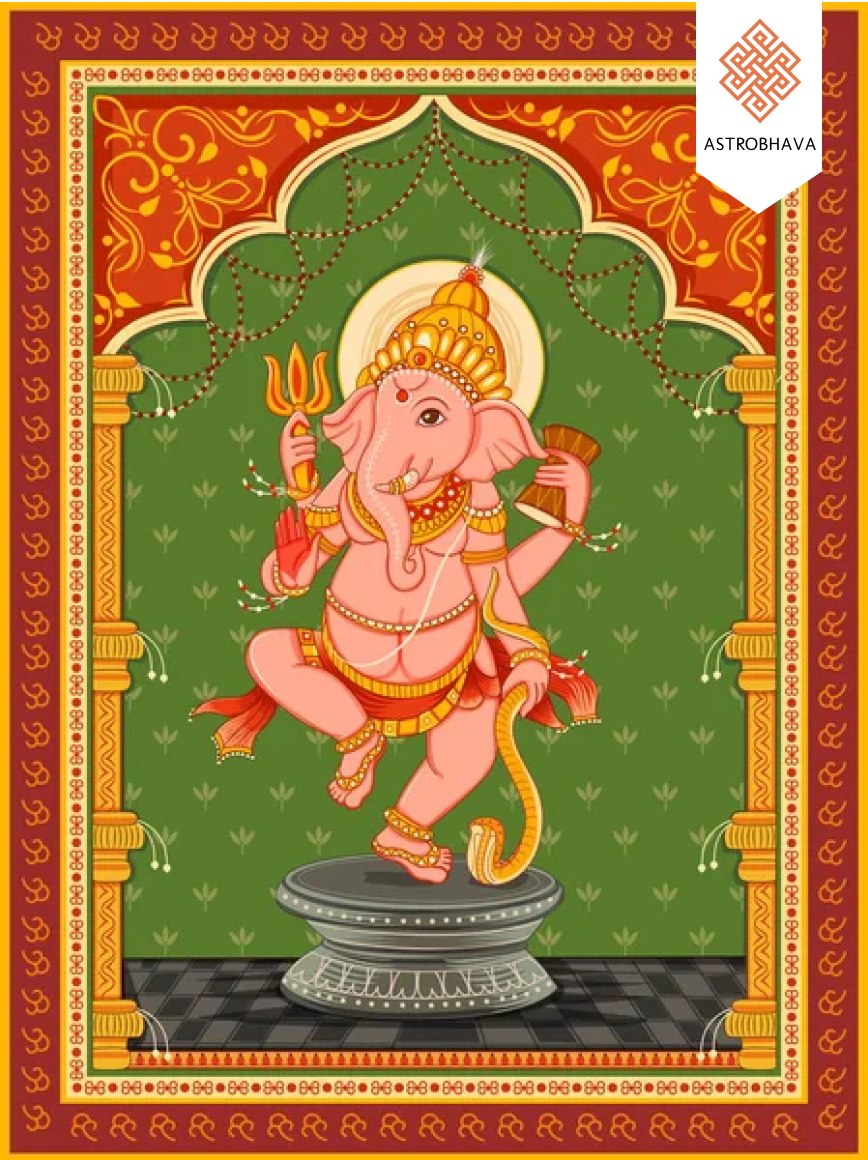
Shakti Ganapathi is the form in which Ganesha is seated with his consort Shakti upon his left thigh, one of the thirty-two forms detailed in the Mudgala Purana. He is four-armed: the upper hands hold the goad and the noose, the lower right is raised in the gesture of freedom from fear, and the lower left encircles the goddess. A modaka is carried in the trunk. The paired figures mark this manifestation as the guardian of the household threshold, where the sustaining power of the home is gathered and kept unbroken. His complexion is likened to the rising moon, cool and even. Contemplation of the form rests on the quiet integrity of domestic space and the inseparable presence of shakti within the remover of hindrances.
Goddess Seated on the Thigh
The Mudgala Purana reveals Shakti Ganapati when the text turns to the protection of the innermost precincts of ordered life. The gods, perceiving that the household—the smallest circle of dharma—required a guardian in whom feminine power would be visibly united with the lord of obstacles, requested such a form. Ganesha appeared with the goddess seated upon his lap, her presence declaring that shakti is not an external ally but is held close within the same figure. The Purana and the silpa texts that depend upon it stress that the image is one of protective enclosure, not of display. The goad and noose guide and restrain whatever might disturb the domestic order; the abhaya mudra steadies those who dwell within it. Later ritual manuals of the Ganesha sampradaya prescribe this paired icon for the home shrine precisely because the two figures together embody the completeness of household sanctity. The moon-like complexion further distinguishes the form, suggesting cool vigilance rather than the heat of battle or the brilliance of royal grant.
The mantra, in six scripts
The seed mantra, and the form most devotees chant daily. No initiation is required — it is open to anyone, including a parent chanting for a child.
“Salutation to the Lord of the ganas who is united with Shakti.”
ॐ
oṃ — the sacred syllable
शक्ति
śakti — power, the consort
गणपतये
gaṇapataye — to the lord of the ganas
नमः
namaḥ — salutation
Aim is the mantra, in a sense. The rest is address and salutation; the seed syllable carries the goddess. Where a practitioner has been given a very short practice, it is often Aim alone.
The syllable people get wrong
The initial śa of śakti is the palatal sibilant, formed with the tongue near the hard palate. It is commonly replaced by the dental sa, producing “sakti” and dulling the crisp clarity linked with the goddess energy the form enshrines. The conjunct kti that follows must be spoken as a single unbroken cluster, not divided into separate syllables.
When Shakti Ganapathi is chanted
Weekday. Tuesday
Questions
In the Mudgala Purana and the iconographic works that follow it, the goddess sits on the deity’s left thigh. His lower left arm encircles her while the upper hands hold goad and noose and the lower right offers the abhaya mudra. The composition presents shakti as held within the same form, not standing apart.
Tradition places this form at the threshold of the household. The paired figures are understood to guard the integrity of domestic space, the goad and noose directing and restraining influences that might unsettle it, while the presence of the goddess signifies the sustaining power kept whole within the home.
The Mudgala Purana recounts the manifestation in response to the gods’ request for a guardian of the household in whom feminine power would be visibly united with Ganapati. Subsequent Agama and silpa texts derive their descriptions of the seated consort and the four-armed posture directly from that narrative.
Not sure a mantra is enough?
Have your chart read before you decide
Chanting is yours to do, and free. But which deity your situation calls for — and whether a mantra alone is the right response — depends on your chart. Sometimes it is; sometimes it is not.
Brahmashree Shivaaya
Guru, Head of Astrological & Spiritual Solutions
Over 30 years in the Guru–Sishya Parampara, from the age of five
He reads every chart himself — 60 minutes, one to one, never delegated
Charts are read only between sunrise and sunset, following tradition
Chanting is yours to do. Some things are performed for you.
Where a matter carries real weight — an examination that decides a course, a performance, a child whose studies have stalled — devotees sponsor the homa alongside their own practice. Performed individually at our Yagna Ashram in your name and gotra, on a muhurta calculated from your chart, and telecast live so you can watch it done for you.