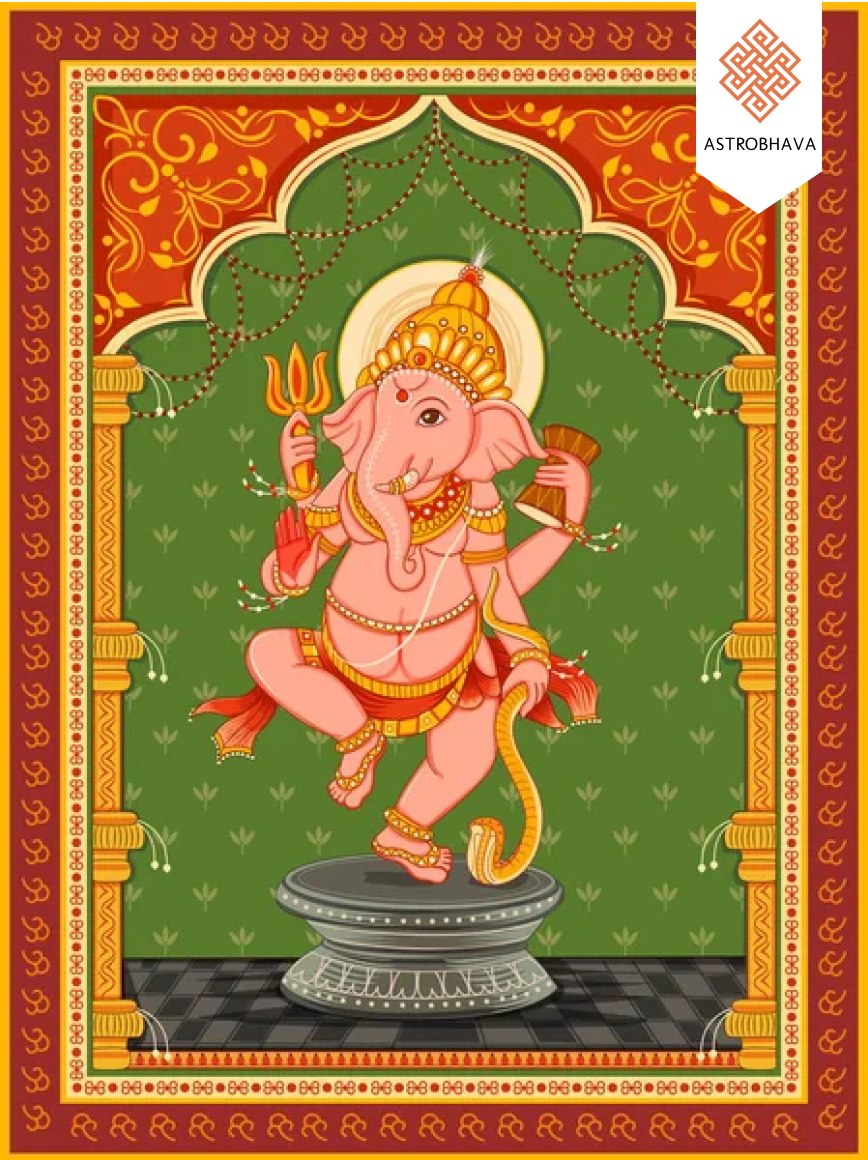
Sankatahara Ganapathi Kavacham, as worshipped at our temple
Mantra · The protective armour recitation.
Sankatahara Ganapathi Kavacham
ॐ श्रीं ह्रीं क्लीं ग्लौं गं संकतहराय गणपतये वर वरद सर्वजनं मे वशमानय स्वाहा
In Devanagari, Tamil, Telugu, Kannada, Malayalam and English — with the meaning of every word, and the one syllable most people pronounce wrongly.
Who Sankatahara Ganapathi Kavacham is
Sankatahara Ganapathi is the aspect of the elephant-headed god addressed by the protective hymn known as the Sankatahara Ganapathi Kavacham, a stotra preserved in South-Indian palm-leaf collections and printed paddhatis of the nineteenth century. The epithet Sankatahara, “remover of constriction,” appears already in the Narada Purana’s list of Ganesha’s names, yet the kavacham itself crystallises a later liturgical practice in which every limb of the reciter is assigned to the deity’s guardianship. Unlike the shorter sankata-nashana stotra attributed to Narada, the kavacham proceeds verse by verse through the body, sealing each part with a distinct name or weapon of Ganapathi. Manuscripts from Thanjavur and Madurai transmit slightly varying recensions, yet all retain the same armour-like structure and the same opening meditation on the deity seated on a jewelled throne beneath a wish-granting tree.
Armour Forged in Hymn
Tradition recorded in the colophons of several Tamil and Grantha manuscripts holds that the sage Agastya first received the Sankatahara Ganapathi Kavacham on the banks of the Kaveri after prolonged contemplation of Ganesha as the one who loosens every knot of distress. The frame narrative describes Agastya witnessing a celestial attendant whose limbs were locked by an invisible binding; upon the recitation of the newly revealed verses the bonds fell away, and the attendant declared that the hymn itself had become an armour. The story is not found in the major Puranas but circulates in the introductory prose of regional kavacham booklets still used in domestic worship. A parallel account in a Kerala palm-leaf collection substitutes the sage Durvasas for Agastya, yet preserves the motif of limbs released by the sequential naming of Ganapathi’s attributes. Both versions emphasise that the text functions as verbal armour rather than as a narrative of cosmic battle, distinguishing it from the longer Ganesha Gita episodes of the Ganesha Purana.
The mantra, in six scripts
The seed mantra, and the form most devotees chant daily. No initiation is required — it is open to anyone, including a parent chanting for a child.
DevanagariSanskrit & Hindiॐ श्रीं ह्रीं क्लीं ग्लौं गं संकतहराय गणपतये वर वरद सर्वजनं मे वशमानय स्वाहा
Tamilௐ ஶ்ரீம் ஹ்ரீம் க்லீம் க்லௌம் கம் ஸம்கதஹராய கணபதயே வர வரத ஸர்வஜநம் மே வஶமாநய ஸ்வாஹா
Teluguఓం శ్రీం హ్రీం క్లీం గ్లౌం గం సంకతహరాయ గణపతయే వర వరద సర్వజనం మే వశమానయ స్వాహా
EnglishRoman transliterationoṃ śrīṃ hrīṃ klīṃ glauṃ gaṃ saṅkaṭaharāya gaṇapataye vara varada sarvajanaṃ me vaśamānaya svāhā
“Om, the seed-syllables, to the constriction-removing Ganapati, O best, O boon-giver, draw every person to my influence, svaha.”
ॐ
oṃ — the primordial sound
श्रीं
śrīṃ — seed-syllable of splendour
ह्रीं
hrīṃ — seed-syllable of the heart-space
क्लीं
klīṃ — seed-syllable of attraction
ग्लौं
glauṃ — seed-syllable of earth-power
गं
gaṃ — seed-syllable of Ganapati
संकतहराय
saṅkaṭaharāya — to the remover of constriction
गणपतये
gaṇapataye — to Ganapati
वर
vara — O best one
वरद
varada — O boon-giver
सर्वजनं
sarvajanaṃ — every person
मे
me — to me
वशमानय
vaśamānaya — draw under influence
स्वाहा
svāhā — offering formula
Aim is the mantra, in a sense. The rest is address and salutation; the seed syllable carries the goddess. Where a practitioner has been given a very short practice, it is often Aim alone.
The syllable people get wrong
In saṅkaṭaharāya the cerebral ṭa is commonly softened to a dental ta by speakers unused to the retroflex series, collapsing the word toward “sankataharaya” and erasing the precise constriction denoted by kaṭa; the nasal ṅ before k must also remain velar, not the ordinary n of everyday speech.
When Sankatahara Ganapathi Kavacham is chanted
Weekday. Tuesday
Festival. Recited especially on Sankatahara Chaturthi, the fourth day of every dark fortnight
Questions
No. The stotra attributed to Narada is a short hymn of thirteen verses; the kavacham is a longer limb-by-limb armour text transmitted mainly in South-Indian manuscript traditions.
Colophons most often name Agastya; a minority of Kerala manuscripts substitute Durvasas, yet both preserve the same armour structure.
The opening dhyana describes him seated on a jewelled throne beneath a kalpaka tree, holding noose and goad, distinct from the dancing or multi-headed forms used in other Ganesha hymns.
Not sure a mantra is enough?
Have your chart read before you decide
Chanting is yours to do, and free. But which deity your situation calls for — and whether a mantra alone is the right response — depends on your chart. Sometimes it is; sometimes it is not.
Brahmashree Shivaaya
Guru, Head of Astrological & Spiritual Solutions
Over 30 years in the Guru–Sishya Parampara, from the age of five
He reads every chart himself — 60 minutes, one to one, never delegated
Charts are read only between sunrise and sunset, following tradition
Chanting is yours to do. Some things are performed for you.
Where a matter carries real weight — an examination that decides a course, a performance, a child whose studies have stalled — devotees sponsor the homa alongside their own practice. Performed individually at our Yagna Ashram in your name and gotra, on a muhurta calculated from your chart, and telecast live so you can watch it done for you.