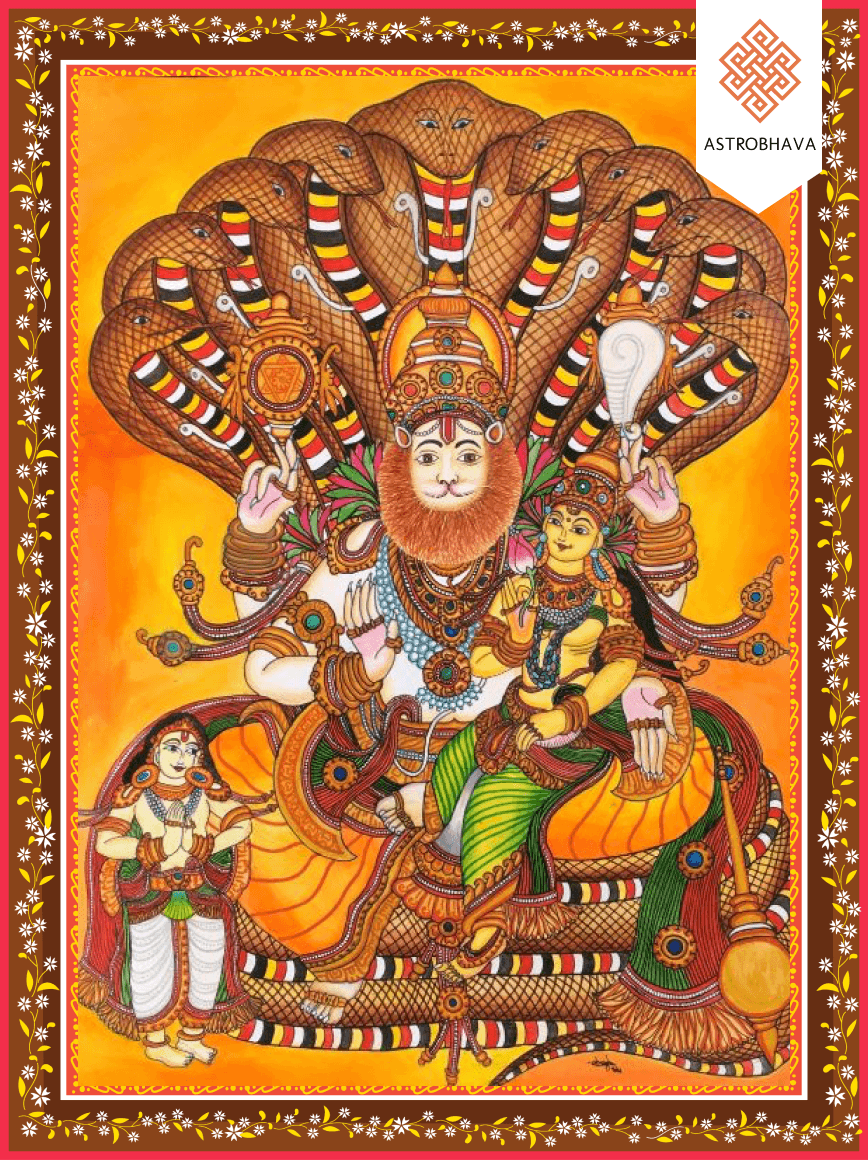
Runa Vimochana Narasimha, as worshipped at our temple
Mantra · Specifically for release from debt.
Runa Vimochana Narasimha
ॐ नमो भगवते नृसिंहाय ऋणविमोचनाय नमः
In Devanagari, Tamil, Telugu, Kannada, Malayalam and English — with the meaning of every word, and the one syllable most people pronounce wrongly.
Who Runa Vimochana Narasimha is
Runa Vimochana Narasimha is the aspect of the man-lion avatara in which Vishnu is addressed under the precise epithet that names him the loosener of ṛṇa. In classical Vaishnava usage ṛṇa signifies far more than a ledger of money owed; it comprises the triple obligation incurred simply by taking birth—debt to the gods for the sustaining elements, to the sages for knowledge, and to the ancestors for the body itself. Temple traditions of Ahobilam, Simhachalam and the scattered Narasimha shrines of the Tamil and Telugu countries isolate this name as a distinct liturgical focus. Iconographically the form remains the Ugra Narasimha who burst from the pillar, yet the mantra literature treats the vimochana quality as the governing note of the invocation. Pancharatra paddhatis and regional stotra collections present the compound Runa-Vimochana as a complete theological claim: the same Lord who ended Hiranyakashipu’s tyranny is the one who unbinds the residual claims that accompany embodied existence.
Pillar and twilight threshold
The Bhagavata Purana, seventh skandha, narrates the conditions that made the Narasimha form necessary. Hiranyakashipu had obtained a boon that he should die neither by day nor night, neither indoors nor outdoors, neither by man nor beast, neither on earth nor in the sky. When the demon struck the palace pillar and challenged the omnipresence of Vishnu, the Lord emerged at the exact junction of day and night, seated the tyrant upon his thighs at the threshold, and tore him with nails that were neither weapon nor bare hand. Prahlada, whose steadfastness had provoked the ordeal, was left unharmed. Later commentarial and stotra traditions read this episode as the archetype of release from an unpayable debt: the devotee’s life had been held in forfeit under a claim that no ordinary agency could discharge. The Runa Vimochana address therefore recalls not a separate incarnation but the same twilight intervention contemplated under the specific aspect of unbinding. South Indian recensions of the Narasimha Tapaniya material and the vernacular retellings that accompany the stotra keep the Prahlada narrative as the narrative ground of the name.
The mantra, in six scripts
The seed mantra, and the form most devotees chant daily. No initiation is required — it is open to anyone, including a parent chanting for a child.
EnglishRoman transliterationoṃ namo bhagavate nṛsiṃhāya ṛṇavimocanāya namaḥ
“Salutation to the Blessed Lord Narasimha, the one who loosens ṛṇa.”
ॐ
oṃ — the sacred syllable
नमो
namo — salutation
भगवते
bhagavate — to the Blessed Lord
नृसिंहाय
nṛsiṃhāya — to Narasimha
ऋणविमोचनाय
ṛṇavimocanāya — to the loosener of ṛṇa
नमः
namaḥ — salutation
Aim is the mantra, in a sense. The rest is address and salutation; the seed syllable carries the goddess. Where a practitioner has been given a very short practice, it is often Aim alone.
The syllable people get wrong
The vocalic ṛ that opens ṛṇavimocanāya is a single syllabic liquid, produced with the tongue-tip slightly curled and no intervening vowel. Speakers almost always insert an i-glide and say “rina-vimochana,” turning one syllable into two and erasing the compact Vedic sound the mantra requires.
When Runa Vimochana Narasimha is chanted
Weekday. Thursday
Festival. Narasimha Jayanti
Questions
In the technical vocabulary of dharma literature ṛṇa denotes the triple debt incurred by birth—to the gods, to the sages, and to the ancestors—before it ever refers to ordinary financial obligation. The epithet therefore addresses Narasimha as the one who loosens that fundamental bondage.
Tradition does not posit a distinct descent. The form remains the man-lion who appeared for Prahlada; the compound Runa Vimochana simply isolates the quality of unbinding already implicit in that intervention and makes it the explicit focus of the mantra.
It is especially current in the liturgical and stotra traditions of the Narasimha kshetras of Andhra and Tamil Nadu, and in the Pancharatra-derived paddhatis that treat the name as a self-contained address.
Not sure a mantra is enough?
Have your chart read before you decide
Chanting is yours to do, and free. But which deity your situation calls for — and whether a mantra alone is the right response — depends on your chart. Sometimes it is; sometimes it is not.
Brahmashree Shivaaya
Guru, Head of Astrological & Spiritual Solutions
Over 30 years in the Guru–Sishya Parampara, from the age of five
He reads every chart himself — 60 minutes, one to one, never delegated
Charts are read only between sunrise and sunset, following tradition
Chanting is yours to do. Some things are performed for you.
Where a matter carries real weight — an examination that decides a course, a performance, a child whose studies have stalled — devotees sponsor the homa alongside their own practice. Performed individually at our Yagna Ashram in your name and gotra, on a muhurta calculated from your chart, and telecast live so you can watch it done for you.