Mantra · The eight-fold form. For comprehensive prosperity.
Mahalakshmi
ॐ श्रीं महालक्ष्म्यै नमः
In Devanagari, Tamil, Telugu, Kannada, Malayalam and English — with the meaning of every word, and the one syllable most people pronounce wrongly.
Who Mahalakshmi is
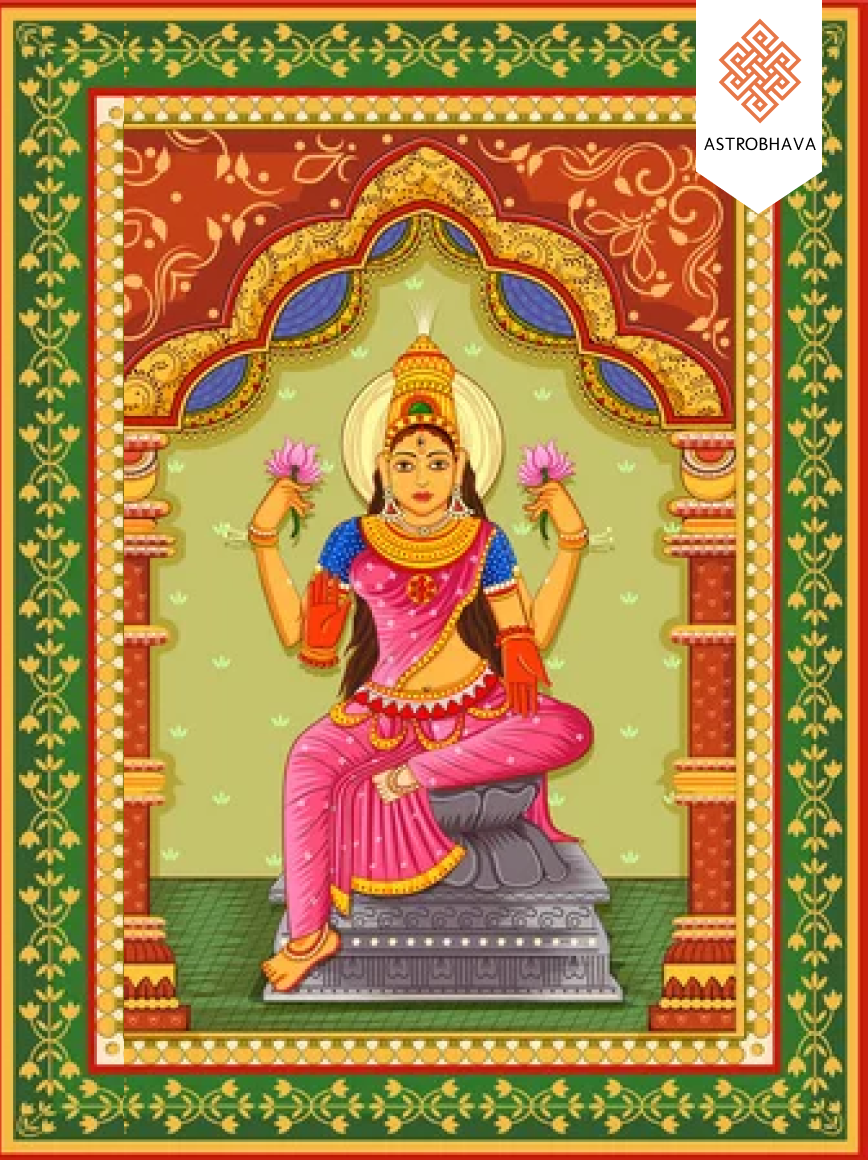
Mahalakshmi is the great, eight-fold sovereign of prosperity in whom the separate gifts of the Ashta-Lakshmis—grain, courage, offspring, victory, knowledge, strength, kingship and ordinary wealth—are gathered into a single unbroken presence. She is not merely the consort of Vishnu but the very shakti that makes his preserving work possible; without her the world would remain inert. She rises from the ocean of milk seated on a full-blown lotus, holding lotuses in two hands while the other two offer the gestures of freedom from fear and of boon-giving. Her complexion is described as that of fresh gold or the interior of a lotus. In the Sri-sukta of the Rig Veda she is already hymned as the moist, radiant one who carries fame and nourishment; the later Puranas expand her into the cosmic mother whose glance confers the eighteen kinds of wealth enumerated in the Lakshmi Tantra. No other form of the goddess is addressed as the totality of all prosperous conditions at once.
Emergence from the Ocean
The Vishnu Purana, the Mahabharata’s Adi Parva and the Valmiki Ramayana all recount the churning of the ocean of milk. When the gods and asuras used Mount Mandara as the rod and the serpent Vasuki as the rope, countless treasures rose from the depths: the elephant Airavata, the horse Ucchaihshravas, the kaustubha gem, and finally Lakshmi herself. She appeared standing on a lotus, radiant, holding lotuses, and was immediately garlanded by the elephants of the quarters. The gods received her with the Sri-sukta, and she chose Vishnu as her eternal abode, taking her place on his chest as the mark called Srivatsa. The same episode explains why she is called Kshirasagara-kanyaka, daughter of the milk ocean, and why every later ritual of prosperity re-enacts, in miniature, that first rising. The texts emphasise that she did not emerge as a partial power but as the complete Mahalakshmi in whom all lesser lakshmis are already contained. This narrative belongs to her alone among the goddesses.
The mantra, in six scripts
The seed mantra, and the form most devotees chant daily. No initiation is required — it is open to anyone, including a parent chanting for a child.
“Salutation to Mahalakshmi, whose seed-syllable is Śrīṃ.”
ॐ
oṃ — the primal syllable
श्रीं
śrīṃ — seed-syllable of prosperity and splendour
महालक्ष्म्यै
mahālakṣmyai — to the great Lakshmi (dative)
नमः
namaḥ — salutation
Aim is the mantra, in a sense. The rest is address and salutation; the seed syllable carries the goddess. Where a practitioner has been given a very short practice, it is often Aim alone.
The syllable people get wrong
The seed-syllable śrīṃ begins with the palatal sibilant ś joined at once to the liquid r; speakers habitually dissolve the cluster into an English “shree” in which the ś loses its sharp palatal friction and the r becomes a mere glide, so that the nasalised ṃ is also weakened. The ś must keep its distinct hush and the r a light tongue-tap before the long ī.
When Mahalakshmi is chanted
Weekday. Friday
Festival. Varalakshmi Vratam, observed on the Friday before the full moon of Shravana, and the Lakshmi Puja of Dipavali night.
Questions
The Ashta-Lakshmi tradition enumerates eight distinct yet inseparable aspects: Adi Lakshmi the primordial, Dhana Lakshmi of material wealth, Dhanya Lakshmi of agricultural plenty, Gaja Lakshmi of royal power and the elephant emblem, Santana Lakshmi of offspring, Veera Lakshmi of courage, Vidya Lakshmi of knowledge, and Vijaya Lakshmi of victory. Mahalakshmi is not a ninth figure added to the list; she is the single consciousness in which these eight already abide. Temples that enshrine the eight forms therefore place Mahalakshmi at the centre or as the overarching name, indicating that prosperity is never merely one of these gifts but their simultaneous presence.
The lotus grows from the mud yet remains untouched by it, an image the Sri-sukta and the Lakshmi Tantra apply directly to Mahalakshmi’s nature: she pervades the world of change without being stained by it. She is herself called Padma, Padmalaya and Padmahasta. In the churning narrative she appears already standing upon a lotus that has risen of its own accord from the ocean, showing that her seat is not constructed by the gods but is co-emergent with her. The two lotuses she holds are further read as the twin perfections of outer abundance and inner detachment.
The Sri-sukta, a khila hymn attached to the Rig Veda, addresses her as the moist, shining one who carries the odour of sandal and bilva, who is the mother of all beings and the giver of fame, cattle, horses and food. It asks that she be present with her golden necklace and her elephant attendants, and that the goddess Jyestha (misfortune) be driven away. The hymn never separates material plenty from moral and aesthetic radiance; the same verses that request grain also request the lustre that makes a household illustrious. Later liturgies of Mahalakshmi therefore begin with or include the Sri-sukta as her oldest and most authoritative praise.
Not sure a mantra is enough?
Have your chart read before you decide
Chanting is yours to do, and free. But which deity your situation calls for — and whether a mantra alone is the right response — depends on your chart. Sometimes it is; sometimes it is not.
Brahmashree Shivaaya
Guru, Head of Astrological & Spiritual Solutions
Over 30 years in the Guru–Sishya Parampara, from the age of five
He reads every chart himself — 60 minutes, one to one, never delegated
Charts are read only between sunrise and sunset, following tradition
Chanting is yours to do. Some things are performed for you.
Where a matter carries real weight — an examination that decides a course, a performance, a child whose studies have stalled — devotees sponsor the homa alongside their own practice. Performed individually at our Yagna Ashram in your name and gotra, on a muhurta calculated from your chart, and telecast live so you can watch it done for you.