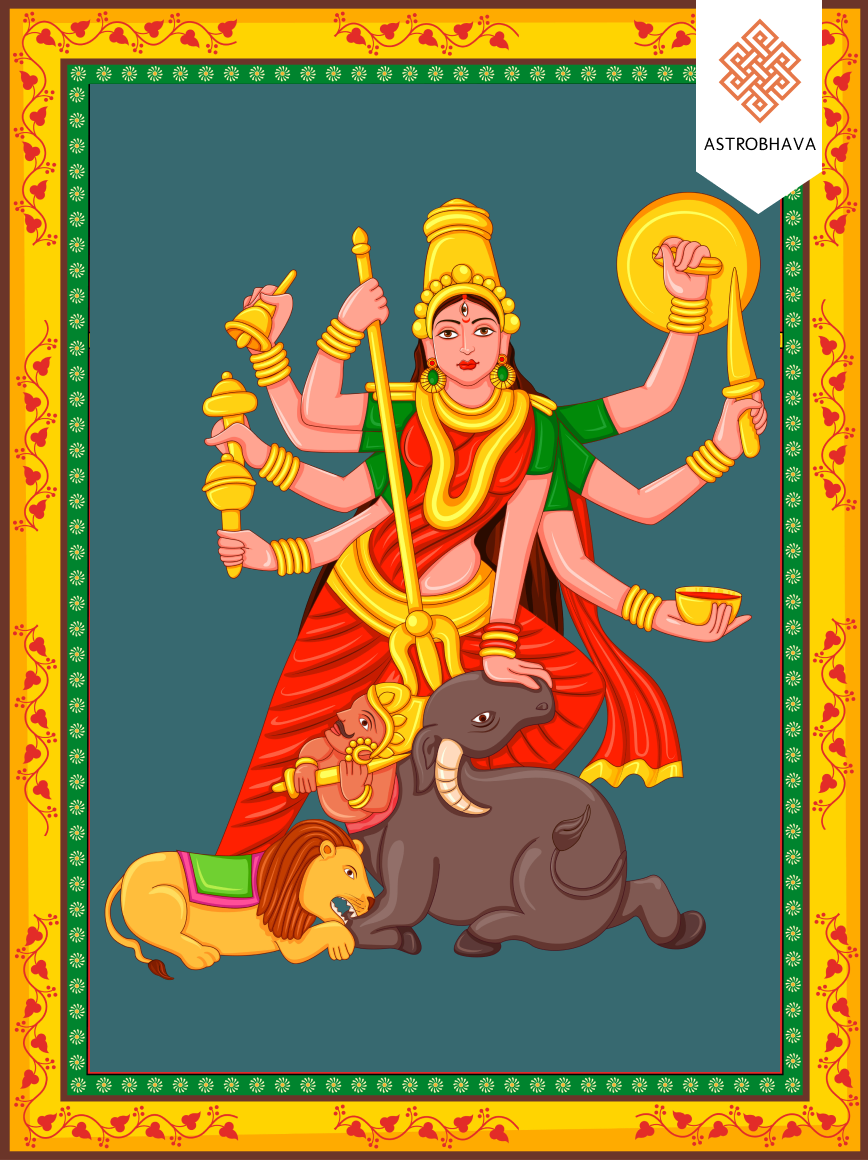
Mantra · For prosperity and stability. The seed syllable is Shreem.
Lakshmi
ॐ श्रीं लक्ष्म्यै नमः
In Devanagari, Tamil, Telugu, Kannada, Malayalam and English — with the meaning of every word, and the one syllable most people pronounce wrongly.
Who Lakshmi is
Lakshmi is the goddess of prosperity, fertile abundance, royal fortune and the quiet stability that allows a household or kingdom to endure. She is portrayed as luminous, four-armed, standing or seated upon an open lotus, flanked by white elephants that pour water from golden vessels. Two of her hands hold lotuses; the others display the gestures of readiness to give and of fearlessness. As the inseparable shakti of Vishnu she accompanies him in every descent—Sita to Rama, Rukmini to Krishna—yet she also appears independently wherever dharma has prepared a seat for her. Her seed-syllable is Shreem, the bija of sri, the radiance of well-being that clings to right order. Texts describe her as restless only when hospitality, truthfulness or generosity fail; where those virtues remain, she is said to dwell without summons.
Rising from the milk ocean
The Vishnu Purana, the Bhagavata Purana and the Mahabharata’s Adi Parva narrate the churning of the ocean of milk. The gods, weakened and stripped of sri, allied with the asuras to turn Mount Mandara in the ocean, using the serpent Vasuki as the rope. After many treasures and beings had risen—the cow Kamadhenu, the horse Ucchaishravas, the jewel Kaustubha—there appeared a goddess of extraordinary radiance, seated on a full-blown lotus, holding lotuses, bathed by the elephants of the quarters. The assembled beings called her Lakshmi and Sri. She moved of her own accord to the chest of Vishnu and took her place there, restoring to the gods the fortune they had lost. The same episode explains why she is called Kshirasagara-kanya, daughter of the milk ocean, and why the lotus remains her inseparable emblem: she is born already standing upon the flower that rises pure from the waters. Later verses in the Vishnu Purana add that when she left the gods in earlier ages, even Indra’s celestial city withered, showing that prosperity in these texts is never a private possession but the visible sign of cosmic favour restored.
The mantra, in six scripts
The seed mantra, and the form most devotees chant daily. No initiation is required — it is open to anyone, including a parent chanting for a child.
“Salutations to Lakshmi, invoked through the seed-syllable Shreem.”
ॐ
oṃ — the primordial syllable
श्रीं
śrīṃ — seed-syllable of prosperity and radiance
लक्ष्म्यै
lakṣmyai — to Lakshmi
नमः
namaḥ — salutations
Aim is the mantra, in a sense. The rest is address and salutation; the seed syllable carries the goddess. Where a practitioner has been given a very short practice, it is often Aim alone.
The syllable people get wrong
In lakṣmyai the conjunct kṣm is commonly broken by an inserted vowel, producing “lakash-myai” or “lakshe-myai.” The sibilant ṣ and the following m belong to a single clustered onset before the semi-vowel y; separating them alters both the rhythm and the traditional sound-shape of the name.
When Lakshmi is chanted
Weekday. Friday
Festival. Varalakshmi Vratam, observed on the Friday before the full moon of Shravana in many southern traditions, and the Lakshmi Puja night of Deepavali
Questions
Puranic and iconographic tradition treat the lotus as the emblem of purity that is in the world yet unstained by it. Lakshmi’s birth from the ocean already places her upon an open lotus; she never wades or swims. Commentators on the Vishnu Purana and on the Sri Sukta read this as the nature of true sri: it arises from the flux of circumstance but does not become sodden by attachment or panic. The same image explains why her other common vehicle, the owl, is a night-seeing bird: prosperity must perceive clearly even when surroundings are obscure. Both symbols are therefore theological statements, not merely decorative choices.
Sri as a common noun means radiance, majesty, the auspicious glow that attends a person, a verse or a kingdom. Shreem is that same principle compacted into a monosyllabic seed for contemplative repetition, carrying the anusvara that interiorises the sound. Mantra shastra regards the bija as the sonic body of the goddess in her most concentrated form, while the fully declined name lakṣmyai addresses her as a personed deity who can receive devotion. The two are used together so that the practitioner holds both the abstract power and the gracious figure who bears it.
Several Puranic passages and the Sri Sukta itself describe Sri as chanchala, moving lightly. The restlessness is not capricious departure; it is the tradition’s way of stating that prosperity withdraws when the conditions that invite her—truthful speech, open-handed giving, care of the stranger, and reverence for the sources of wealth—are neglected. When those conditions are restored, the same texts show her returning without rancour. The adjective therefore functions as ethical instruction embedded in mythology rather than as a claim about divine moodiness.
Not sure a mantra is enough?
Have your chart read before you decide
Chanting is yours to do, and free. But which deity your situation calls for — and whether a mantra alone is the right response — depends on your chart. Sometimes it is; sometimes it is not.
Brahmashree Shivaaya
Guru, Head of Astrological & Spiritual Solutions
Over 30 years in the Guru–Sishya Parampara, from the age of five
He reads every chart himself — 60 minutes, one to one, never delegated
Charts are read only between sunrise and sunset, following tradition
Chanting is yours to do. Some things are performed for you.
Where a matter carries real weight — an examination that decides a course, a performance, a child whose studies have stalled — devotees sponsor the homa alongside their own practice. Performed individually at our Yagna Ashram in your name and gotra, on a muhurta calculated from your chart, and telecast live so you can watch it done for you.