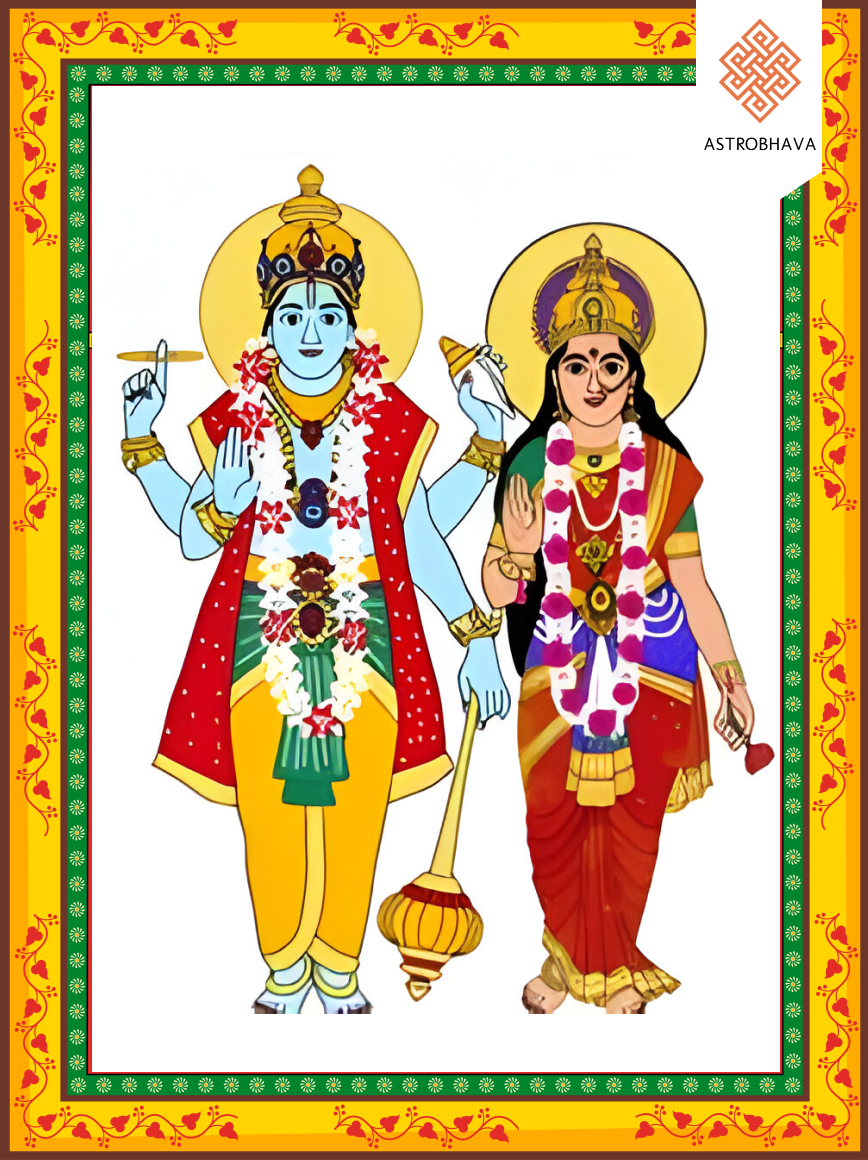
Mantra · The couple together. For household prosperity.
Lakshmi Narayana
ॐ श्रीलक्ष्मीनारायणाय नमः
In Devanagari, Tamil, Telugu, Kannada, Malayalam and English — with the meaning of every word, and the one syllable most people pronounce wrongly.
Who Lakshmi Narayana is
Lakṣmī-Nārāyaṇa is the indivisible pair in whom the goddess of plenitude and the all-pervading Puruṣa are contemplated as a single liturgical presence. Nārāyaṇa reclines upon the serpent of infinity; Lakṣmī massages his feet or sits upon his left thigh, her gaze turned toward him alone. The dual formula does not address two separate deities in succession but names the one reality in its inseparable masculine and feminine aspects. Temple images from Khajuraho to the Tamil country show them sharing a single pedestal, her right hand holding the lotus, his hands bearing the four Vaiṣṇava emblems. In household shrines the pair is installed for the quiet continuity of domestic life rather than for martial or renunciant ends. The mantra therefore belongs to the grammar of companionship: every syllable presupposes that prosperity without the sustaining ground, or the sustaining ground without prosperity, would be an incomplete utterance.
Lakṣmī’s Choice on the Ocean
The Viṣṇu Purāṇa and the Bhāgavata Purāṇa both recount the episode that establishes the pair. When the ocean of milk was churned, treasures rose in succession: the elephant Airāvata, the horse Uccaiḥśravas, the Kaustubha gem, and finally Lakṣmī herself, radiant, standing upon a lotus. The assembled gods and demons gazed, yet she passed them all and placed the garland of bridehood around the neck of Nārāyaṇa, who had supported the churning in his Kurma form and later appeared as the enchanting Mohinī. From that moment the texts speak of them as eternally united. In the Lakṣmī-tantra of the Pāñcarātra the goddess declares that she never leaves the Lord’s chest, where she resides as the Śrīvatsa mark. The dual mantra restates this scriptural choice: it does not summon wealth as an external boon but names the couple whose togetherness is the measure of completeness in the cosmic household.
The mantra, in six scripts
The seed mantra, and the form most devotees chant daily. No initiation is required — it is open to anyone, including a parent chanting for a child.
śrīlakṣmīnārāyaṇāya — to the radiant Lakṣmī-Nārāyaṇa
नमः
namaḥ — salutation
Aim is the mantra, in a sense. The rest is address and salutation; the seed syllable carries the goddess. Where a practitioner has been given a very short practice, it is often Aim alone.
The syllable people get wrong
Inside the compound lakṣmīnārāyaṇāya the long ī of lakṣmī is commonly clipped to a short i before the following nā, so that the name collapses into lakṣminarāyaṇāya. The shortened vowel erases the deliberate quantitative weight that marks the goddess’s name as a full and equal member of the pair.
When Lakshmi Narayana is chanted
Weekday. Thursday
Festival. The dual presence is honoured on Varalakṣmī Vratam in many South Indian households and on the evening of Dīpāvalī when the couple is remembered together as the source of household continuity.
Questions
Sanskrit compounds of this type, called dvandva when equal and tatpuruṣa when dependent, here function to insist on inseparability. Commentators on the Lakṣmī-tantra note that to utter Nārāyaṇa without Lakṣmī is to speak of a ground without its expressive power, while to utter Lakṣmī without Nārāyaṇa is to speak of plenitude without its sustaining source. The one dative ending -āya therefore governs the entire compound, marking them as a single recipient of the salutation.
When Lakṣmī appears independently she is usually shown seated or standing upon a lotus, pouring gold from her hands or holding lotuses in both. In the paired icon she turns toward Nārāyaṇa, often seated on his left thigh or standing at his side with one hand on his shoulder. The visual grammar underscores that her plenitude is directed toward him, and his permanence is completed by her presence. The mantra mirrors this orientation by refusing to isolate either name.
The Lakṣmī-tantra itself is framed as a dialogue in which the goddess expounds the nature of the pair. Several other saṃhitās contain chapters on the joint installation of Lakṣmī-Nārāyaṇa images and on the mantras that treat them as one liturgical person. These texts consistently refuse to rank one above the other; the dual formula is therefore not a later popular abbreviation but a formulation already present in the Āgamic stratum.
Not sure a mantra is enough?
Have your chart read before you decide
Chanting is yours to do, and free. But which deity your situation calls for — and whether a mantra alone is the right response — depends on your chart. Sometimes it is; sometimes it is not.
Brahmashree Shivaaya
Guru, Head of Astrological & Spiritual Solutions
Over 30 years in the Guru–Sishya Parampara, from the age of five
He reads every chart himself — 60 minutes, one to one, never delegated
Charts are read only between sunrise and sunset, following tradition
Chanting is yours to do. Some things are performed for you.
Where a matter carries real weight — an examination that decides a course, a performance, a child whose studies have stalled — devotees sponsor the homa alongside their own practice. Performed individually at our Yagna Ashram in your name and gotra, on a muhurta calculated from your chart, and telecast live so you can watch it done for you.