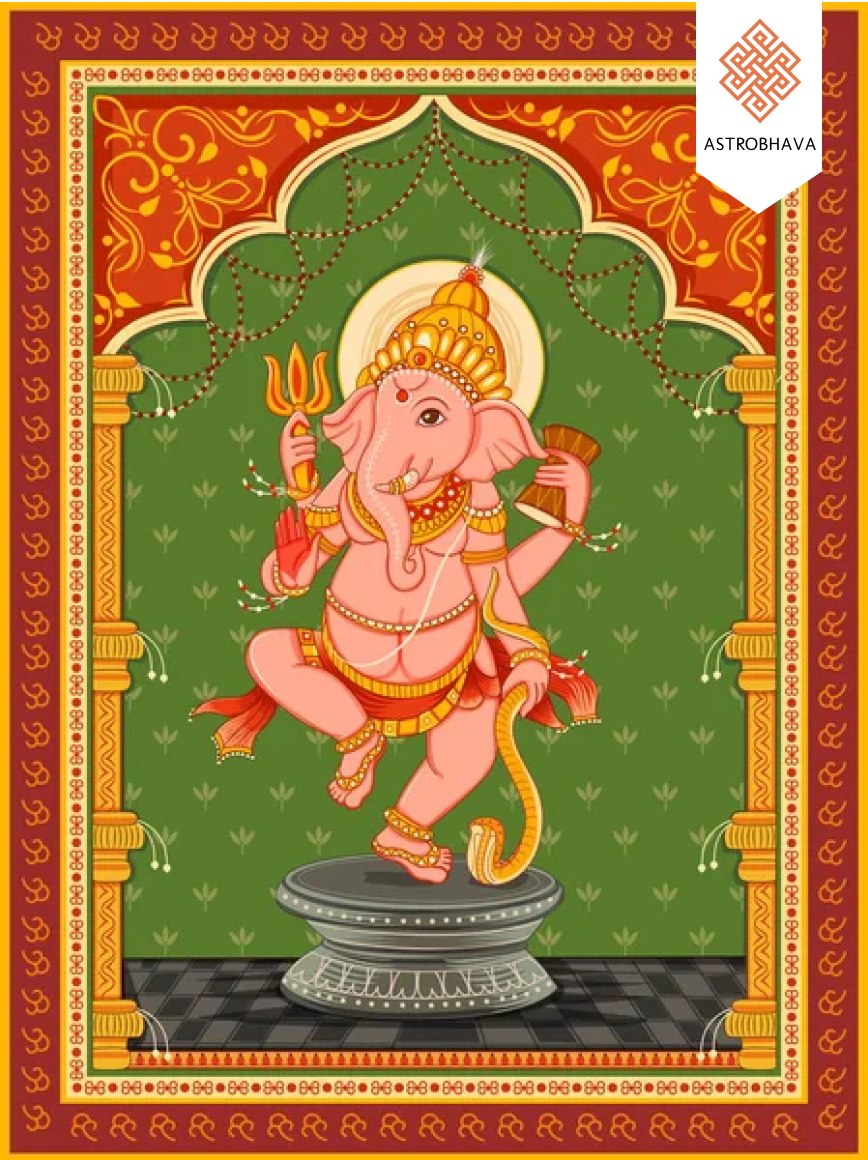
Kshipra Prasada Ganapathi, as worshipped at our temple
Mantra · For quick grace where a matter is urgent.
Kshipra Prasada Ganapathi
ॐ क्षिप्रप्रसादगणपतये नमः
In Devanagari, Tamil, Telugu, Kannada, Malayalam and English — with the meaning of every word, and the one syllable most people pronounce wrongly.
Who Kshipra Prasada Ganapathi is
Kshipra Prasada Ganapathi is the aspect of Ganesha whose distinctive mark is prasāda that does not tarry. Dhyana shlokas of the thirty-two forms portray him seated on a jewelled throne, body luminous like the early sun, four arms carrying the noose, the goad, a sprig of the kalpavṛkṣa and a bowl of payasam still warm. The compound kṣipra-prasāda is treated in Ganapatya tantras as a technical name for this single deity, not as a loose epithet that could apply to any swift form of Ganesha. His trunk bends toward the vessel of payasam, a gesture read as the readiness with which nourishment of favour is extended. No other classic form is described with the wish-fulfilling twig held together with freshly prepared payasam.
Favour Before the Petition Ends
The Ganesha Purana and the paddhatis that enumerate the thirty-two forms tell of a moment when the gods met an obstruction so abrupt that ordinary sequences of rite could not be finished. They turned to Ganesha in the specific form of Kshipra Prasada. He appeared holding the kalpavṛkṣa sprig and the bowl of payasam, and the narrative states that prasāda was given before the petition had fully left their lips. The text is careful to note that such speed belongs to the nature of this form alone; other manifestations move according to different rhythms. In the accompanying dhyana the payasam is described as still warm, a detail reserved for Kshipra Prasada and indicating that the favour has not had time to cool. Ganapatya manuals preserve the episode as the scriptural ground for the mantra addressed solely to him, distinguishing his immediate prasāda from the slower or more conditional graces associated with neighbouring forms in the same list of thirty-two.
The mantra, in six scripts
The seed mantra, and the form most devotees chant daily. No initiation is required — it is open to anyone, including a parent chanting for a child.
kṣipraprasādagaṇapataye — to Ganapati of swift prasāda
नमः
namaḥ — salutation
Aim is the mantra, in a sense. The rest is address and salutation; the seed syllable carries the goddess. Where a practitioner has been given a very short practice, it is often Aim alone.
The syllable people get wrong
The opening cluster kṣi in kṣipra is the point that belongs to this mantra alone. Speakers often replace the retroflex ṣ with a palatal ś, yielding ‘kshipra’ as if written with sh, or drop the k entirely and say ‘shipra’. The correct onset keeps the k closed against a true retroflex sibilant before the short i, so the urgency coded in the name remains phonetically intact.
When Kshipra Prasada Ganapathi is chanted
Weekday. Tuesday
Questions
Although both names contain the word kṣipra, the classic lists treat them as separate forms. Kshipra Prasada is identified by the jewelled throne, the kalpavṛkṣa sprig and the bowl of warm payasam; Kshipra Ganapathi carries a different set of attributes and a shorter mantra.
The detail is unique to this form. It signals that the prasāda has been prepared and offered in the same unbroken moment, matching the swiftness named in the deity’s title.
Yes. The Purana places the manifestation in an episode of sudden obstruction faced by the gods, where only the form that grants prasāda without delay is able to answer before the crisis lengthens.
Not sure a mantra is enough?
Have your chart read before you decide
Chanting is yours to do, and free. But which deity your situation calls for — and whether a mantra alone is the right response — depends on your chart. Sometimes it is; sometimes it is not.
Brahmashree Shivaaya
Guru, Head of Astrological & Spiritual Solutions
Over 30 years in the Guru–Sishya Parampara, from the age of five
He reads every chart himself — 60 minutes, one to one, never delegated
Charts are read only between sunrise and sunset, following tradition
Chanting is yours to do. Some things are performed for you.
Where a matter carries real weight — an examination that decides a course, a performance, a child whose studies have stalled — devotees sponsor the homa alongside their own practice. Performed individually at our Yagna Ashram in your name and gotra, on a muhurta calculated from your chart, and telecast live so you can watch it done for you.