In Devanagari, Tamil, Telugu, Kannada, Malayalam and English — with the meaning of every word, and the one syllable most people pronounce wrongly.
Who Kshipra Ganapathi is
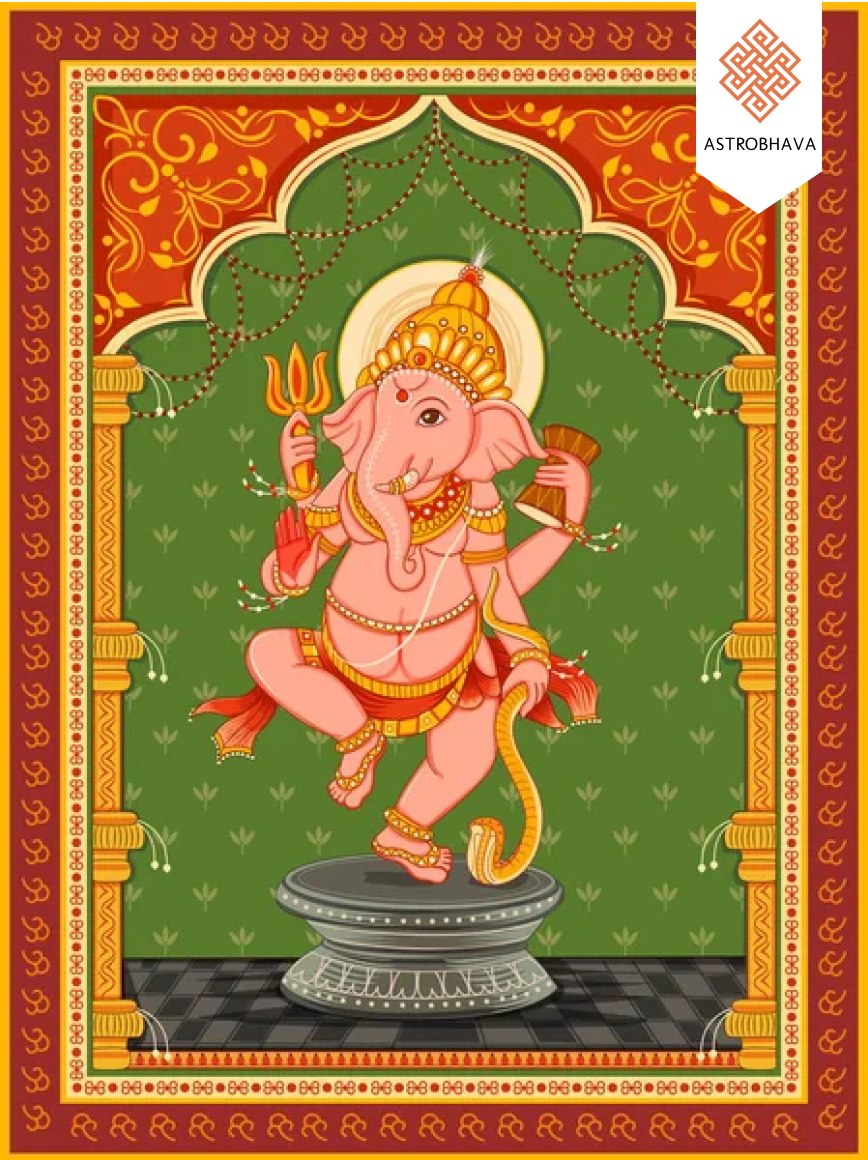
Kshipra Ganapathi is the swift-acting form of the elephant-faced lord, distinguished by the red hue of his body and by the broken tusk held in one of his four hands. The remaining hands carry a noose, a goad and a pot of jewels or a modaka. In the thirty-two-form lists drawn from the Mudgala Purana lineage, the adjective kshipra—“quick,” “speedy”—is attached to him alone, marking the deity whose grace is understood to move without delay. The broken tusk, already familiar from other narratives, here underscores readiness rather than sacrifice. Contemplation of this form centres on the quality of swiftness itself, the compression of time between petition and response that the tradition attributes uniquely to him.
The Lord Who Does Not Delay
Within the meditative catalogues of the thirty-two Ganeshas, Kshipra Ganapathi is introduced by the simple declaration that he acts at once. The Mudgala-derived dhyana verses give him a vermilion body, a broken tusk, the noose and goad of control, and a vessel of precious things. No extended combat myth is attached; the emphasis falls entirely on the tempo of his response. Later paddhatis and temple traditions that invoke Kshipra Ganapathi preserve the same note: the deity is approached when the interval between need and fulfilment must be short. The broken tusk, elsewhere the sign of the scribe who wrote the Mahabharata, is here read as the weapon already prepared, the tool that need not be fetched. Commentators observe that the form therefore stands at the opposite pole from the unhurried student Dwija or the ripened completer Siddhi; Kshipra is the face of Ganesha turned toward urgency of time, yet the texts themselves never prescribe haste on the part of the devotee—only the recognition that this particular aspect is characterised by speed.
The mantra, in six scripts
The seed mantra, and the form most devotees chant daily. No initiation is required — it is open to anyone, including a parent chanting for a child.
Aim is the mantra, in a sense. The rest is address and salutation; the seed syllable carries the goddess. Where a practitioner has been given a very short practice, it is often Aim alone.
The syllable people get wrong
The initial conjunct kṣi of kṣipra is often simplified to a plain “shi” or “ksi” without the proper retroflex sibilant. The correct sound begins with a full k fused to the cerebral ṣ, released into a short i; omitting the ṣ turns the name into something the tradition does not recognise as this form.
When Kshipra Ganapathi is chanted
Weekday. Tuesday
Questions
In this iconography the tusk is read as an instrument already in hand, ready for immediate use. The emphasis is on preparedness rather than on the older narrative of the Mahabharata’s scribe.
The vermilion or deep-red complexion is the colour traditionally assigned to this form in the dhyana shlokas. It distinguishes him visually from the crystal Dwija and the golden Siddhi within the same list of thirty-two.
The adjective is occasionally applied to Ganesha in stotras of other lineages, yet the fully articulated four-armed icon with broken tusk, noose, goad and jewel-pot belongs to the Mudgala-derived catalogue of thirty-two meditative forms.
Not sure a mantra is enough?
Have your chart read before you decide
Chanting is yours to do, and free. But which deity your situation calls for — and whether a mantra alone is the right response — depends on your chart. Sometimes it is; sometimes it is not.
Brahmashree Shivaaya
Guru, Head of Astrological & Spiritual Solutions
Over 30 years in the Guru–Sishya Parampara, from the age of five
He reads every chart himself — 60 minutes, one to one, never delegated
Charts are read only between sunrise and sunset, following tradition
Chanting is yours to do. Some things are performed for you.
Where a matter carries real weight — an examination that decides a course, a performance, a child whose studies have stalled — devotees sponsor the homa alongside their own practice. Performed individually at our Yagna Ashram in your name and gotra, on a muhurta calculated from your chart, and telecast live so you can watch it done for you.