Mantra · For marriage, particularly where it is delayed.
Katyayani
ॐ कात्यायन्यै नमः
In Devanagari, Tamil, Telugu, Kannada, Malayalam and English — with the meaning of every word, and the one syllable most people pronounce wrongly.
Who Katyayani is
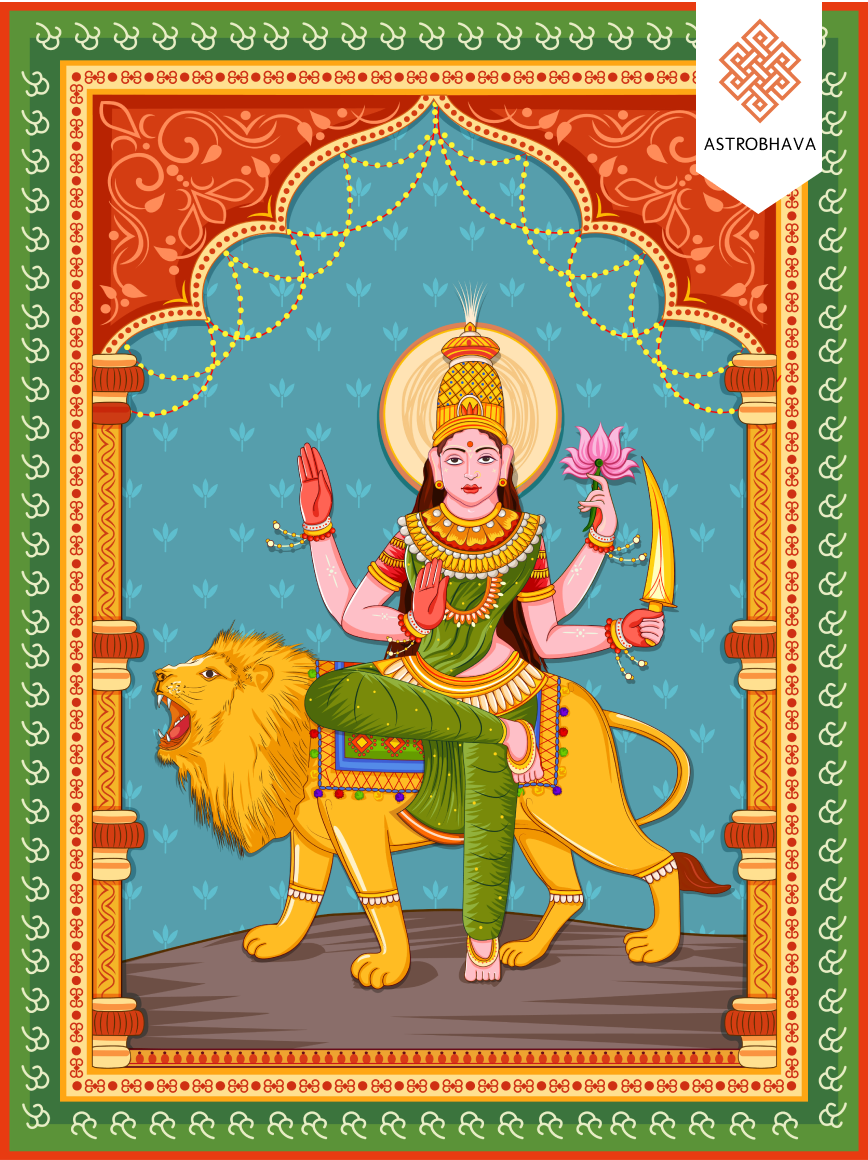
Katyayani is the fierce yet maternal sixth form among the Navadurga, born from the accumulated tejas of the gods in the hermitage of the sage Katyayana and therefore bearing his name. She is four-armed or sometimes eighteen-armed, dark or golden of complexion, riding a lion, carrying sword, shield, lotus and trident. While she shares the demon-slaying career of Durga, the tradition isolates her as the particular goddess to whom unmarried women turn when marriage is delayed or obstructed. The Bhagavata Purana records that the gopis of Vraja worshipped her through the cold nights of Margashirsha with the single prayer that Krishna become their husband; that episode has fixed her identity as the granter of a suitable union. She is not a generic marriage deity; she is the one whose own origin story is bound to the longing of the cowherd women and to the austerity of a Vedic rishi.
The Gopis’ Winter Vow
The tenth skandha of the Bhagavata Purana narrates that the unmarried gopis of Vrindavana rose before dawn throughout the month of Margashirsha, bathed in the cold Yamuna, fashioned an earthen image of Katyayani on the riverbank, and offered her fragrant powders, garlands and food. Their collective prayer, repeated each morning, was simple: “O Katyayani, mahamaye, great mistress of yoga, make the son of Nanda our husband.” On the final day Krishna himself appeared, took their garments from the trees, and after testing their devotion accepted their vow. The same text notes that the goddess, pleased by the purity of their intent, granted what they asked. Earlier Puranic layers add that Katyayani had first manifested when the sage Katyayana performed severe tapas to obtain a daughter who could destroy a demon threatening the worlds; the gods deposited their radiance in the sage’s sacrificial fire and the girl-child who emerged was named after him. Thus two origins—one of rishi austerity, one of gopi longing—converge on the single figure addressed in the mantra.
The mantra, in six scripts
The seed mantra, and the form most devotees chant daily. No initiation is required — it is open to anyone, including a parent chanting for a child.
DevanagariSanskrit & Hindiॐ कात्यायन्यै नमः
Tamilௐ காத்யாயந்யை நமஃ
Teluguఓం కాత్యాయన్యై నమః
Kannadaಓಂ ಕಾತ್ಯಾಯನ್ಯೈ ನಮಃ
Malayalamഓം കാത്യായന്യൈ നമഃ
EnglishRoman transliterationoṃ kātyāyanyai namaḥ
“Salutation to Katyayani.”
ॐ
oṃ — the primal syllable
कात्यायन्यै
kātyāyanyai — to Katyayani (dative)
नमः
namaḥ — salutation
Aim is the mantra, in a sense. The rest is address and salutation; the seed syllable carries the goddess. Where a practitioner has been given a very short practice, it is often Aim alone.
The syllable people get wrong
The sequence tyā inside kātyāyanyai carries a long ā after the dental t; speakers almost always shorten that ā to a neutral schwa and then blur the following ya, collapsing the name into a rapid “kat-ya-ya-ni.” The long ā must be held for a full measure so that kā-tyā remains two distinct beats before the yanyai ending.
When Katyayani is chanted
Weekday. Friday
Festival. The sixth night of Navaratri, dedicated to Katyayani, and the month-long Katyayani Vrata observed by the gopis in Margashirsha.
Questions
The link rests almost entirely on the Bhagavata episode of the gopis. Because those cowherd women chose Katyayani alone as the deity who could give them Krishna as husband, later custom adopted her as the form of Durga approached when a marriage is sought or delayed. The prayer they recited—“patiṃ me kuru te namaḥ”—is still quoted in ritual handbooks. Other goddesses may be asked for general auspiciousness; Katyayani’s narrative identity is fixed by that specific winter vow beside the Yamuna. The association is therefore scriptural rather than merely folk.
The Vamana Purana and the Devi Bhagavata describe the gods depositing their combined radiance into the sacrificial fire of the sage Katyayana, who had prayed for a daughter capable of destroying a powerful asura. The child who arose was already a mature warrior goddess, armed and lion-mounted, yet she retained the name of the rishi whose austerity had called her forth. This double parentage—divine tejas and human tapas—gives her a character both fierce and approachable: she is terrible to demons yet responsive to the earnest vows of ordinary devotees, exactly as the gopis later experienced.
In the standard sequence of the nine nights she is worshipped on the sixth day, following Skandamata and preceding Kalaratri. Each of the nine forms emphasises one aspect of the supreme Devi; Katyayani’s aspect is the mature, independent power that has already left the parental home and acts in the world to remove obstacles. Her lion vahana and her dark or golden complexion distinguish her visually from the preceding maternal forms and from the subsequent fierce, emaciated Kalaratri. The sixth-day liturgy therefore addresses her both as the granter of the gopis’ desire and as the warrior who continues Durga’s work of protection.
Not sure a mantra is enough?
Have your chart read before you decide
Chanting is yours to do, and free. But which deity your situation calls for — and whether a mantra alone is the right response — depends on your chart. Sometimes it is; sometimes it is not.
Brahmashree Shivaaya
Guru, Head of Astrological & Spiritual Solutions
Over 30 years in the Guru–Sishya Parampara, from the age of five
He reads every chart himself — 60 minutes, one to one, never delegated
Charts are read only between sunrise and sunset, following tradition
Chanting is yours to do. Some things are performed for you.
Where a matter carries real weight — an examination that decides a course, a performance, a child whose studies have stalled — devotees sponsor the homa alongside their own practice. Performed individually at our Yagna Ashram in your name and gotra, on a muhurta calculated from your chart, and telecast live so you can watch it done for you.