Mantra · For protection and removal of fear. Chanted on Kalashtami.
Kala Bhairava
ॐ कालभैरवाय नमः
In Devanagari, Tamil, Telugu, Kannada, Malayalam and English — with the meaning of every word, and the one syllable most people pronounce wrongly.
Who Kala Bhairava is
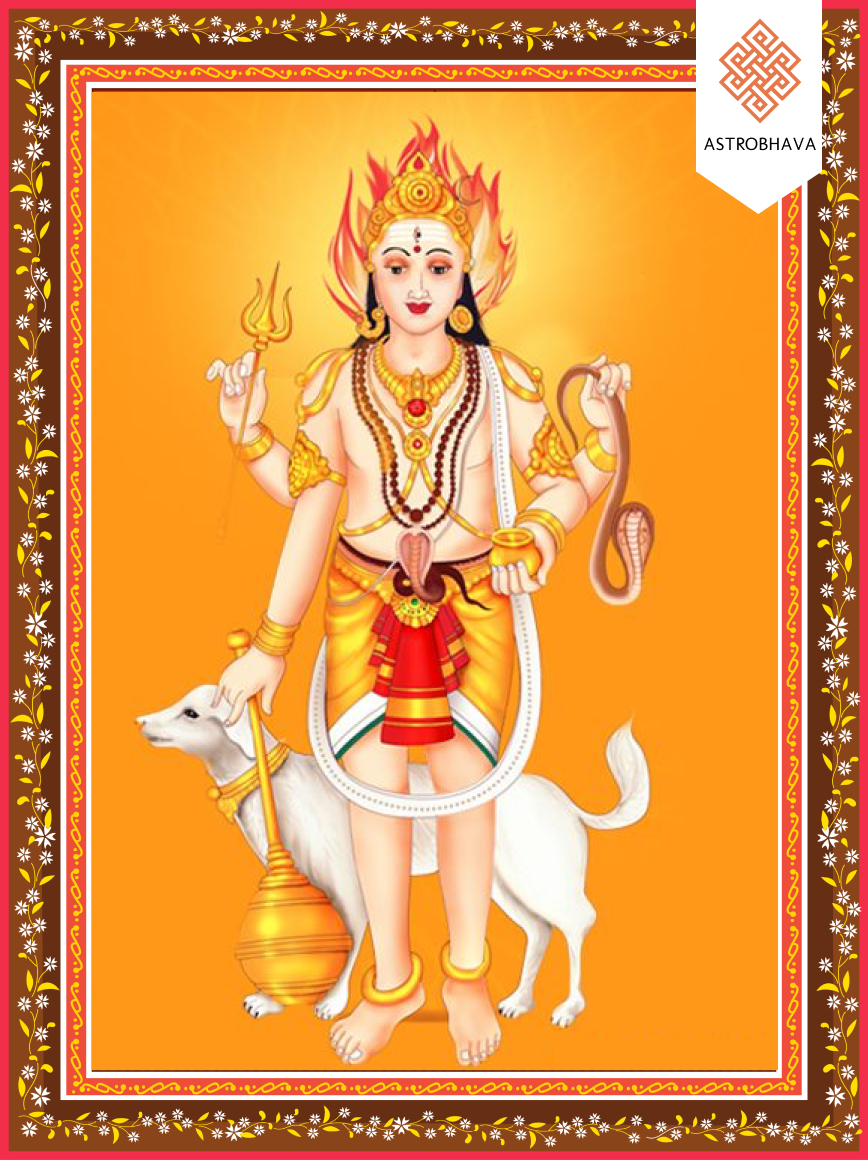
Kala Bhairava is the fierce manifestation of Shiva who embodies kala, time itself, and who stands as appointed guardian of the sacred city of Varanasi. Dark-hued, adorned with crescent moon and garland of skulls, he carries trident, drum, noose and sword while his vehicle is the black dog. In Puranic and Tantric traditions he is the one who severed Brahma’s fifth head and thereafter wandered as the mendicant bearing the kapala until it fell at Kapalamochana in Kashi. As lord of the cremation ground and master of the passage of hours, Kala Bhairava is the deity to whom the city itself is said to belong; every watch of the night falls under his jurisdiction. The name joins kala, the devourer of all created things, with Bhairava, the terrifier who liberates through direct confrontation with mortality and the measure of duration.
Severing of Brahma's Fifth Head
According to the Shiva Purana and the Vamana Purana, a dispute arose between Brahma and Vishnu over supremacy. Shiva appeared as an infinite pillar of fire, the jyotirlinga. Vishnu took boar form and plunged downward; Brahma became a swan and flew upward. Neither found an end. Vishnu confessed failure, yet Brahma falsely claimed to have reached the summit and enlisted the ketaki flower as witness. In wrath Shiva manifested the terrible form of Bhairava, who with the nail of his left thumb struck off Brahma’s fifth head. The skull adhered to Bhairava’s hand, condemning him to wander as a kapali until it dropped of its own accord at the Kapalamochana tirtha in Varanasi. From that moment the form became known as Kala Bhairava, the Bhairava of time, appointed eternal kotwal of Kashi, whose leave alone permits a soul to quit the city at death. The Kashi Khanda of the Skanda Purana adds that the very ground of Varanasi is regarded as his body.
The mantra, in six scripts
The seed mantra, and the form most devotees chant daily. No initiation is required — it is open to anyone, including a parent chanting for a child.
Aim is the mantra, in a sense. The rest is address and salutation; the seed syllable carries the goddess. Where a practitioner has been given a very short practice, it is often Aim alone.
The syllable people get wrong
The diphthong ai in the opening syllable bhai- of bhairavāya is commonly flattened to a short e, producing “bheravaya” instead of the proper “bhai-ra-vā-ya.” The syllable must retain the full vocalic glide from a to i before the r is sounded, so that both the terror and the austere beauty held inside the name Bhairava remain audible; a collapsed vowel erases the characteristic sound by which this form is addressed.
When Kala Bhairava is chanted
Weekday. Monday
Festival. Kala Ashtami, the eighth lunar day of each dark fortnight, observed with particular solemnity when it falls in Kartika or Margashirsha
Questions
Tradition recorded in the Kashi Khanda of the Skanda Purana holds that after the kapala fell from his hand at Kapalamochana, Shiva appointed this form as the eternal guardian of the city, without whose permission no departing soul may leave.
The dog serves as his vahana and is understood as the vigilant companion that moves through cremation grounds, embodying the awareness that remains loyal through the dissolution brought by time.
Kala names him as time itself, the force that measures and consumes every finite existence, so that the confrontation he presents is specifically with the passage and termination of duration.
Not sure a mantra is enough?
Have your chart read before you decide
Chanting is yours to do, and free. But which deity your situation calls for — and whether a mantra alone is the right response — depends on your chart. Sometimes it is; sometimes it is not.
Brahmashree Shivaaya
Guru, Head of Astrological & Spiritual Solutions
Over 30 years in the Guru–Sishya Parampara, from the age of five
He reads every chart himself — 60 minutes, one to one, never delegated
Charts are read only between sunrise and sunset, following tradition
Chanting is yours to do. Some things are performed for you.
Where a matter carries real weight — an examination that decides a course, a performance, a child whose studies have stalled — devotees sponsor the homa alongside their own practice. Performed individually at our Yagna Ashram in your name and gotra, on a muhurta calculated from your chart, and telecast live so you can watch it done for you.