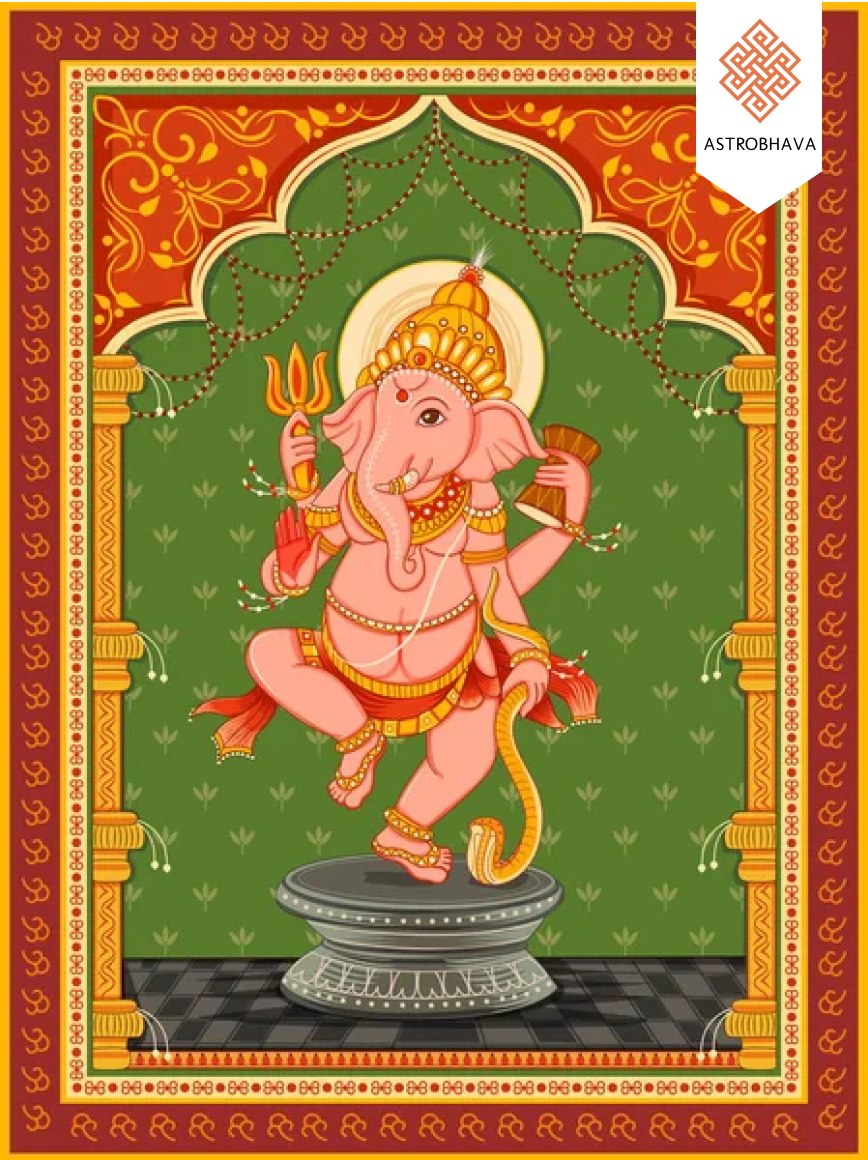
Mantra · The five-faced form. For protection of the weak.
Heramba Ganapathi
ॐ हेरम्बाय नमः
In Devanagari, Tamil, Telugu, Kannada, Malayalam and English — with the meaning of every word, and the one syllable most people pronounce wrongly.
Who Heramba Ganapathi is
Heramba Ganapathi is the five-faced manifestation of Ganesha whose name joins the particle he, marking compassion, with ramba, a designation for the weak or helpless. In the iconography fixed by the Mudgala Purana he sits astride a lion rather than the mouse, ten arms displaying noose, goad, axe, rosary, modaka, broken tusk, and the gestures of fearlessness and boon-giving. Each face turns toward a cardinal direction and the zenith, mapping the five sheaths of embodied life. White or faintly golden in complexion, he is the form whose multiple gazes leave no quarter unwatched, a presence cultivated in Karnataka and Maharashtra where the lion-mounted murti remains visually distinct from every other Ganesha image.
Five Faces on the Lion
The Mudgala Purana places Heramba among the thirty-two discrete forms of Ganapati and recounts that the five faces appeared when simultaneous threats advanced upon the helpless from every quarter. The gods, seeing asuras strike first at those without defense, called upon Ganesha to assume a shape that could watch all directions at once. He manifested seated on a lion, the vehicle of Durga, thereby binding his office of shelter to the fierce maternal energy that refuses to abandon the defenseless. The central face is described as the seat of pure consciousness; the four surrounding faces govern the elements and the quarters of space. Later Ganapatya paddhatis elaborate that the ten hands distribute instruments of restraint and nourishment so that each direction receives its own measure of protection. The same texts note that Heramba’s worship took root in forest hermitages and border settlements where ordinary fortifications were thin and the need for an all-seeing guardian was most keenly felt.
The mantra, in six scripts
The seed mantra, and the form most devotees chant daily. No initiation is required — it is open to anyone, including a parent chanting for a child.
DevanagariSanskrit & Hindiॐ हेरम्बाय नमः
Tamilௐ ஹேரம்பாய நமஃ
Teluguఓం హేరమ్బాయ నమః
Kannadaಓಂ ಹೇರಮ್ಬಾಯ ನಮಃ
Malayalamഓം ഹേരമ്ബായ നമഃ
EnglishRoman transliterationoṃ herambāya namaḥ
“Salutation to Heramba, the one who shelters the helpless.”
ॐ
oṃ — the sacred syllable
हेरम्बाय
herambāya — to Heramba
नमः
namaḥ — salutation
Aim is the mantra, in a sense. The rest is address and salutation; the seed syllable carries the goddess. Where a practitioner has been given a very short practice, it is often Aim alone.
The syllable people get wrong
In herambāya the conjunct mb inside the third syllable is commonly simplified to a lone m, yielding the flattened “heramāya.” The labial stop b must stay audible after the nasal, so the tongue releases a clear ba before the long ā of the dative ending.
When Heramba Ganapathi is chanted
Weekday. Tuesday
Questions
The Mudgala Purana links the lion vehicle directly to the protective office named in Heramba’s own title. Because the form is defined as the shelter of those who cannot defend themselves, the texts assign him the mount already associated with Durga’s uncompromising guardianship. The lion signals that the same consciousness that removes ordinary obstacles can also stand between the vulnerable and forces that would overwhelm them. Iconographic manuals of the medieval Deccan therefore show the five-faced figure seated firmly on the lion’s back, the animal’s head turned slightly as if scenting danger from an unseen quarter. This choice of vehicle is never transferred to the single-faced or mouse-mounted forms; it remains the visual signature that tells the devotee at once which aspect of Ganesha is present.
Ganapatya commentators read the five faces as the five koshas, or sheaths, that encase the self: the food-body, the vital breath, the mind, the intellect, and the bliss sheath. Each face is said to preside over one sheath so that no layer of embodied life lies outside the deity’s regard. A secondary reading, preserved in certain tantric paddhatis, maps the faces onto the five elements and the five directions, the upward face corresponding to the ether and the zenith. Both interpretations agree that the multiplicity is functional rather than decorative: the form exists so that protection may be extended simultaneously along every axis of experience. Sculptors therefore carve subtle differences of expression among the faces, the central one serene, the lateral ones alert, underscoring that watchfulness itself is the offering Heramba makes to those who approach him.
Within the classical list of thirty-two forms, Heramba alone combines five faces with the lion vehicle and the explicit epithet of protector of the weak. Trimukha carries three faces and rides a peacock; other multi-faced images may sit on the mouse or on a throne without an animal mount. The Mudgala Purana further isolates Heramba by assigning him ten arms rather than the four or six common to neighboring forms, and by specifying a white or golden complexion that contrasts with the red or dark hues of several other manifestations. These cumulative marks—five faces, lion, ten arms, the name Heramba—allow temple priests and iconographers to identify the murti without ambiguity, even when the image appears in a crowded shrine hall beside other Ganesha figures.
Not sure a mantra is enough?
Have your chart read before you decide
Chanting is yours to do, and free. But which deity your situation calls for — and whether a mantra alone is the right response — depends on your chart. Sometimes it is; sometimes it is not.
Brahmashree Shivaaya
Guru, Head of Astrological & Spiritual Solutions
Over 30 years in the Guru–Sishya Parampara, from the age of five
He reads every chart himself — 60 minutes, one to one, never delegated
Charts are read only between sunrise and sunset, following tradition
Chanting is yours to do. Some things are performed for you.
Where a matter carries real weight — an examination that decides a course, a performance, a child whose studies have stalled — devotees sponsor the homa alongside their own practice. Performed individually at our Yagna Ashram in your name and gotra, on a muhurta calculated from your chart, and telecast live so you can watch it done for you.