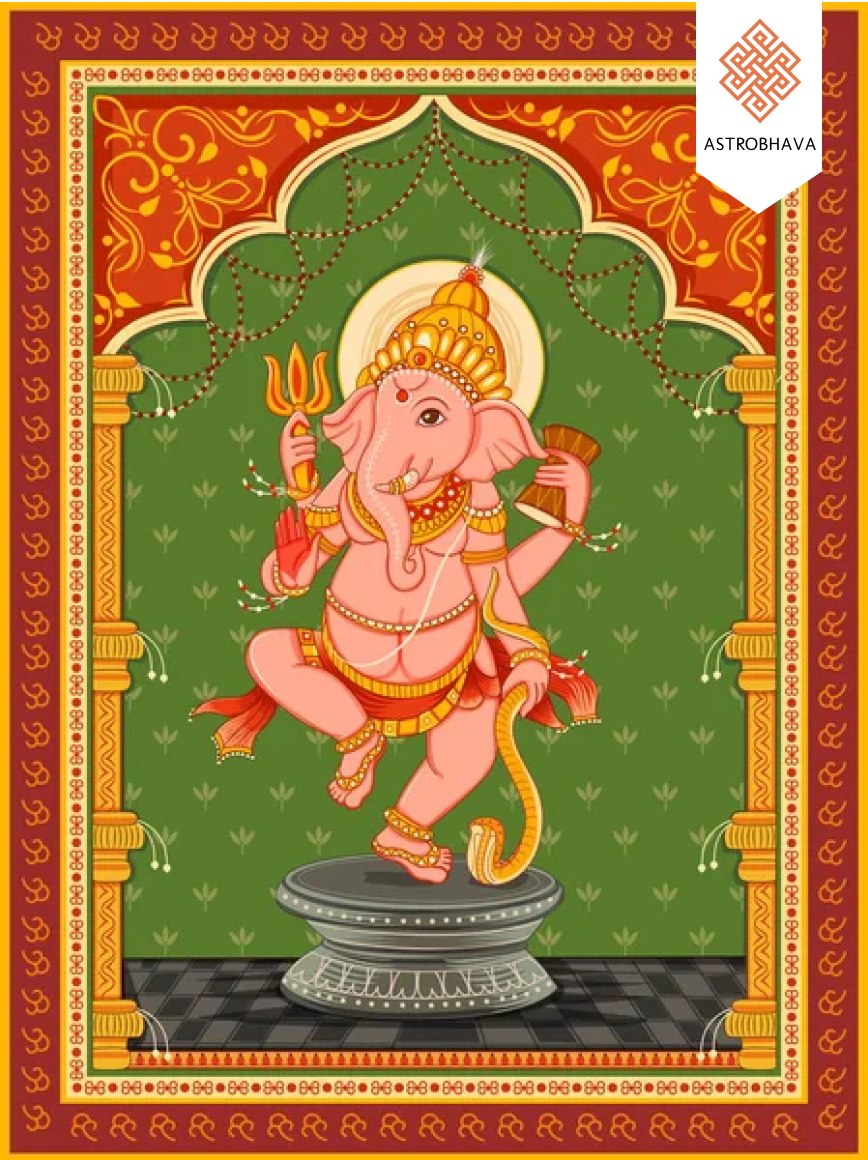
Mantra · The turmeric form. For auspiciousness in the home.
Haridra Ganapathi
ॐ हरिद्रागणपतये नमः
In Devanagari, Tamil, Telugu, Kannada, Malayalam and English — with the meaning of every word, and the one syllable most people pronounce wrongly.
Who Haridra Ganapathi is
Haridra Ganapathi is the turmeric-bodied manifestation of Ganesha, whose substance is identified with the root haridrā itself. Iconographic sources of the thirty-two forms describe him as brilliant yellow, three-eyed and four-armed, holding the broken tusk, the modaka, the noose and the goad. The yellow radiance is not an external coating applied to a generic image; the dhyana verses treat the turmeric hue as the deity’s own body. He is seated in a settled posture, sometimes upon the mouse, and is contemplated especially within the domestic threshold where turmeric already marks doors, vessels and bridal hands. No other classic form is defined by this particular root or by the domestic paste that bears its name.
When Turmeric Took Form
South Indian āgama compilations and the oral paddhatis of household Ganapatya worship preserve a quiet narrative of origin. When the earth required a guardian of threshold auspiciousness, Ganesha took form as Haridra. The story relates that Parvati, preparing a protective paste of fresh turmeric for the household, watched the paste gather itself into the shape of her son. From that moment the yellow figure was recognised as Haridra Ganapathi, whose presence moves through the same root already used to mark thresholds and hands. The account is not cast as a cosmic battle; it is an intimate manifestation in which the deity chooses the substance of ordinary domestic life so that contemplation requires no foreign material. Later texts link the episode to the short-lived turmeric images shaped for household observance, always identifying those figures with this specific form rather than with any other of the thirty-two. The narrative thereby anchors Haridra Ganapathi inside the daily grammar of the home.
The mantra, in six scripts
The seed mantra, and the form most devotees chant daily. No initiation is required — it is open to anyone, including a parent chanting for a child.
Aim is the mantra, in a sense. The rest is address and salutation; the seed syllable carries the goddess. Where a practitioner has been given a very short practice, it is often Aim alone.
The syllable people get wrong
The long vowel inside haridrā is the syllable that slips. Speakers commonly shorten it to a quick ‘haridra’ with equal light syllables, or place stress on the first ha so the name sounds like ‘HA-ridra’. Tradition keeps a clear long ā after the dental d, letting the second half of the word open fully before gaṇapataye begins.
When Haridra Ganapathi is chanted
Weekday. Tuesday
Questions
No. The classic lists reserve the name Haridra for the form whose very body is identified with the turmeric root. A merely painted yellow image of another form does not become Haridra Ganapathi.
The origin narrative places the deity’s appearance inside the paste Parvati was already preparing. The root is therefore not an added offering but the substance from which the form itself arises.
They describe a settled, domestic posture, sometimes upon the mouse, contrasting with the more dynamic or multi-headed stances given to neighbouring forms in the same enumeration of thirty-two.
Not sure a mantra is enough?
Have your chart read before you decide
Chanting is yours to do, and free. But which deity your situation calls for — and whether a mantra alone is the right response — depends on your chart. Sometimes it is; sometimes it is not.
Brahmashree Shivaaya
Guru, Head of Astrological & Spiritual Solutions
Over 30 years in the Guru–Sishya Parampara, from the age of five
He reads every chart himself — 60 minutes, one to one, never delegated
Charts are read only between sunrise and sunset, following tradition
Chanting is yours to do. Some things are performed for you.
Where a matter carries real weight — an examination that decides a course, a performance, a child whose studies have stalled — devotees sponsor the homa alongside their own practice. Performed individually at our Yagna Ashram in your name and gotra, on a muhurta calculated from your chart, and telecast live so you can watch it done for you.