In Devanagari, Tamil, Telugu, Kannada, Malayalam and English — with the meaning of every word, and the one syllable most people pronounce wrongly.
Who Ekakshara Ganapathi is
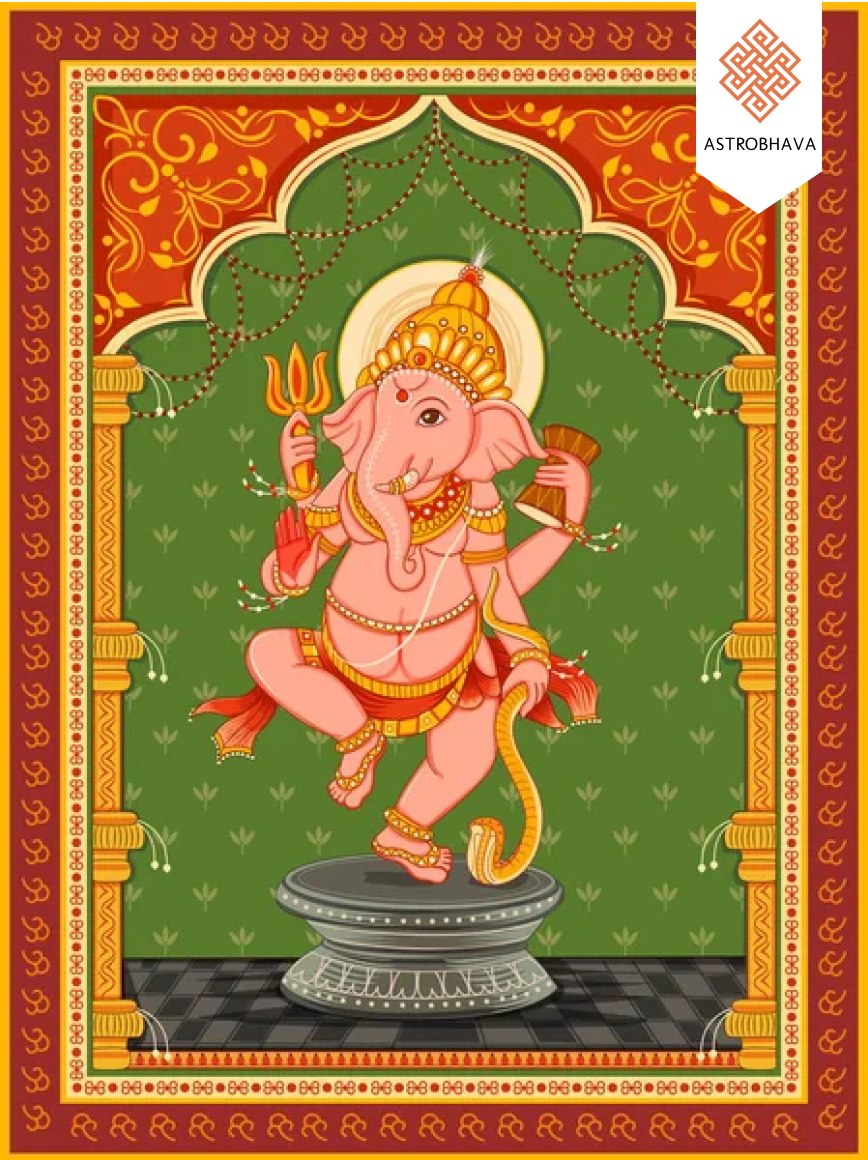
Ekakshara Ganapathi is the single-syllable form of Ganesha counted among the thirty-two meditational aspects. His name declares that the essential mantra belonging to him is the one bija gaṃ. Iconographic verses portray a youthful figure of clear red complexion, three-eyed and four-armed, seated in padmasana on a lotus and holding the noose, the goad, a modaka and the broken tusk. Most descriptions omit a consort, keeping the visual field as uncluttered as the monosyllable itself. The entire contemplative identity of the form is gathered into that solitary sound; the attributes merely give the eye a quiet place to rest while the syllable occupies the centre of attention.
When the Mantra Becomes One Syllable
Both the Mudgala Purana and the tantric digests that expand its list of thirty-two forms present Ekakshara Ganapathi as the aspect whose power is concentrated in a single seed-syllable. Where other forms are approached through mantras built from several bijas strung together, this Ganapati is reached through gaṃ alone. The underlying scriptural logic is that the elephant-headed god, who already contains every sound, can also reduce himself to the briefest possible utterance. Consequently the dhyana verses dwell on the simplicity of his lotus seat and the clarity of his four hands, as if the visible image must remain spare so that the monosyllable may dominate. Later manuals of mantra-shastra therefore treat the ekakshara entry as a distinct item in the Ganesha repertoire, set apart from the longer mulamantra and from the gayatri forms. The ‘story’ preserved for Ekakshara Ganapathi is precisely this deliberate paring-away of every extra syllable until only gaṃ remains as both name and offering.
The mantra, in six scripts
The seed mantra, and the form most devotees chant daily. No initiation is required — it is open to anyone, including a parent chanting for a child.
“Salutations to Ekakshara Ganapati, whose seed-syllable is gaṃ.”
ॐ
oṃ — the pranava
गं
gaṃ — the single seed-syllable
एकाक्षरगणपतये
ekākṣaragaṇapataye — to the single-syllable Ganapati
नमः
namaḥ — salutation
Aim is the mantra, in a sense. The rest is address and salutation; the seed syllable carries the goddess. Where a practitioner has been given a very short practice, it is often Aim alone.
The syllable people get wrong
The anusvāra that closes gaṃ is frequently turned into a full labial ‘m’, producing a closed-mouth ‘gam’, or else hardened into the ‘ng’ of ‘gang’. Correctly the sound remains a light velar nasal resonance without either a lip closure or a voiced plosive.
When Ekakshara Ganapathi is chanted
Weekday. Tuesday
Questions
The title records that the mantra traditionally assigned to him consists of the one bija gaṃ. In the Mudgala catalogue each of the thirty-two aspects carries a distinctive sonic or visual marker; for this form the marker is the reduction to a solitary syllable.
Standard dhyana descriptions seat him alone on the lotus. The absence of a shakti keeps the iconography as unadorned as the monosyllable that defines the form, distinguishing him from several neighbouring aspects who are portrayed with a companion.
Tradition treats gaṃ as the compact seed from which fuller formulas grow. Ekakshara Ganapathi is the aspect in which that seed is contemplated by itself, without the additional words that appear in the mulamantra or the gayatri.
Not sure a mantra is enough?
Have your chart read before you decide
Chanting is yours to do, and free. But which deity your situation calls for — and whether a mantra alone is the right response — depends on your chart. Sometimes it is; sometimes it is not.
Brahmashree Shivaaya
Guru, Head of Astrological & Spiritual Solutions
Over 30 years in the Guru–Sishya Parampara, from the age of five
He reads every chart himself — 60 minutes, one to one, never delegated
Charts are read only between sunrise and sunset, following tradition
Chanting is yours to do. Some things are performed for you.
Where a matter carries real weight — an examination that decides a course, a performance, a child whose studies have stalled — devotees sponsor the homa alongside their own practice. Performed individually at our Yagna Ashram in your name and gotra, on a muhurta calculated from your chart, and telecast live so you can watch it done for you.