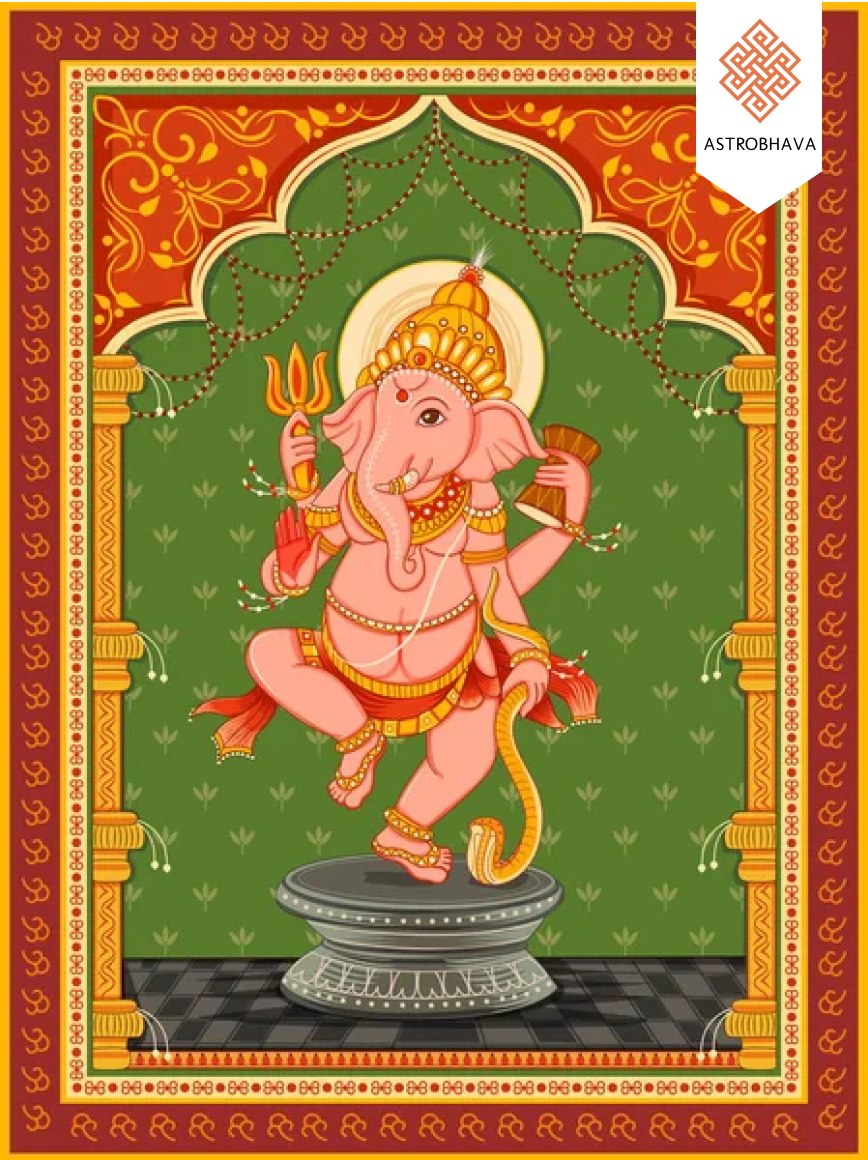
Mantra · The single-tusked form. For focus and singleness of purpose.
Ekadanta Ganapathi
ॐ एकदन्ताय नमः
In Devanagari, Tamil, Telugu, Kannada, Malayalam and English — with the meaning of every word, and the one syllable most people pronounce wrongly.
Who Ekadanta Ganapathi is
Ekadanta Ganapathi is the single-tusked manifestation whose very name records the deliberate sacrifice of one ivory tusk. In the iconographic sequence of the Mudgala Purāṇa he appears with a blue or ink-dark body, four arms, and the broken tusk held as a writing instrument. The remaining tusk curves unbroken, while the severed one rests in his lower right hand or is pressed to a manuscript. Tradition links this form to the act of scribe-ship: the deity who accepted incompleteness of body in order to complete a text. He is therefore contemplated wherever singleness of purpose is the inner theme—one tusk, one task, one-pointed mind. The belly is large, the ears like winnowing fans, yet the gaze is quiet, fixed on the work of inscription rather than on outer display.
Tusk Offered for the Text
The Mahābhārata frame story, preserved also in the Skanda and Mudgala Purāṇas, tells that Vyāsa required a scribe who could grasp and set down the vast poem without pause. The elephant-headed lord agreed on the condition that the dictation never cease. When the quill broke, Ekadanta did not rise to seek another; he simply snapped off his own right tusk and continued writing with the ivory point. The text was finished without a break in the flow of syllables. Later dhyāna verses freeze that moment: the dark-bodied Gaṇapati seated, one tusk gone, the broken piece still stained with ink, the left tusk whole. The episode is less a tale of violence than of chosen limitation; the form called Ekadanta forever carries the mark of that decision, reminding the contemplative that wholeness of purpose may require the willing surrender of a perfect appearance.
The mantra, in six scripts
The seed mantra, and the form most devotees chant daily. No initiation is required — it is open to anyone, including a parent chanting for a child.
DevanagariSanskrit & Hindiॐ एकदन्ताय नमः
Tamilௐ ஏகதந்தாய நமஃ
Teluguఓం ఏకదన్తాయ నమః
Kannadaಓಂ ಏಕದನ್ತಾಯ ನಮಃ
Malayalamഓം ഏകദന്തായ നമഃ
EnglishRoman transliterationoṃ ekadantāya namaḥ
“Salutation to the single-tusked one.”
ॐ
oṃ — the primal syllable
एकदन्ताय
ekadantāya — to the single-tusked one
नमः
namaḥ — salutation
Aim is the mantra, in a sense. The rest is address and salutation; the seed syllable carries the goddess. Where a practitioner has been given a very short practice, it is often Aim alone.
The syllable people get wrong
The opening e of ekadantāya is a pure monophthong. Many speakers prefix a palatal glide, producing “yekadantāya.” The tongue must remain neutral and unraised at the start; the vowel alone begins the word, without the y-sound that turns it into a diphthong foreign to the name.
When Ekadanta Ganapathi is chanted
Weekday. Tuesday
Questions
The unbroken tusk remains as the sign of original completeness; the broken one, retained in the hand, records the deliberate act of self-limitation undertaken so that Vyāsa’s dictation could continue without interruption.
Tradition identifies them. The Mudgala Purāṇa and the epic’s own frame narrative present the single-tusked scribe as this same mūrti, whose iconography forever holds the tusk-pen.
The meditation verses of the Mudgala tradition assign him a blue or ink-dark complexion, echoing the colour of the ink with which the epic was set down.
Not sure a mantra is enough?
Have your chart read before you decide
Chanting is yours to do, and free. But which deity your situation calls for — and whether a mantra alone is the right response — depends on your chart. Sometimes it is; sometimes it is not.
Brahmashree Shivaaya
Guru, Head of Astrological & Spiritual Solutions
Over 30 years in the Guru–Sishya Parampara, from the age of five
He reads every chart himself — 60 minutes, one to one, never delegated
Charts are read only between sunrise and sunset, following tradition
Chanting is yours to do. Some things are performed for you.
Where a matter carries real weight — an examination that decides a course, a performance, a child whose studies have stalled — devotees sponsor the homa alongside their own practice. Performed individually at our Yagna Ashram in your name and gotra, on a muhurta calculated from your chart, and telecast live so you can watch it done for you.