In Devanagari, Tamil, Telugu, Kannada, Malayalam and English — with the meaning of every word, and the one syllable most people pronounce wrongly.
Who Durga Ganapathi is
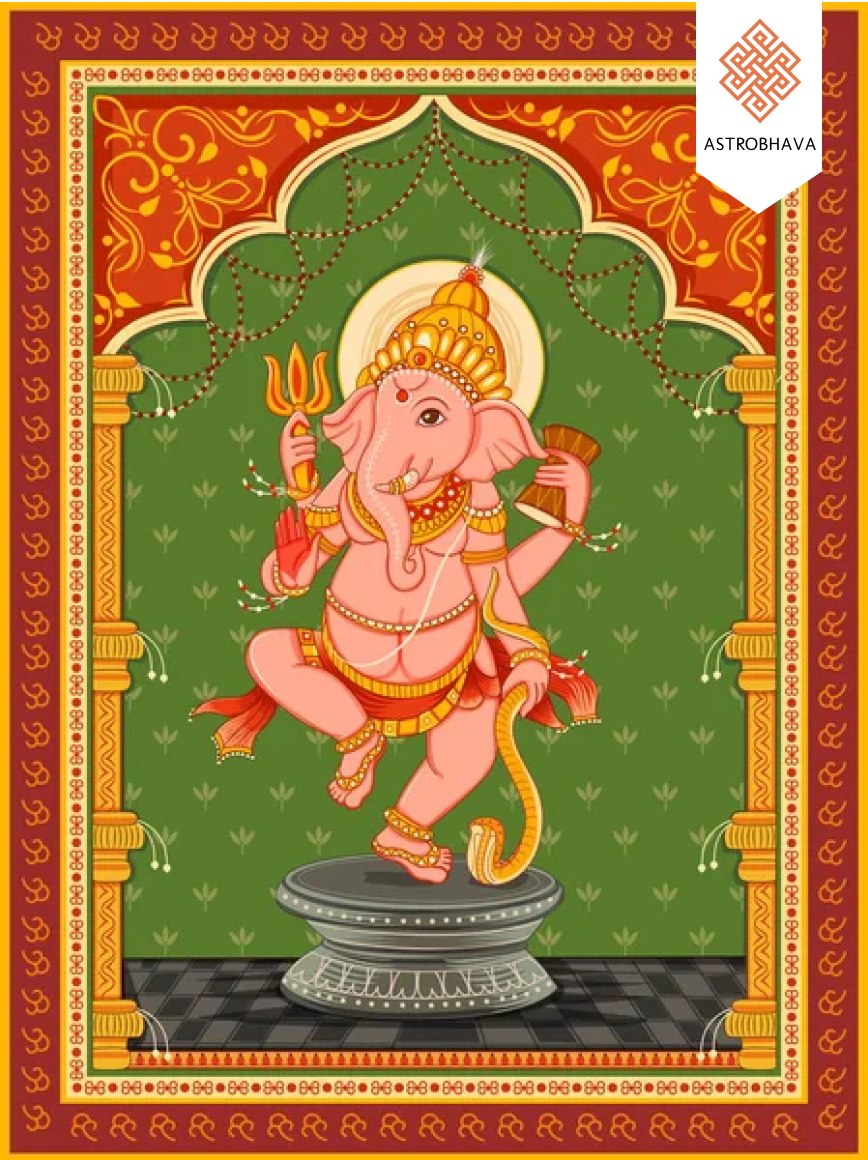
Durga Ganapathi is the manifestation of Ganesha who bears the name and the unobstructed radiance of the goddess Durga, appearing in the thirty-two-form lists as the lord who cannot himself be hindered. Eight-armed and of deep red complexion, he holds bow, arrow, noose, goad, rosary, tusk, a flower garland, and the abhaya mudra. The Mudgala Purana and the dhyana verses attached to this form present him as the point at which the elephant-headed remover of obstacles and the invincible goddess share a single fierce grace. He is the aspect approached when impediments have already defeated ordinary means, for the tradition assigns him the quality of undoing what is hard to overcome while never separating that quality from Ganesha’s essential nature. Separate festival images and subsidiary shrines in parts of Tamil Nadu and Andhra preserve this combined identity.
The Invincible Shared Name
Dhyana tradition surrounding Durga Ganapathi recounts that when an asura secured boons rendering him immune to every familiar weapon of Ganesha, the elephant-headed lord took upon himself the invincible shakti named Durga. The Mudgala Purana’s enumeration of forms places this manifestation among those assumed for precise cosmic crises, noting that the eight arms replicate the arsenal long associated with the goddess who rides the lion. In the narrative the bow and arrow signal the capacity to strike across distance, while the noose and goad retain Ganesha’s own instruments of restraint and guidance. Ganapatya commentators insist that the double name does not describe a late fusion of two deities but the disclosure of an aspect already latent: the same consciousness that clears ordinary hindrances can, when fully roused, dismantle hindrances that have grown dense and fortified. Medieval sculptural programs in the Tamil country occasionally place a small emblem of the goddess near the crown or upon the curl of the trunk, underscoring that the title of invincibility is held in common.
The mantra, in six scripts
The seed mantra, and the form most devotees chant daily. No initiation is required — it is open to anyone, including a parent chanting for a child.
“Salutation to Durga Ganapati, the invincible lord of the ganas.”
ॐ
oṃ — the sacred syllable
दुर्गगणपतये
durgagaṇapataye — to Durga Ganapati
नमः
namaḥ — salutation
Aim is the mantra, in a sense. The rest is address and salutation; the seed syllable carries the goddess. Where a practitioner has been given a very short practice, it is often Aim alone.
The syllable people get wrong
In durgagaṇapataye the opening syllable dur carries a short u that speakers frequently lengthen into dūr, producing a vowel closer to the word for distance. The u must remain brief and closed, matching the ordinary Sanskrit durga rather than a drawn-out dūrga.
When Durga Ganapathi is chanted
Weekday. Tuesday
Questions
Durga Ganapathi remains, in every classical list, a form of Ganesha: elephant-headed, pot-bellied, and addressed as gaṇapati, lord of the ganas. The name Durga is added to indicate that the invincibility proper to the goddess is here disclosed as an intrinsic capacity of the remover of obstacles. The goddess Durga is independently hymned with her own dhyanas, lion mount, and cycle of narratives from the Devi Mahatmya; she is not given an elephant head or the title gaṇapati. The shared epithet therefore signals resonance, not identity. Temple practice keeps the two distinct: a shrine to Durga Ganapathi receives the rites and offerings customary for Ganesha, while the goddess receives her own liturgy, even when both images stand within the same temple complex.
Standard dhyana shlokas for this form place in the eight hands the bow, the arrow, the noose, the goad, a string of rudraksha or crystal beads, the broken tusk, a garland of flowers, and the open palm of the abhaya mudra. The bow and arrow are the clearest borrowings from the goddess’s arsenal, signaling reach and precision; the noose and goad remain Ganesha’s own instruments of drawing near and directing. The rosary and tusk affirm continuity with other Ganapati forms, while the garland and the fearlessness gesture complete the iconography of a lord who both confronts and reassures. Sculptors follow this distribution closely, so that an eight-armed red Ganesha holding bow and arrow can be identified as Durga Ganapathi even before the label is read.
The Mudgala Purana and the paddhatis that elaborate it reserve the double name Durga Ganapathi for the moment when ordinary methods of removing obstacles have already failed. The form is therefore defined by the crisis it answers: an impediment that has grown dense enough to require the shakti whose very title means “hard to overcome.” Invincibility here is not a general promise attached to every Ganesha image; it is the particular attribute that the tradition isolates in this red, eight-armed manifestation. By giving the form both names, the texts indicate that the elephant-headed lord does not borrow a foreign power but reveals a depth of his own nature that remains latent in milder aspects. The distinction keeps the theology precise: each of the thirty-two forms carries its own emphasis, and invincibility against entrenched obstruction is the emphasis that belongs to Durga Ganapathi alone.
Not sure a mantra is enough?
Have your chart read before you decide
Chanting is yours to do, and free. But which deity your situation calls for — and whether a mantra alone is the right response — depends on your chart. Sometimes it is; sometimes it is not.
Brahmashree Shivaaya
Guru, Head of Astrological & Spiritual Solutions
Over 30 years in the Guru–Sishya Parampara, from the age of five
He reads every chart himself — 60 minutes, one to one, never delegated
Charts are read only between sunrise and sunset, following tradition
Chanting is yours to do. Some things are performed for you.
Where a matter carries real weight — an examination that decides a course, a performance, a child whose studies have stalled — devotees sponsor the homa alongside their own practice. Performed individually at our Yagna Ashram in your name and gotra, on a muhurta calculated from your chart, and telecast live so you can watch it done for you.